Platform on new construction, renovation, restoration and transformation
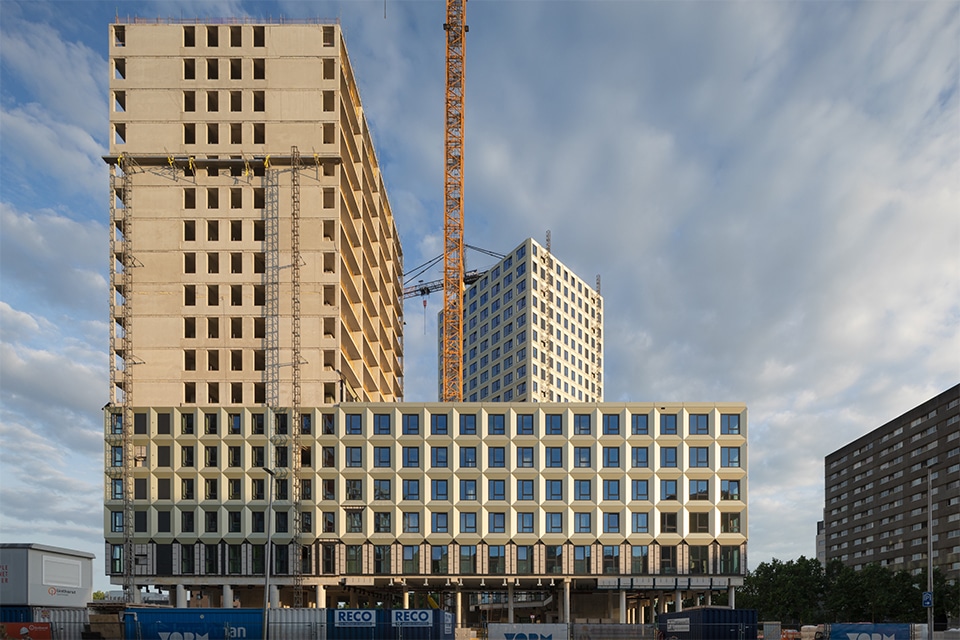
The shortage of affordable student housing continues to grow. Addressing this problem requires an innovative way of developing, engineering and building. High Five in Utrecht shows what is possible in this regard. The project consists of two tall residential towers on the Utrecht Science Park with a total of 921 studios and rooms, realized in a short time. For example, by prefabricating as many parts as possible. From the main load-bearing structure to the interior walls, floors and element façade. Construction partners Sorba Projects, Vianen and Facédo joined forces for this.
Sorba Projects has been a household name in the world of high-quality cladding and project cladding for more than half a century. "Our origins are in specialized sheet metal fabrication, but we have since become a material-independent full-service collaboration partner," says Roeland Burgers, project manager at Sorba Projects. "We prove this, for example, in project High Five, for which we developed the elements in collaboration with Vianen and Facédo. Together with Vianen, we also coordinated the engineering of the timber frame elements and mounting and assembly of our façade panels on the hsb elements. We looked at where the lumber had to come from and how strong it had to be. But we also looked at the right element dimensions so that the elements were easy to transport and assemble. We also looked at the air and water sealing."
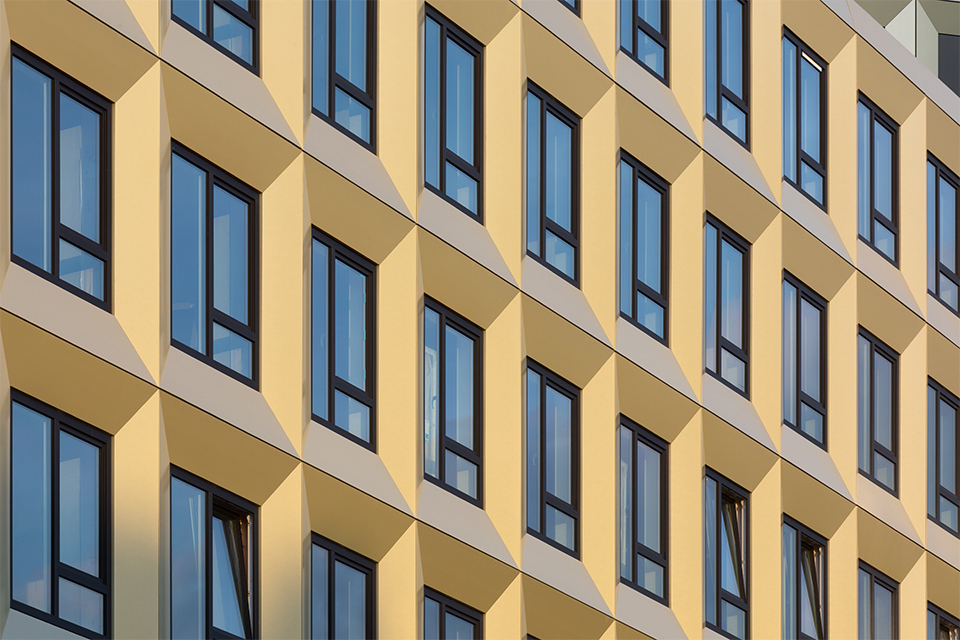
The element facade was fitted by Sorba Projects with 7,764 Alpolic ACM facade panels, 4 mm thick, which provide the perfect finishing touch. Each element consists of four panels, which were attached to the timber frame elements using keyhole lugs and sketch plates, Burgers says. Then the elements are secured with screws. "Because the mitred corners can be brought together neatly, we developed special plastic studs. As a result, all the panels sit at exactly the right depth."
"At our site in Winterswijk, a full-scale mock-up was built of two floors and with four elements. This allowed us to test in detail how VORM 2050 could best hoist and assemble the elements," Burgers says. "In addition, all couplings were tested for air and water tightness. In the process, a test pressure of 600 Pa was achieved, while 300 Pa was the requirement."
A major advantage of the element façade is that the contractor can assemble largely scaffold-free. "In addition, the hsb elements are lightweight, so both the foundation and the shell could be made lighter. The precast façade elements are transported ready-made and just-in-time to the construction site, where they are assembled at a rate of about eight elements per day." Just before the 2025 construction period, the final elements will be delivered.