Platform on new construction, renovation, restoration and transformation

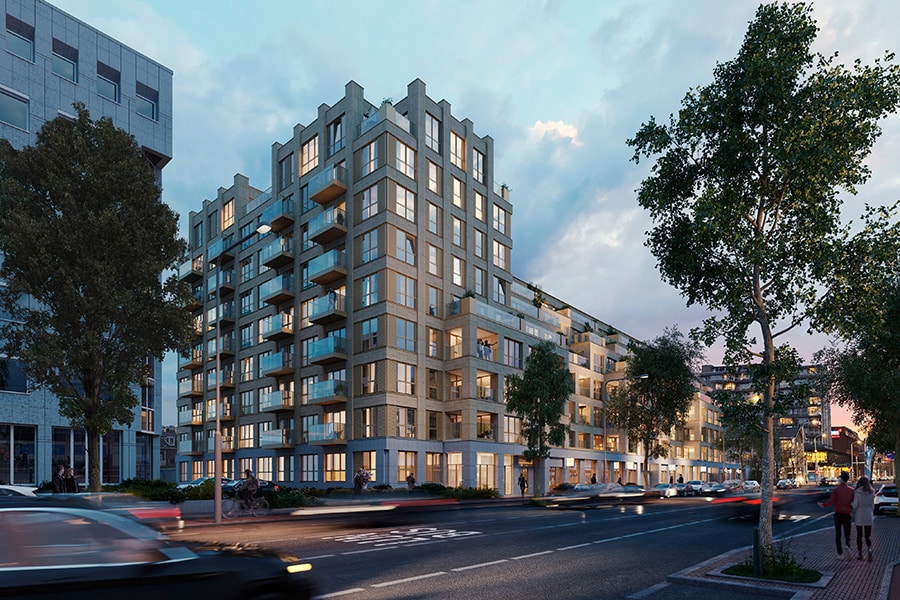
Franki Grondtechnieken is currently laying the foundations for Waldorp Four. With 1,171 homes and a total area of 75,285 m², this will be the largest – and, at 70 meters, also the tallest – modular building in the Netherlands. The building plot, on the other hand, is extremely compact, sandwiched between Waldorpstraat and the railway line, and also has two levels. It is up to the foundation specialist to lay the foundations in a safe and sustainable manner using its heavy drilling rigs.
Waldorp Four comprises seven building volumes, including four high-rise towers and three lower intermediate sections. All of this will be realized on a narrow, elongated strip measuring 400 meters long and only 35 meters wide, including a construction road of approximately 12 meters. “It is our job to install a total of 875 ground-displacing screw piles with lost points on this limited plot,” says Leon van Kempen, project manager at Franki Grondtechnieken. “The work will be carried out on two levels, with the rear section near the railway line being higher than the section on the side of the shopping center.”
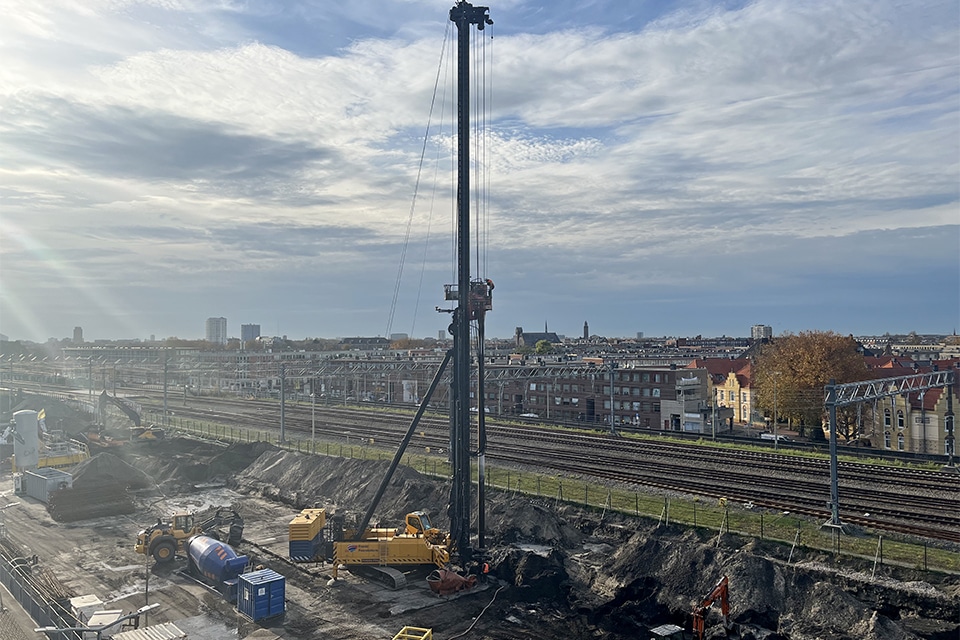
After the construction industry's summer break in August 2025, Franki, commissioned by Heddes Bouw & Ontwikkeling and Ballast Nedam West, will start work on the higher part of the site, after which the work will gradually move towards the lower part. “The main contractor is excavating the embankment in the meantime, so that work can be carried out safely on both levels,” explains Van Kempen. “We started with two scaffolding structures to speed things up, but since mid-November, one scaffolding structure has already been moved to another project.” Franki is also laying the foundations for the three tower cranes that will be needed during the construction of this impressive residential project. “Initially, ground-displacing screw piles with lost points were also planned here. Due to construction safety requirements and the presence of an existing sewer pipe, it was decided in consultation with Heddes Bouw & Ontwikkeling and Ballast Nedam West to replace these piles with screwed steel tubular piles. With this method, the steel casing remains in the ground and smaller machinery can be used.” At the end of the project, the upper part of the casing will be removed again.
According to Van Kempen, the conditions at the work site make the project quite challenging. “The space between the railway track and the existing road is limited, while other parties have already started work. For safety reasons, the municipality requires a temporary road closure when we remove or install the drill pipe. This has already happened four times and requires careful coordination with all parties.” Franki also takes a sustainable approach. “The drilling mud is cleaned and reused on site by separating the sand with a so-called desander installation. This saves 60 to 70 percent on cement. In addition, we have optimized the concrete design: by using a higher concrete strength, shorter reinforcement can be used, which results in approximately 20-30 percent steel savings.”
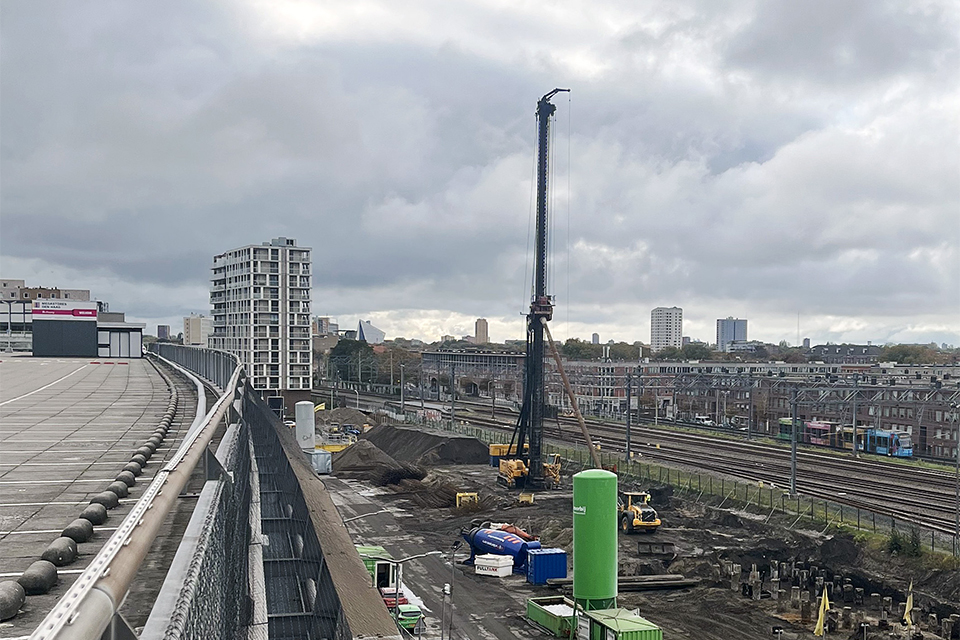
Van Kempen expects to complete the foundation work by the end of this year. Despite the limited space and logistical challenges, the work is progressing nicely according to plan, with maximum attention to safety, cooperation, and sustainability.