Platform on new construction, renovation, restoration and transformation
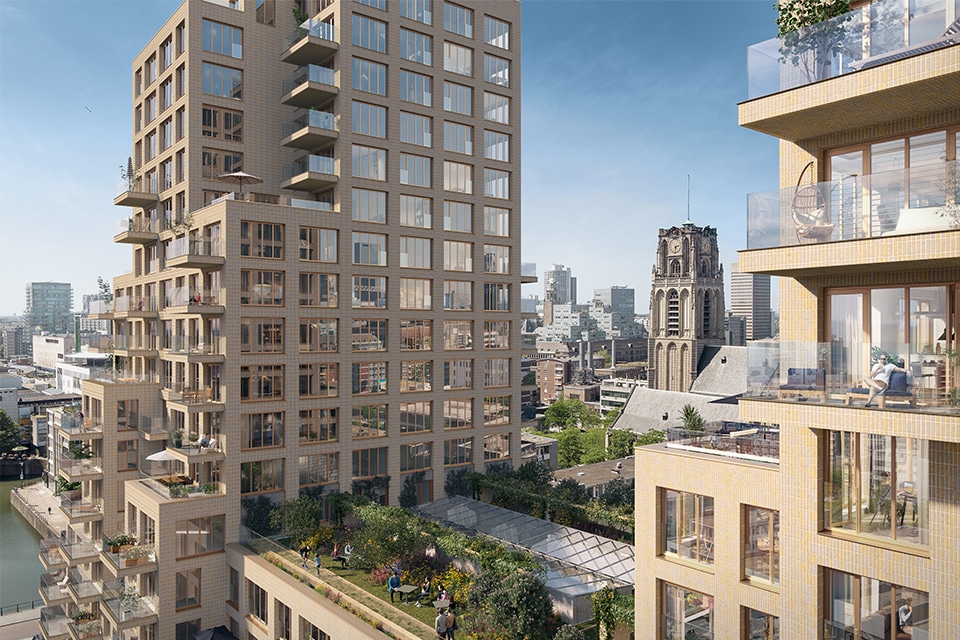
ARCHITECTURAL MASTERPIECE IN THE HEART OF ROTTERDAM
On the spot where Rotterdam was founded a thousand years ago, an impressive new mixed-use building is being constructed: RottaNova. The project consists of 259 rental and owner-occupied homes in a composition of two towers, with a commercial plinth underneath containing restaurants, retail, and creative business spaces. In addition, the building will have a two-story car/bicycle parking garage that will be connected to the basement of the adjacent Markthal. A nature-inclusive communal roof garden will ensure the preservation of nature in the city. Movares | Zonneveld Ingenieurs was involved in the structural design, which presented a number of area-specific challenges and peculiarities. In addition, the Rotterdam branch of engineering firm Movares is responsible for coordinating the construction of the (main) supporting structure.
“On behalf of the NEOO development consortium, we developed the project structurally from preliminary to technical/implementation design,” says Bas Janssen, project manager at Movares | Zonneveld Ingenieurs. “Since then, we have been working on behalf of the contractor consortium as the main structural engineer and coordinating structural engineer.” Like many buildings in Rotterdam, the building is being constructed on the first layer of sand, he explains. “In combination with the weight of the building, we will have to deal with settlement, which will cause additional forces. We have carefully calculated these forces and taken them into account in the dimensioning of the structure. For example, we have added additional piles under the basement walls at the outer edges. In addition, additional reinforcement has been added to absorb the forces resulting from the settlement. The columns at the edge of the facade have also been made slightly heavier.”
A second special feature concerns the underground connection to the Markthal, says Janssen. “This not only adds complexity to the design, but also to the execution. During the construction of the Markthal, a temporary sheet pile wall was installed, which will be demolished at the basement floor level of the parking garage during the execution of RottaNova. The RottaNova structure will then be built against this.” This structure basically consists of cast-in-place walls, columns, and a cast-in-place basement floor, with wide-slab floor slabs on strips above. “The walls and columns from the ground floor to the second floor will also be cast in situ, while above that, cast-in-situ load-bearing walls, wide-slab floor slabs and facades of prefab sandwich concrete with brick slips have been chosen.” To ensure that the various functions of the building (parking, commerce, and residential) are well integrated, Movares | Zonneveld Ingenieurs has used transition structures including concrete beams and walls.
Most remarkable, however, is that RottaNova is being built on the Rotte, the site where Rotterdam originated. “For this reason, extensive archaeological research was conducted, resulting in several interesting discoveries,” says Janssen, citing a medieval lock and quay wall as examples. “In order to protect the archaeology in the ground, the piles for the new building could only be placed in carefully considered positions. Together with the archaeologists, we therefore developed a sophisticated pile plan that spares the medieval locks and quay walls without compromising the integrity of the towers.”
The archaeological research has now been completed and a new phase has begun, giving this historic site a new future. Construction is expected to be completed by the end of 2027.