Platform on new construction, renovation, restoration and transformation

The construction of the parking garage under Booking.com's new building at the head of Amsterdam's Oosterdokseiland, near Central Station, can rightly be called a bravura piece of work. The construction of the new office with parking garage is taking place on a postage stamp site, which is virtually inaccessible to trucks. Preventing unsafe situations and nuisance for the surrounding area during the construction work also requires solid logistical planning and preparation. VBI is supplying 20,000 square meters of hollow-core slabs for the parking garage under Oosterdokseiland and for part of the first floor of the Booking.com building. Inventive transport and storage of the hollow-core slabs by boat contributes significantly to the reduction of noise and environmental pollution and reduction of CO2 emissions.

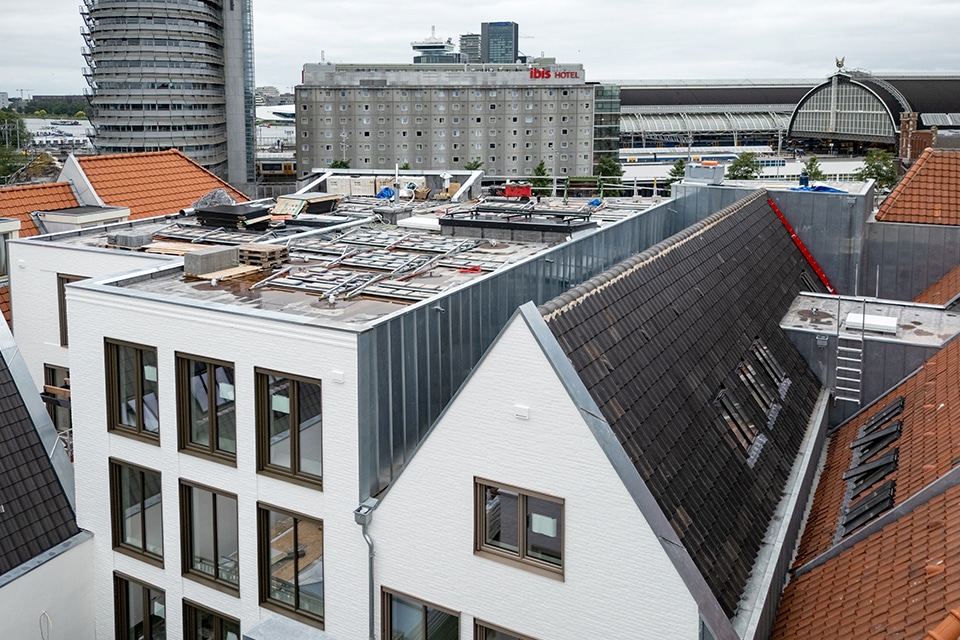
At 225,000 square meters, Oosterdokseiland on the IJ in Amsterdam is one of the largest inner-city projects in Europe. This former PTT site, now houses the conservatory, the Public Library, the main offices of TomTom, Adyen and Takeaway and several apartment complexes. The first developments on Oosterdokseiland date back to 2001. Since 2016, the last lots, totaling 72,500 square meters, on which a social hub is being created, with public facilities, apartments and office space for Booking.com, have been tackled at the head of the island. The entire area will be occupied by 2021. Amsterdam-based area developer BPD undertook the development of the entire Oosterdokseiland. Jeroen Galle, director of projects at BPD Europe, says that hundreds of people come and go daily on Oosterdokseiland to work, live and go out. "The area has gained its own identity in the city center. For the last subplan, Lot 5B/6, the Booking.com office is being built. Architectural firm UN Studio/Ben van Berkel from Amsterdam created the design," Galle explained.
Olga van de Ven is project manager for Oosterdok/Oosterdokseiland at the City of Amsterdam. "Developments in urban areas can take longer than expected," she says. "In the meantime, quite a lot can have changed in such a dynamic area. New developments and projects in the area were often not yet foreseeable in the original plans," Van der Ven says. "Meanwhile, several projects have been realized on the island, people are already living there and all kinds of new construction and restructuring projects are being prepared." The City of Amsterdam imposes requirements on the builder during construction for good accessibility, liveability, safety and communication (BLVC) with local residents. Within the BLVC plan, each development phase specifies how the project will be implemented for all parties involved. For the construction of lot 5B/6, the municipality of Amsterdam arranged at an early stage for BPD, building inspectors and consultants to be involved as much as possible in this plan to determine the frameworks within which construction can take place. "With as little disruption as possible from trucks driving back and forth to the construction site at a busy location in the Amsterdam city center. With the best possible accessibility for visitors to the island," says Van de Ven.

Frank de Roo is project director at Züblin, the general contractor for the construction of Booking.com and responsible for its shell and finishing. He explains that the project is extremely complex in terms of its structure and architecture. Part of the development of Lot 5B/6 is the expansion of the existing underground parking garage, which covers roughly the entire island. The plan is to expand the new parking garage from 1,400 to 1,800 parking spaces. In addition, an additional 2500 spaces of bicycle parking will be built for Booking.com. The parking garage will also house a large technical room with the entire utility system for the entire island. The total area below ground is 30,000 square meters. "The project is complex because of cantilevers on the Booking.com building, which is being built over Oosterdoksstraat," says De Roo. These are cantilevers with a point of 24 meters on one side and of 36 meters on the other side that is cantilevered. Special steel structures were designed for this, with one-story high box girders. "Complex is also that the entrance to the existing Oosterdokseiland parking garage, where residents and visitors to the businesses, department stores and supermarkets park their cars will be relocated during construction. This existing entrance and exit will fall in the middle of the construction project and will remain intact during the work. In addition, the new entrance and exit to the parking garage will be built at a location further away." As a solution, De Roo developed a temporary steel table structure, a kind of crash deck, to mount the steel structure of the overhang. "In addition, this table structure protects passing cars from falling construction materials." For construction traffic, access to the site is possible through only one location. De Roo illustrates how complicated construction is then: no stacking space and absolutely no room for trucks to transport construction materials to the construction site. "Hence we reserve this narrow access only for the supply of concrete. All other construction materials are delivered by a different means of transport - by boat! Until the completion of the parking garage roof, almost all construction materials will be transported by water," says De Roo.

Mustafa Yurttas, technical consultant at VBI, explains that VBI supplied the hollow-core slabs for the floors of the parking garage under Oosterdok Island and for part of the first floor of the Booking.com building. "The underground parking garage was realized with 20,000 square meters of VBI's hollow-core slabs, slabs from 8 to 10 meters long and 1.2 meters wide. "The hollow-core slabs were transported to the construction site by ship" says Yurttas. "This significantly reduced the number of freight movements. In addition, you get a large quantity of hollow-core slabs delivered at the same time." VBI transports the hollow-core slabs to the Afrikapier outside Amsterdam's city center. There they are placed on a ship, which sails to the Oosterdokseiland. The slabs remain on board for the quay and are moved as soon as the cranes on the quay are free. "For VBI, this is an ideal way of transporting and storing construction materials in such a postage stamp location," Yurttas says. "We can bring and unload the floor boards in a controlled way to one location, eliminating waiting times on the construction site itself." The 20,000 square meters of hollow-core slabs were transported in about 20 shipments. That means 1,000 square meters of hollow-core slabs per freight, where a truck carries on average between 70 to 75 square meters. Not only hollow-core slabs, but also other building materials such as precast steel piles and netting for reinforcement are transported by boat. "A big advantage of this is that you can optimally use the cranes on the quay to move the right building materials, which you need at that moment. In terms of planning, this method of transport and storage is extremely ideal," says De Roo. In the context of noise and environmental pollution and reduction of CO2 emissions, transportation of construction materials by ship is to be welcomed. "Especially the students of the adjacent conservatory found this a golden solution!" said De Roo.
VBI helps to build sustainable, flexible and comfortable living and working environments. Starting from the business case of the clients, the specialists of VBI think along and offer clear solutions. Through service, innovation and intelligent industrialization we make it possible for our partners to achieve their goals. From architect to contractor and from housing corporation to private individual. VBI does this by delivering the highest quality precast floors as part of an innovative support structure. VBI is based in Huissen, and is part of the International Consolis. The Consolis Group focuses on making smart, sustainable precast concrete structures for Building, Rail and Infra and has approximately 11,000 employees in 25 countries worldwide.