Platform on new construction, renovation, restoration and transformation

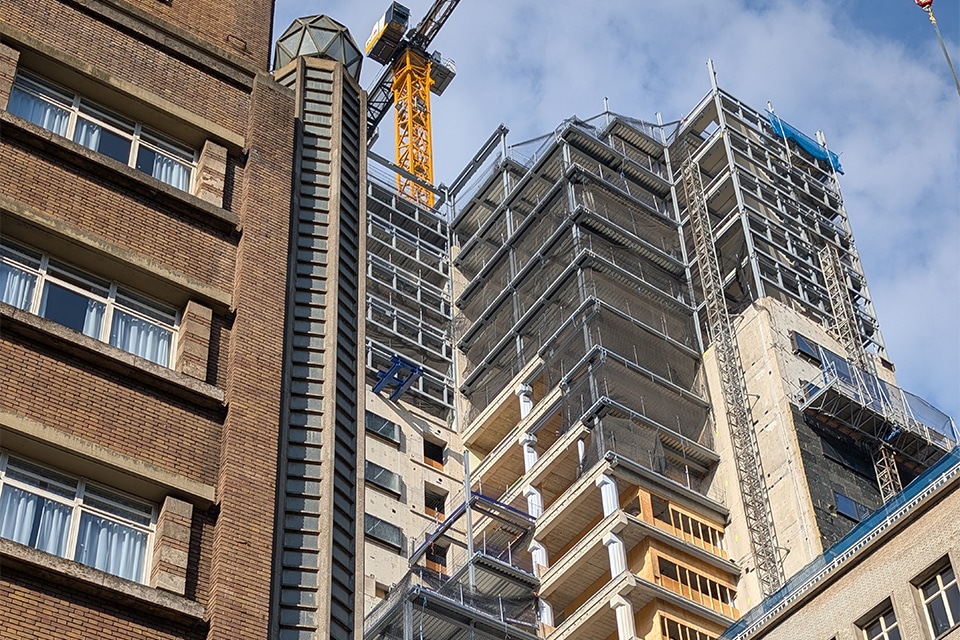
The NDSM wharf in Amsterdam-North has been enriched in recent years with a selection of large apartment buildings. As a result, the former port site is increasingly emerging as a hotspot for metropolitan living. The most recent development is Het Dok, initiated by COD after a design by the Architekten Cie. Van Wijnen is the main contractor commissioned by Bouwinvest. The large construction volume requires logistical feats. For example, the shell construction of the towers including façade sealing is being carried out floor by floor.
Text | Jan-Kees Verschuure Image | Van Wijnen
Het Dok consists of a robust, east-west situated plinth 150 meters long on TT Vasumweg, topped by three sturdy towers of up to 23 floors (74 meters high). The social rental and mid-rent complex contains a total of 449 housing units between 45 and 106 sq. m. A large number of housing units are located at the corners of the three towers and therefore have views to two sides. Communal roof gardens are planned on the roofs of the low-rise buildings; penthouses are located at the top of the towers. Underground will be a parking garage for about a hundred cars, and bicycle escalators will provide access to a generously sized, indoor bicycle storage facility on a plug-in floor. This leaves the first floor entirely free for public functions.
The complex will be connected to the Amsterdam heat grid. In combination with balanced ventilation (CERA units) in the houses, this should result in a low EPC. The plinth on which the three towers will rise is composed of a mix of wet and dry concrete - wide slab floors and precast elements, to be finished with single-shell concrete cladding. Expected to be at height by October this year, the plinth has four layers and forms a table structure on which three partially cantilevered towers rest. These will be fully precast after completion of the substructure, with interior/core walls and Bestcon 60 floors. Hibex is making about 900 pieces of sandwich elements for the towers, partly finished with stone strips and partly with bands in exposed concrete. These load-bearing façade elements (up to 14 tons in weight) are assembled fully glazed, using high-rise cranes.

The plinth in roughcast.
In the lower part of the complex, storey floors extend into the balconies, and in the upper segment of the towers, the architect has provided a staggered facade line. These tower segments are finished with extensive concrete grids. The combination of cantilevers with heavy facade elements provided key work in the structural engineering phase, in which Van Wijnen was involved. Work planner Stefan Duerink: "It proved impossible to carry out the entire construction in prefab. The tower floors will, however, be constructed entirely in precast in connection with the speed of construction, so the facade closure of the towers will be carried out floor by floor." The façade elements fine-tuned with the architect actually ended up being slightly heavier. "That is solved with the additional transfer of forces downward," he said.
The chosen combination of construction methods also presents logistical challenges, says Van Wijnen's chief foreman Rob Kaaijk. "Interior wall elements and large air ducts, for example, have to be on the floor before the next floor goes on, and the floors have to be poured indoors." Nevertheless, the builders will soon be able to complete a tower floor every five days, albeit not followed by regular "trains" of facade builder, installer and finisher. "Everything in the execution of the tower construction has to be coordinated per floor," he says. Van Wijnen has already worked with a number of parties involved in this way on De Hoge Regentesse in The Hague, "but it remains logistically customized," Kaaijk said.
With more than 50 housing types and a great diversity of elements, Het Dok has little repetition in execution. "In addition, it is a very deep building," says Kaaijk. "There is little building site; we perform as many operations as possible in the factory and have a paved area available nearby to store the facade elements." Duerink: "One advantage is that we can start using the plinth roof for the high-rise cranes. Also, where possible, the sandwich elements for the tower facades will be coupled prior to assembly." The Bestcon 60 system, consisting of solid prestressed precast floors with factory cast-in-place balconies, allows the builders to continue stacking without interruption, based on a proven, dry construction method. "The Dock is a fully bolted custom project with as much coordination as possible, allowing the construction pace to be leading in the execution schedule."