Platform on new construction, renovation, restoration and transformation

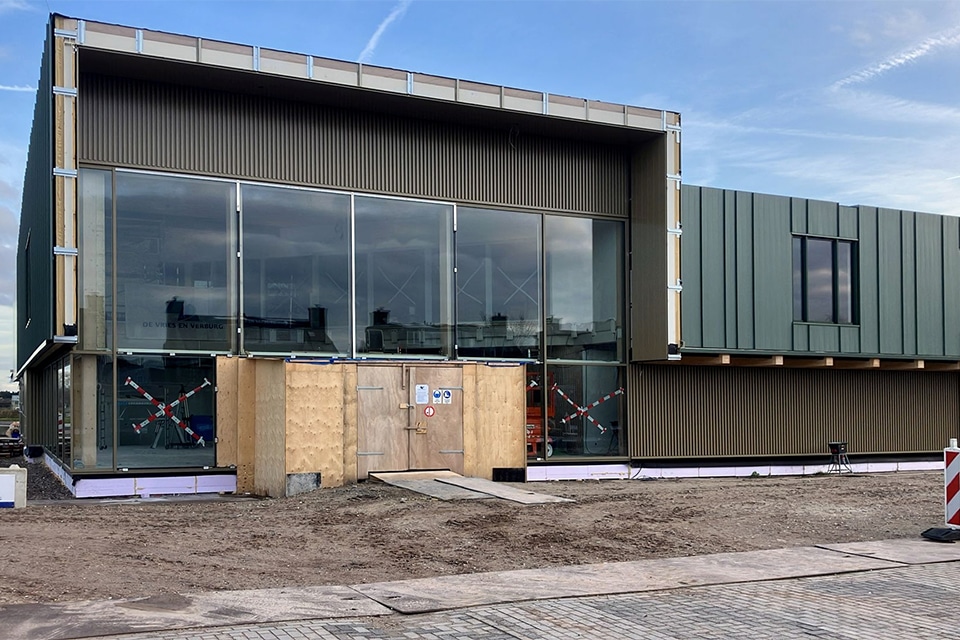
Zonnestein Medical Center is a development of Built by De Wildt (BbDW), a nationwide consulting, design and project management firm that specializes in setting up primary health centers. BLR-Bimon was involved in the project at an early stage. "We are among BbDW's regular partners," says BLR-Bimon director Jan Paul Birkhoff. "Together with the other partners, as one team, we think about the design and implementation method from the preliminary stage. That works pleasantly and efficiently."
From the beginning, it was determined that Zonnestein Medical Center would be a sustainable building. The new health center had to comply with the new BENG legislation. That ambition was amply achieved with sustainable applications such as solar panels, a sedum roof, high-quality roof and wall insulation, and energy-efficient installations. Birkhoff: "We engineered, delivered and installed an air-to-air heat pump in the form of a three-pipe VRF system. The system's outdoor unit is located, hidden from view, on the roof. This unit draws most of the energy it needs from the outside air and exchanges energy between rooms. As a result, the unit consumes minimal electrical energy."

"The advantage of a three-pipe VRF system is that you can choose whether to heat or cool per indoor unit," continues Birkhoff. "For a multifunctional building like Zonnestein Medical Center, this is of great importance. The health center houses several disciplines, including a general practitioner's office, physical therapist, obstetrician, dietician, speech therapist and dental hygienist. Each discipline has its own heating or cooling needs. For example, a physical therapist's exercise room always requires cooling. The heat energy released in this process is put back into parts of the building where there is a heat demand. This process also takes place between the sun and shade sides of the building. The energy is exchanged via the distribution boxes with an environmentally friendly refrigerant as the energy carrier. This makes that when the cooling and heat demand are equal, the outdoor unit fans are stopped. This is the most ideal situation." Another advantage of the system is that you can use air to heat or cool a room very quickly.
Ventilation is an integral part of BLR-Bimon's climate control concept. For health centers, the continuous supply of fresh outside air and the removal of polluted, humid indoor air is very important. "Especially in corona time, ventilation is high on the agenda," Birkhoff emphasizes. "We therefore ventilate the buildings to a higher degree than required by the Building Code. In addition, we apply heat recovery. Heat wheels ensure that the heat used is reused to preheat the incoming fresh air. This results in considerable energy savings."
BLR-Bimon installed the air conditioning systems between September and December 2020. Meanwhile, the building has been completed and put into use. According to Birkhoff, the fact that the implementation went according to plan is mainly due to the good preparation: "Because we had coordinated the work with all parties in detail, we knew where we stood from the start of implementation. That contributed to the smooth course of events and the beautiful, sustainable end result." BLR-Bimon is also responsible for management and maintenance, and in that capacity contributes to ensuring that the climate systems of Zonnestein Medical Center continue to function optimally.