Platform on new construction, renovation, restoration and transformation
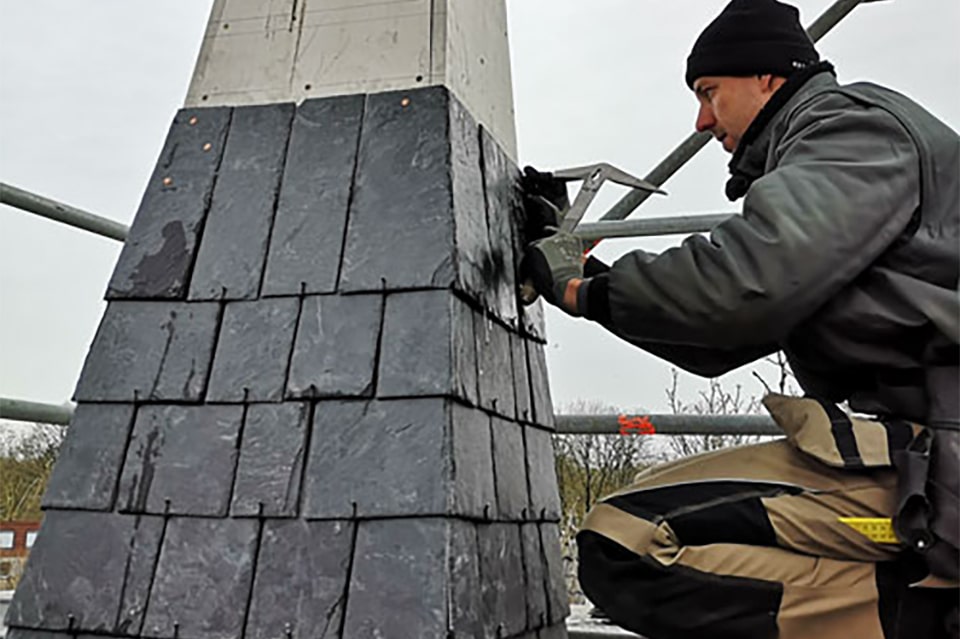
Within the development of Oostpoort Plot 1F, the facade plays a determining role in the appearance and durability of the building. For the slate facade finishing, specialized craftsmanship was called upon. Leidekkersbedrijf Nijland was responsible for the delivery and installation of natural slates on a large part of the facades, accounting for a total of approximately 1,800 m2 of slate cladding on a building approximately 30 to 32 meters high.
What set this project apart (among other things) was the degree of coordination between design and execution. According to Nijland Leidekkersbedrijf, there was exceptionally close cooperation to ensure that the facade dimensions matched the size of the slates optimally. “They really looked at whether certain parts could be made a few centimeters wider or narrower, so that we ended up with whole slates exactly. You don't experience that very often. Usually it's: this is the design, figure it out,” says case manager Robin Nijland.
This precision is not a detail, but essential to the quality and durability of natural slates. Moreover, the choice of this material did not come about by chance. In fact, natural slate proved to go perfectly with the use of wood in this project. “Natural slate does not burn,” Nijland said. “That makes the material inherently fireproof, which in a building of this scale and height is an important argument.”
In addition to fire safety, durability also plays a role. Natural slates are a purely natural product with a long lifespan and minimal processing. “They come from nature and eventually go back into nature,” says Nijland. “True circularity, in other words.” Maintenance remains limited, although moss formation may occur over time. Periodic cleaning can limit that and thus extend the lifespan, although cladding is less sensitive in that respect than roof finishes.
Another special feature of Oostpoort Plot 1F is the coloring of the facade. A conscious choice was made to use a combination of three different slate types, in varying shades of gray and green. Mixing these carefully and sorting them on site creates a nuanced facade appearance with a distinctly green character. “True green slates hardly exist,” explains Nijland. “But by combining lighter and darker shades, the whole still gets that green look.” The slates are sourced from Brazil and China, among others, a choice related to the desired color, thickness and strength of the material.
In addition to its technical and aesthetic qualities, the project is also an example of how important good cooperation is within complex construction processes. The willingness of other building partners to help think about detailing and dimensions made accurate execution possible. Oostpoort Plot 1F thus shows how façade finishing is more than a finishing layer. It is a combination of material choice, craftsmanship and cooperation. And that determines both the appearance and the life span of the building.