Platform on new construction, renovation, restoration and transformation

On Parnassusweg on Amsterdam's Zuidas, directly opposite the Vrije Universiteit, Hurks Bouw is building the new Hourglass building. The 80-meter high-rise, which owes its name to the facade that first tapers and then widens again halfway up, poses a number of architectural and constructional challenges. The stability the hourglass-shaped structure, among other things, to the two concrete cores built with Doka formwork.
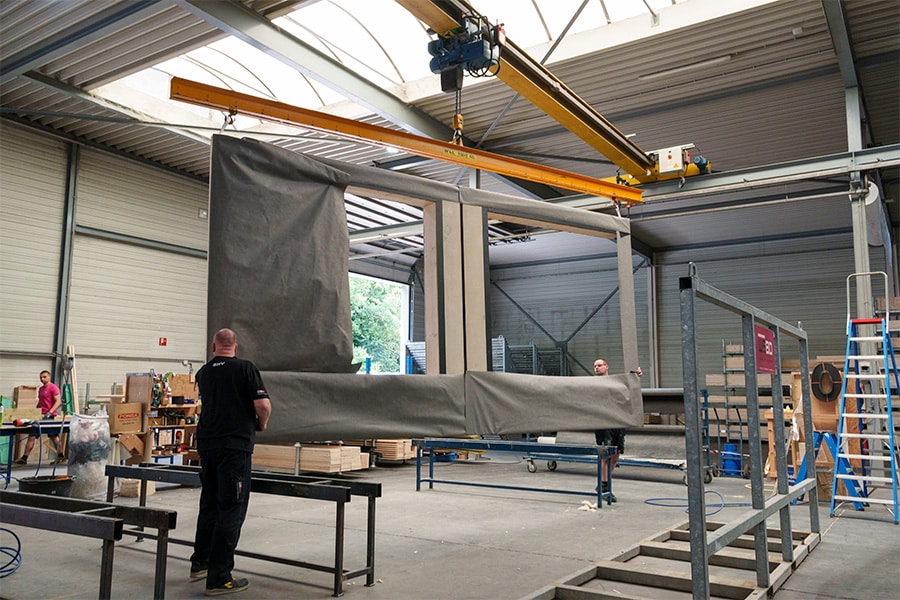
In addition to the hourglass shape, Hourglass is distinguished by the prefabricated facades that are delivered ready-made to the building site. Ruud Hendriks of Hurks Bouw says about the construction and the cooperation with Doka: "Doka was brought in at an early stage. For the cores and a number of structures to be poured on site, we were looking for a party that could do them reliably and quickly. The cores are structurally vital elements. When determining the construction method, the choice was made to pre-draw them so that the machining time was taken out of the cycle time. Doka had a climbing formwork solution that met all the requirements."
Sound construction
"A two-story, underground parking garage was first built on the Hourglass foundation. The walls of this were cast in situ using Doka panel formwork. The first three above-ground layers were also cast in situ, as was the lower part of the cores, which extend to the foundation. We then continued for the cores from floor -1 using the Doka climbing formwork system. In addition to the cores, the first three layers from ground level were cast in situ. On the structure of concrete columns and ring beams, the first facade elements were cast in situ using a Doka suspended scaffold. From the third floor, we continued with the precast facade elements."
Structural cores
In total, Hourglass has three cores, the two large ones being pulled with the climbing formwork Xclimb 60. "For construction, we use a cycle of eight days per floor. The floors transfer their loads to the cores and facade. This means that the cores must always be ahead of the rest of the shell construction process. Beforehand, Hurks Bouw looked at three variants when determining the construction method. The Doka climbing formwork emerged as the best solution. By sitting down together early in the process, the design and execution of the climbing formwork could be optimized."