Platform on new construction, renovation, restoration and transformation
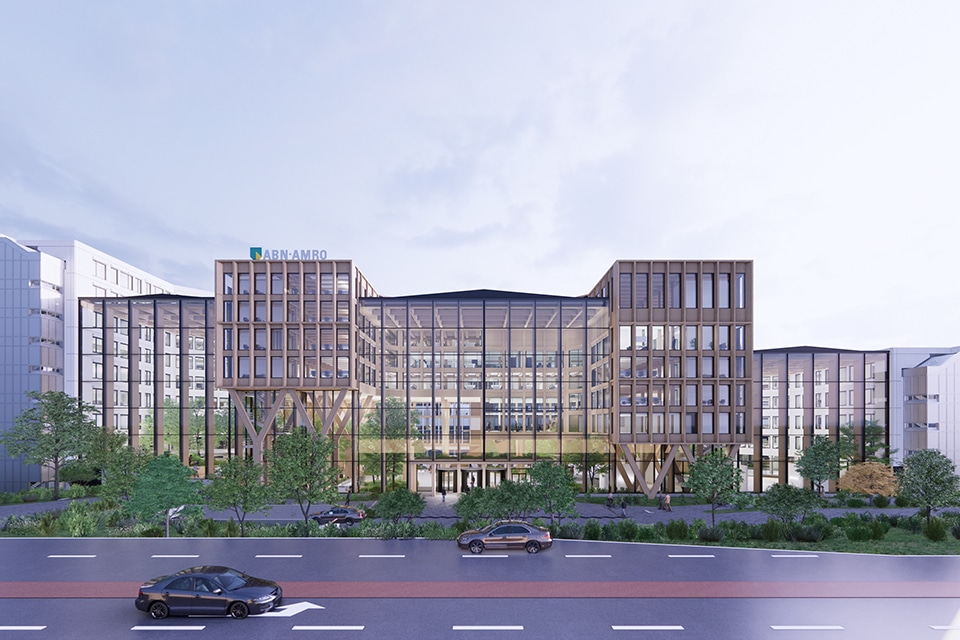
A unique transformation is taking place on the Foppingadreef in Amsterdam-Zuidoost, where the ABN AMRO office is being renovated, extended and redesigned in a circular way to create a modern and Paris Proof place to work and meet. From the summer of 2027, employees and visitors alike will be able to settle into a highly sustainable building that meets the highest label requirements. Thanks to smart design choices, for example, the building will be twice as sustainable as required by the Paris climate agreement and energy consumption will be almost halved compared to the old situation. The remaining energy demand will also be generated as sustainably as possible, which means that the ABN AMRO office will also soon comply with BENG standards and be eligible for BREEAM Outstanding certification.
The development is in the hands of Edge. BAM Bouw en Techniek is handling construction, while BBC (Bosman BAM Combination) is responsible for all installation techniques.
The redevelopment officially started in September 2023, but the first plans were forged well before that. “We have been involved in this project since 2019 to harmonize the design principles, spatial appearance, building programming and required architectural and installation modifications with the high project ambitions of ABN AMRO and ourselves,” says Mayada Shaaban, Director Projects at Edge. “ABN AMRO helps its customers to become more sustainable and sets a good example itself. For example, Foppingadreef will be fully Paris Proof when it opens in 2027, and ABN AMRO is opting for redevelopment and conscious use of materials rather than new construction. The building encourages a pleasant and healthy working and living environment, as well as interaction between departments and employees. Moreover, it fulfills an important social function, with a public atrium and restaurant.”
The reason for the redevelopment was ABN AMRO's Technical Refreshment Program (TRP), in which an installation upgrade and preservation of the building were key principles, says Shaaban. “The moment we came to the table, new insights about working from home, sustainability and the bank's role for its employees and society were added to this. Soon the idea arose to make this place a showcase for sustainability, circularity and innovation, where increasing the volume creates even more impact.” Cooperation was also sought with the municipality, which wants to make Southeast even more vibrant. The presence of large companies in the neighborhood contributes to this.
“To maximize sustainability, we have divided our ambition into three focal points,” says Daphne Lautenbach, Real Estate Development Manager at ABN AMRO. “First, we want to save as much energy as possible, in accordance with the Paris Proof and BENG criteria. In addition, sustainability relates to the well-being of employees and visitors, and we are strongly committed to views and daylight, for example. Finally, circularity is an important spearhead. The building contains many elements that have been reused, such as climate ceilings and computer floors.”
The ABN AMRO building on Foppingadreef dates from the 1980s and was designed by Broekbakema Architects. ’Together with this architect, we analyzed and optimized the unusual building structure,“ says Shaaban.
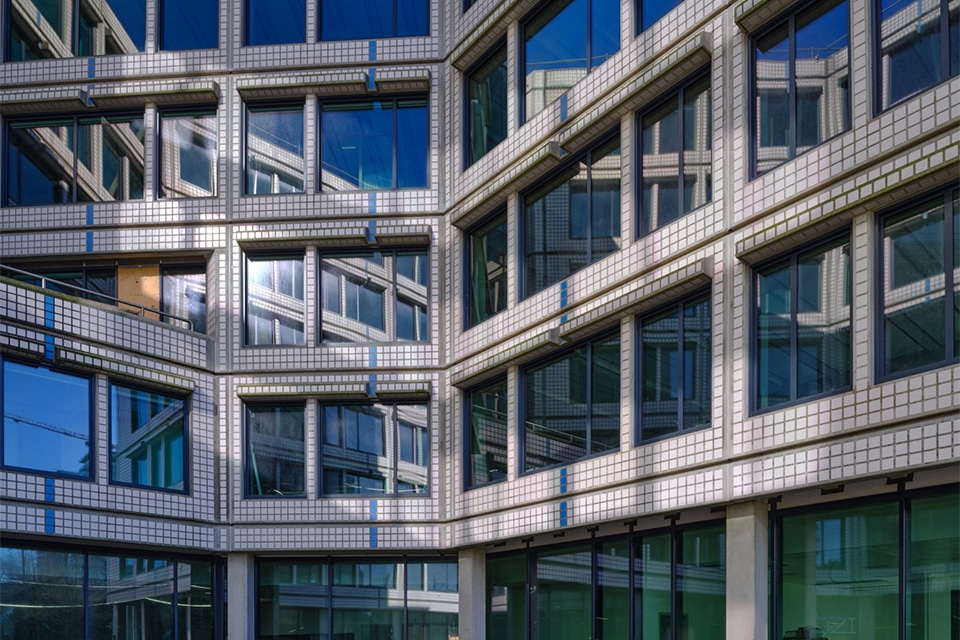
“The office was once designed from structuralism and consists of a main building with three cores with Y-shaped office wings, some of which will be scaled up in the new situation. Three new Y-elements will also be added. With this, we are following the human scale and modular construction that are so typical of structuralism as well as Broekbakema Architects” special form structure.“ What is special is that both the distinctive structure and architecture will be preserved during the redevelopment, Lautenbach believes, citing the facade cladding with white tiles as an example. ”By introducing these tiles harmoniously into the elevation, it seems as if this building in this form has always been there."
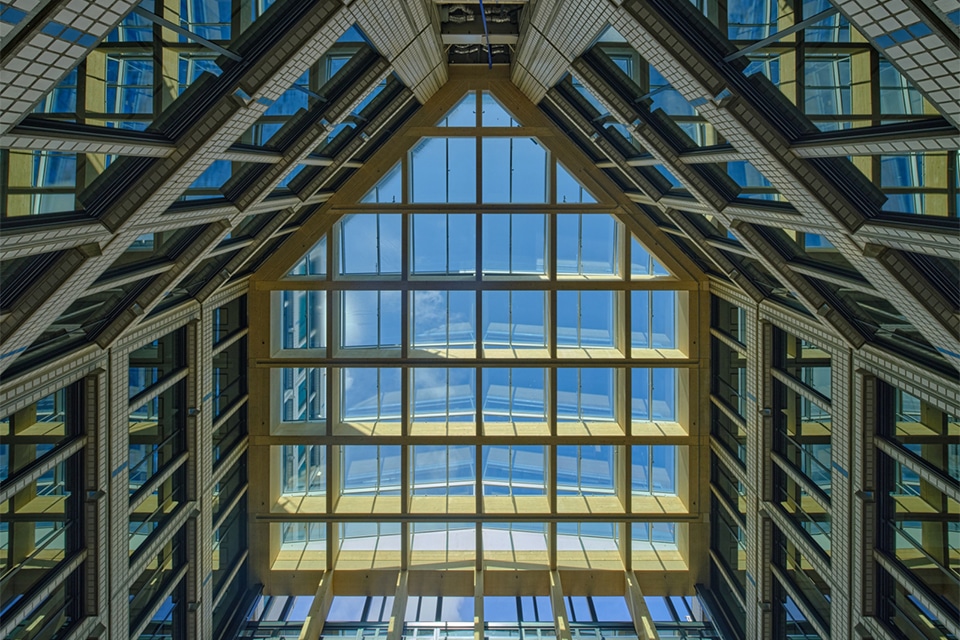
Where the old situation lacked a connecting element, the new situation solves this by adding nine light and green atriums in the open spaces that connect the building from start to finish and where employees can meet. “Thanks to this strategic facade closure, the logical ratio of office to facade area improves and reduces the thermal envelope of the building, harmonizing environmental and social impact nicely,” says Ron van der Horst, Project Director at BAM Bouw en Techniek. “Thanks to lightweight steel and glass roofs, the indoor climate also improves, without a major material impact.” Lautenbach: “The atria provide more overview, better orientation and create more liveliness. A nice eye-catcher, among other things, is the large spiral staircase, which encourages employees to move and thus contributes to a healthier and more active working environment.”
Upon its completion in 1988, the ABN AMRO office was already remarkably energy efficient, thanks to a robust foundation, a then-excellent thermal shell and double-glazed aluminum window frames. Yet there was also room for improvement, says Van der Horst. “The thermal shell and air sealing of the existing building were upgraded to current standards, and all window frames and glass were replaced. At the new building levels, we also applied a high-quality facade. In combination with energy-efficient installations such as WKO sources and heat pumps, the energy demand of the ABN AMRO office is greatly reduced. The remaining energy demand will be met as sustainably as possible thanks to 10,500 m2 of solar panels on the roof and facades. In doing so, we are meeting both the BREEAM, BENG and Paris Proof ambitions in this project.”
To comply with the Paris climate agreement, according to the WEii methodology, every office building should consume no more than 70 kWh/m2/year by 2050. When the redevelopment of the ABN AMRO office is soon completed, this consumption will be about half, says Lautenbach. “This will make our building twice as sustainable as the agreement requires - and that 23 years ahead of the Paris deadline as well as three years ahead of our own targets.” To make this ambition possible, the installation techniques were carefully considered, says Rick van Haren, Project Director at BAM Bouw en Techniek and installation combination BBC (Bosman BAM Combination). “In our view, circularity starts with a realistic analysis. So too in the ABN AMRO project, where many systems proved to be technically obsolete or insufficiently energy efficient and/or no longer eligible for warranty. Combined with ABN AMRO's desire for maximum flexibility in use, the decision was made to completely replace this technology.”
In the new situation, ABN AMRO will have a modular and logically constructed installation with separate control zones, making it easy to create new layouts in the future. “This makes the installation very circular towards the future,” says Van Haren. “Because the zones are individually controllable, an optimal working environment is guaranteed. Both in terms of climate and lighting, where carefully chosen bandwidths keep energy consumption under control. Thanks to an extremely smart building management system with energy dashboard, ABN AMRO will soon be able to see exactly how much energy the climate and electrical installations are using and where unexpected energy is lost, based on which consumption can be continuously optimized.”
“During the project, ABN AMRO's BREEAM ambition was raised from Excellent to Outstanding. For this we picked all the low-hanging fruit,” says Van Haren. “For example, we went high on BENG by calculating heating, cooling, ventilation and lighting in detail. For the heating system, ‘zero excess’ was taken as the starting point. In addition, we tuned the ventilation exactly to the number of people in each room and accurately determined the positioning of supply air grilles and CO2 meters. The building will soon have comfort class A climate ceilings with heat regulation and LED lighting. Movement and daylight sensors ensure that no unnecessary lighting is lit anywhere. Moreover, all toilet groups will have their own shut-off valve in the water system that will be linked to the lighting system, so that water wastage is also out of the question.” BBC also scored additional innovation credits by equipping the rainwater collection tanks with a weather station for predictable rainwater management. “Combined with a comprehensive emergency power, data and security installation, all of BBC's areas of expertise come into play.”
As in any project, BBC on Foppingadreef is dealing with advancing insights. “Here, every change has potential implications for sustainability ambitions,” Van Haren said. “This is why every change is tested against our sustainability dashboard, where BENG, BREEAM and Paris Proof are the most important parameters.” The dashboard is also the basis of monthly partner meetings, in which the feasibility of all intended sustainability pillars is checked. “This allows timely adjustments to be made. For example, by adding additional PV panels.” Moreover, the dashboard will soon be offered to the client as proof.
“During the redevelopment, the existing concrete structure of the building will be preserved as much as possible,” Shaaban emphasizes. “A wooden main load-bearing structure was chosen for the topping, which meant that reinforcement of the existing structure was not necessary. Moreover, this allowed us to keep our carbon footprint as low as possible. Many materials harvested from the building were temporarily stored for reuse. Both in the ABN AMRO office and in other buildings or applications.” In the building, for example, computer floors, interior walls, window sills and aluminum window frames have been reused, Van der Horst says. “In addition, some of the climate ceilings were upgraded and reused as technical installations. Several climate ceilings have also been given new life as acoustic elements in the atriums, and old air ducts and parts of the tube mail system give the pantries a special finishing touch.” In addition, several harvested materials have been reused in the State Property Agency's circular Office full of Waste (KaVa) project.
Sustainable, circular and biobased materials with a low environmental impact were chosen wherever possible for the newly added materials. “From the main load-bearing structure to the floor coverings,“ Van der Horst says. ”Combined with efficient construction logistics, just-in-time deliveries, the use of a construction hub and the choice of as much electrical equipment as possible, the CO2 impact of the redevelopment and expansion is kept as low as possible."
In February 2027, the ABN AMRO office will be handed over as shell, after which ABN AMRO will take care of the interior design in-house. “In the summer of 2027, we hope to occupy the building,” says Lautenbach. “If we meet this tight schedule including all ambitions and our colleagues will soon be sitting in their new workplace with a wow feeling, this transformation will be more than successful.”