Platform on new construction, renovation, restoration and transformation
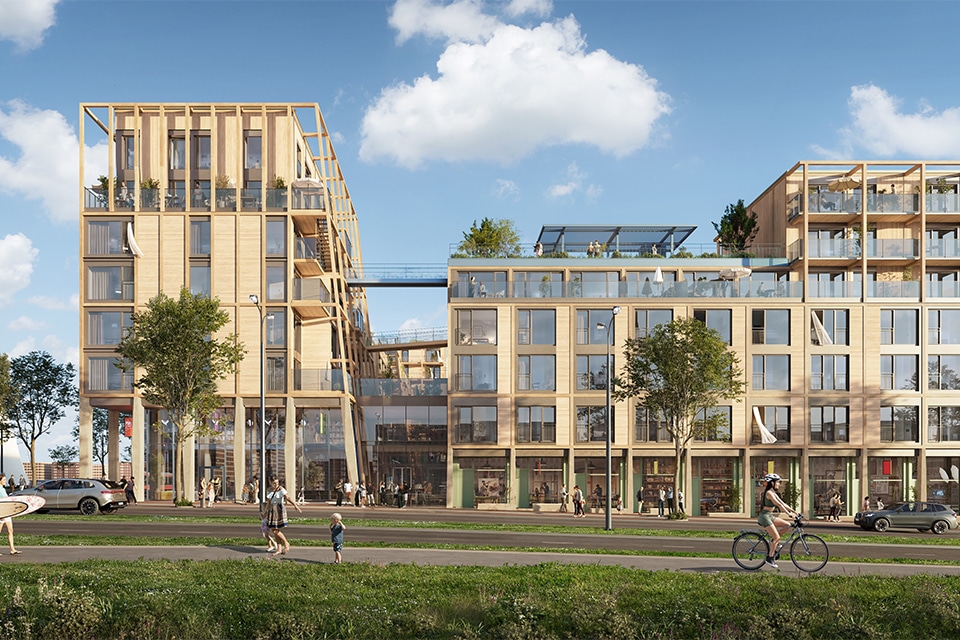
Wood construction sounds sustainable and logical, but it's only when you get started with it that you realize it's still in its infancy. Soon you run into limits. Aesthetic wishes are not always compatible with technical performance. Slokker Bouwgroep experienced this first-hand with the design of Robin Wood on Centrumeiland. The initial plan was therefore fundamentally altered.
“The project for Robin Wood came to us in mid-2023,” begins Dennis Jansen, project manager at Slokker Bouwgroep. “The client won the tender for lot 1 on Centrumeiland, an incubator for creative people, with a plan that was fully committed to wood construction.” When Slokker Bouwgroep joined the construction team, there was a design based on modular 3D units. “However, that idea was financially unframeable, partly because of the mismatch between the architect's aesthetic wishes and technical performance.”
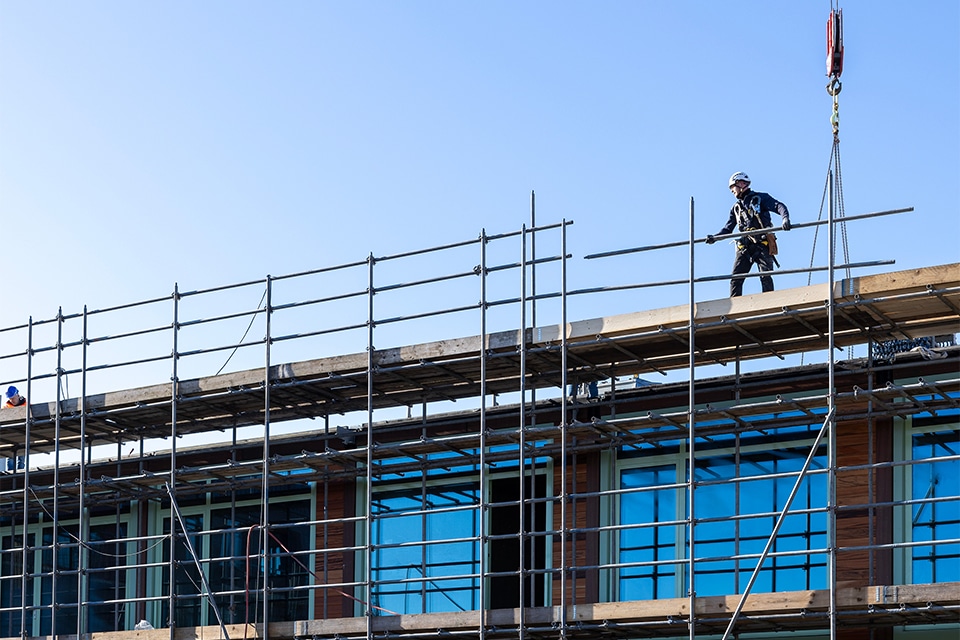
The supporting structure was therefore fundamentally revised: from modular units to a CLT system. From the second floor up, the building is constructed in CLT (Cross Laminated Timber), with a concrete plinth as a solid base. “This changeover also provided a significant percentage of additional lettable floor space,” says André Breg, project coordinator at Slokker Bouwgroep. “After all, stacking modular units involves double walls and floors.”
On Center Island, wood construction is the norm. “Wooden facades are popular, but knowledge and experience are still limited,” Jansen knows from experience. “Nevertheless, the architect had conceived a facade grid consisting of wooden beams combined with tongue-and-groove boards.” Instead of chemically impregnated wood, with all its environmental impact, Slokker Bouwgroep looked for a natural alternative. The choice fell on Azobé for the facade grid, a type of wood that can naturally achieve fire class B. It is anything but standard facade timber, as Azobé is sensitive to deformation. Nevertheless, the challenge was met.
Together with specialized parties, deformation tests were carried out. “The thickness of the beams was reduced from 40 to 30 millimeters and the beams were extensively tested for behavior and fastening,” says Jansen. “We then deliberately chose reclaimed Azobé from the Dutch market. Old wood has less internal tension and is therefore more stable; a form of urban mining that also fits perfectly within the project's sustainability ambition.”
“For the rebates, we were initially on the track of bamboo, because of its stability and fire resistance, but the client wanted natural wood,” Jansen continues. “Ultimately the choice fell on Muiracatiara from Van den Berg Hardwood, also known as Tigerwood because of its dark brown veins.” Fire tests with Tigerwood rebates and the Azobé beams showed that fire class B was not feasible as a total system. Working with consulting firm Nieman, an equivalency solution was sought, which was found in far-reaching compartmentalization of the facade. “Each facade element forms a separate fire compartment in the cavity, with compartmentation strips and intumescent graphite bands against fire spread,” Jansen explains. “In this way, the fire cannot simply spread and the response time of the fire department is extended at each element. In close consultation with the municipality, this approach was tested and accepted.”
The façade will be completely prefabricated at Frank van Roij: 962 HSB elements, including aluminum flashing, glass, fencing and screens, will arrive at the construction site ready-made. “There is scaffolding-free construction,” says Breg. “The iconic Azobé facade grid will be installed later. First the main volume rises, then the apartments are finished internally. Then the gallery grid will be assembled and connected to the CLT structure with steel brackets. A careful phasing to ensure quality and safety.”
Finally, Slokker Bouwgroep also ‘had’ to come up with a solution for noise overlay and even found inspiration in an article in Stedenbouw about HAUT. Jansen: “There is no standard ‘best practice’ for CLT floors in housing construction. In the end we opted for a loose ballast layer of lime split on top of the 200 mm thick CLT floor. This layer incorporates installations. Above that come insulation layers of rock wool and tack board with underfloor heating, finished with 50 mm anhydrite.”
According to Breg, what makes this project special is not just the wood construction or the unique facade grid. “It is the way of working together as well as the hospitality of other timber builders struggling with the same challenges in timber construction. We were pleasantly surprised by that. A sign that the industry is pioneering and learning together.”