Platform on new construction, renovation, restoration and transformation

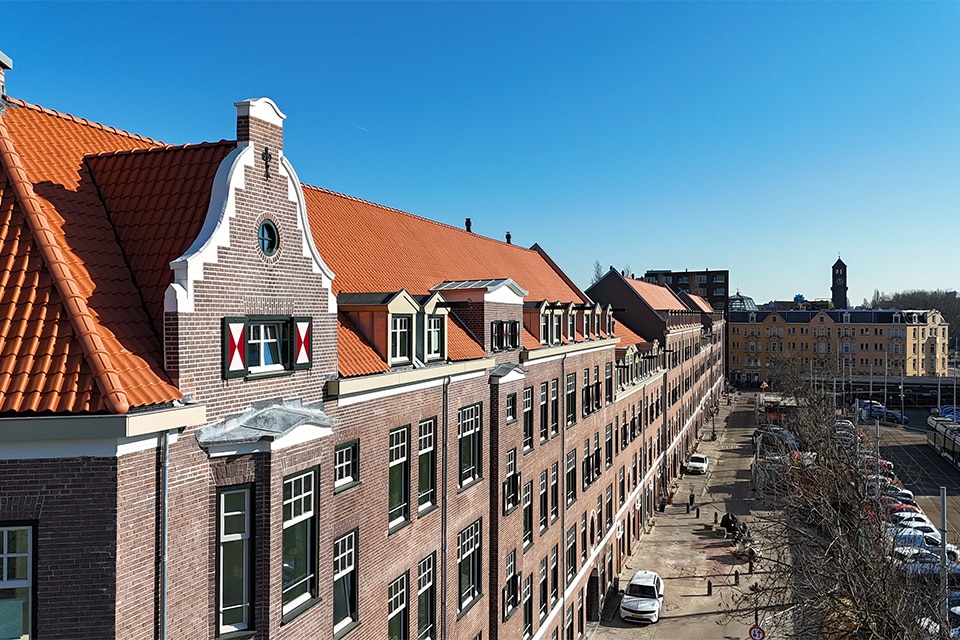
The project involves the sustainable and energetic improvement of 14 porches with a total of 112 homes from the 1950s, named after architect Johannes Fake Berghoef. "The porch houses were very dated both in terms of insulation and installation," says Rob Duinmeijer, business manager at De Nijs Warmenhuizen. "The light and prefabricated Airey construction, however, was still in excellent condition. Therefore, the homes were stripped down to this construction and rebuilt. In addition, the homes were taken off the gas and connected to the district heating network. This makes the Dobbebuurt one of the first existing neighborhoods in Amsterdam to go 'off the gas'."
Construction company M.J. de Nijs en Zonen B.V. was responsible in this project for both the structural and installation work. "On behalf of and in close cooperation with housing foundation Rochdale, we looked at how we could upgrade the Berghoef blocks to current requirements and standards," Duinmeijer says. "Because we already have extensive experience in renovating so-called Airey homes, even across the street, we stepped into this project with quite a bit of foreknowledge. Among other things, we used our knowledge and experience from project 'Alliance Theodorus Dobbestraat' to make an efficiency improvement and renovate the Berghoef blocks even better, faster and smarter. This led to a clear and high-quality Plan of Action, which formed the basis of the implementation."

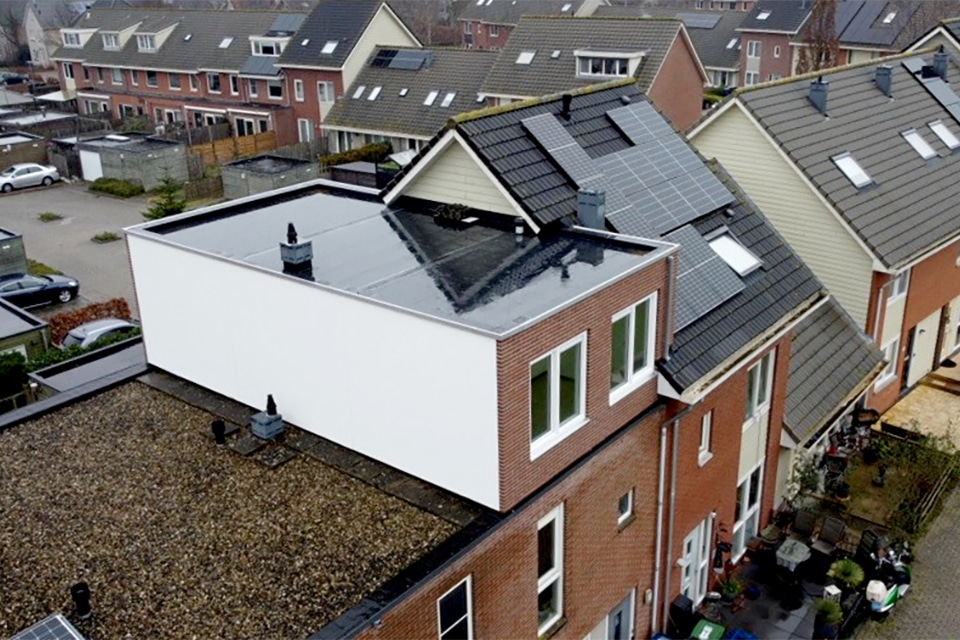
For each porch, the homes were completely gutted, including the installation techniques down to the meter box. "We checked the main construction of the houses and improved it where necessary, after which the houses were rebuilt and casco+ finished," Duinmeijer said. "The facades were fitted on the inside with insulated wood frame racks, which were finished to a high standard. PUR spray insulation was chosen for the floors, and the roof is also insulated. This has significantly reduced the energy demand of the homes." In addition to new roof insulation and roofing, all the homes have been fitted with solar panels, ensuring that the energy demand that remains is generated as sustainably as possible. "In the homes, we also installed new kitchens, toilets and bathrooms." Importantly, all homes have been taken off the gas. The Berghoef blocks are connected to Amsterdam's district heating network. "A new radiator system ensures optimal heating of the homes, while new mechanical ventilation provides sufficient fresh air supply," Duinmeijer emphasizes. "Thanks to the work, resident comfort increases significantly. This will also be clearly visible in the consumption costs."
In addition to the above "standard work," residents had several tenant options. For example, they could determine their own kitchen layout and select different tiles for their kitchen and/or washrooms. In addition, an option for the two-story house units (ground floor apartments) was to move the bathroom, resulting in a larger living space. During the work, residents were accommodated in temporary housing, for which Rochdale provided resident supervision. This enabled Bouwbedrijf M.J. de Nijs en Zonen B.V. and its subcontractors to carry out the work quickly, properly, undisturbed and completely coronaproof.