Stedenbouw is part of Louwers Mediagroep: 45+ trade platforms in the Netherlands, Flanders and Wallonia. Trade magazines, websites, newsletters, video and podcasts, since 1987.
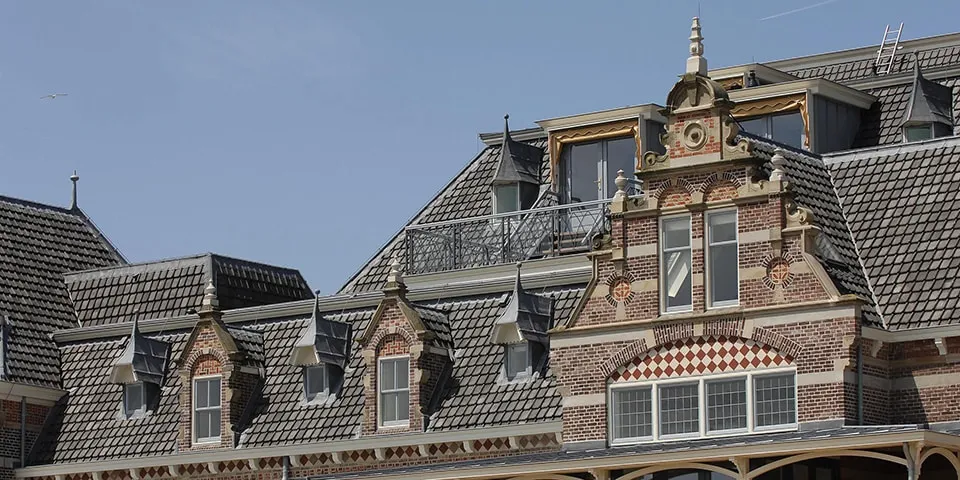
Anyone looking out over a village or town from a church tower will immediately notice the number of traditional tiled roofs. Seventeenth-century canal houses, eighteenth-century mansions, nineteenth-century workers’ homes, the church itself… Each is a historic roof that defines the appearance of its building. The question is how much longer we will be able to enjoy this roofscape, because the traditional Dutch tiled roof is under threat. This prompted BMI Monier to launch a Workshop on Traditional Roofs.
The latest building regulations set requirements for roof insulation, ventilation and construction, including when a traditional Dutch tiled roof is renovated. Can these requirements be reconciled with the desired appearance, where the roof should look as it did two hundred years ago? Are traditional Dutch roof tiles and their associated components still available, or are you forced to use a modern roof tile when renovating? Are there clear municipal or provincial rules on which roof is appropriate for which building? These are just some of the questions answered during BMI Monier’s Workshop on Traditional Roofs.
The roof is a system, even a traditional roof
At BMI Monier, they are dismayed to see the traditional Dutch roof gradually disappearing. One reason is a lack of knowledge about the availability of the right products, as well as insufficient knowledge of how to apply the latest building regulations to a traditional roof. And if there are no clear guidelines from local planning or heritage committees, it is easy to choose the wrong roof tile. Guus Killaars, head of logistics and export manager at BMI Monier, as well as a specialist in traditional roof tiles, sees examples of what not to do every day: “The tiles may be right, but incompatible ridge tiles have been used; the roof tiles have been sealed with mortar, so there is no ventilation; or tiles of the wrong size have been laid, throwing the whole roof out of balance. There is absolutely no need for this. Traditional roof tiles such as Kruispan, Grote Romaanse, Tuile du Nord, Oude Holle, Verbeterde Holle and Opnieuw Verbeterde Holle are still in production. So are the matching verge tiles, ridge tiles and broekstukken, as well as the tile clips specific to each tile type, for correct fixing. We see the roof as a complete system,” Killaars continues, “not as a collection of separate components. By including the underlay, insulation material and eaves in this system, a traditional roof can meet the latest building requirements while retaining the appearance it was originally intended to have.”
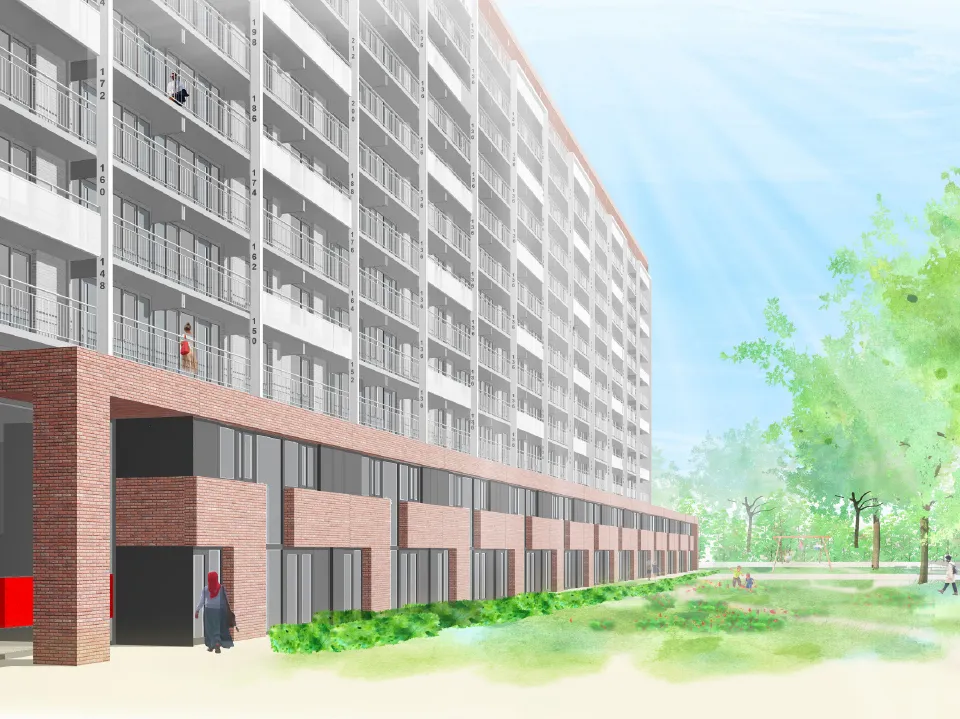
De blinde gevel met garages en bergingen maakt plaats voor een uitbouw van twee bouwlagen waarin twaalf appartementen in het middeldure huursegment komen.
Made to measure
Traditional Dutch tiled roofs often feature beautiful ornaments, such as finials and specially shaped broekstukken and ridge tiles. These defining elements give the whole building a distinctive, authentic appearance. Such components are often no longer in stock. “But we can still make them,” says Guus Killaars. “Sometimes by hand, and sometimes by using an old component as the basis for a new mould that we can use to produce them. With the right clay, to the right dimensions and in the original colour. We also keep small stocks of a wide range of traditional components in a special storage area at our factory in Tegelen. They are dried and ready for an engobe or glaze coating, so they can go straight into the kiln. Not everyone knows that this bespoke work is possible, but we can supply almost anything for any tiled roof.” Advice on maintenance, repair or renovation Many owners of traditional buildings struggle with the question: what condition is my roof in? How much longer will it last? Does it need repairing or renovating? And, above all, how should I go about it? BMI Monier’s Roof Service department can provide the answers. Its own laboratories can assess the quality of roof tiles, and the entire roof structure can be inspected on site. “Sometimes we do the latter ourselves,” explains Jan Mussche, Product Manager Pitched Roofs at BMI Monier, “but often we refer clients to certified roofers who understand traditional roofs and know where to source new old roof tiles and bespoke components. They then draw up a report, always working on the principle of ‘preserving the roof’. It is objective advice that the building owner can put into practice.” As well as repairs, it may be decided that some or all of the roof tiles need replacing. There are several options, says Jan Mussche: “You can look for the same second-hand tiles, sort the existing tiles by quality and use the old ones on one section of the roof and new old tiles on another, or replace the entire roof with the right new traditional tiles and all the associated components. In every case, a good roofer will ensure that the roof fully complies with the latest building regulations and provide a full guarantee.”
A lesson in traditional roofs
Owners and managers of traditional buildings, roofers and construction companies can learn how to preserve traditional roofs and get answers to important questions at the Workshop on Traditional Roofs. Yes, a traditional roof can fully comply with current building regulations. Yes, traditional Dutch roof tiles and all their components are readily available. Yes, special components can be made to order. No, there is no consistent heritage policy, but BMI Monier can use its extensive knowledge and expertise in roofing systems to guide every owner and manager of a traditional building through the many options available.
The next Workshop on Traditional Roofs will be held at the factory in Tegelen on 17 January 2020. The workshop includes a tour of the factory, following the complete production process for traditional roof tiles.
You can register for the workshop via www.monier.nl/klassieke-daken. For questions about traditional roofs, the Roof Service department can be contacted by email at dakservice@bmigroup.com.
Find the right company in constructionSearch by product, specialist field, region or project, across the company directory and all Stedenbouw articles.
We use cookies to keep the site working properly. With your consent, we also use cookies for statistics and third-party banners. Read more in our privacy and cookie statement.