Platform on new construction, renovation, restoration and transformation
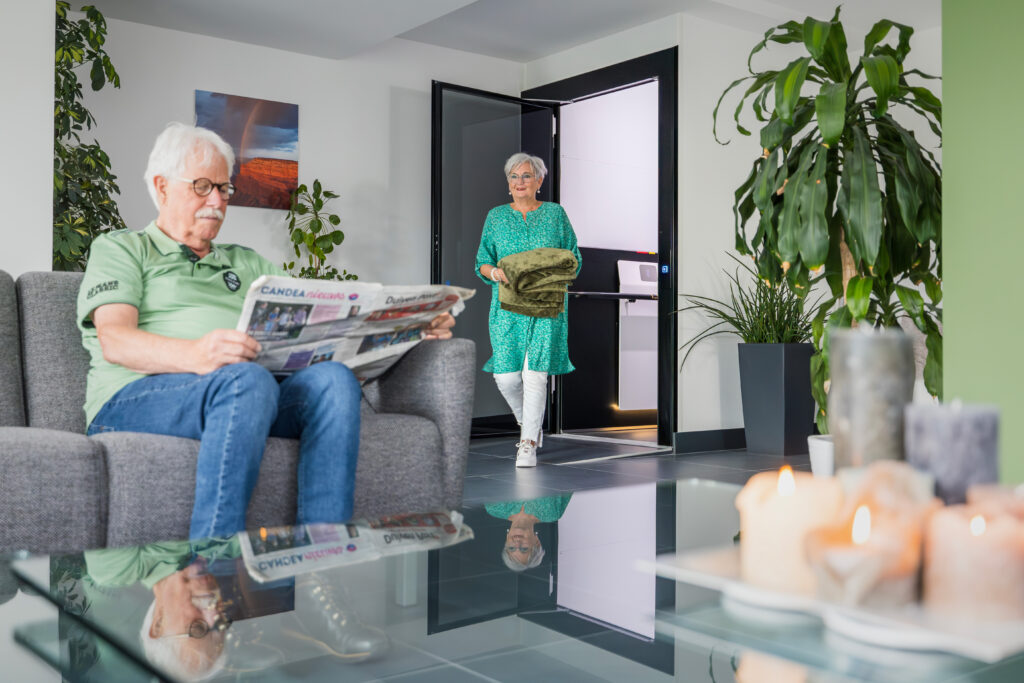
Since a change in the law in 2015, more and more older people are living independently, even at older ages. While this contributes to independence and quality of life, it also brings with it a new reality: independent living requires a living environment that is safely equipped for physical limitations. And this is precisely where a growing field of tension arises.
The increase in elderly people living independently is evident. People aged 85 and older are also living at home more often. At the same time, it appears that their care needs and degree of self-reliance have not changed substantially. This leads to an important conclusion: independent living is not the same as safe living. The home itself plays a crucial role in this. Without adaptations, the home situation can actually become a place where risks accumulate (RIVM, 2026).
Limitations are not an exception, but a growing part of aging. What is striking here is that these limitations are unevenly distributed within society.
From research shows that impairments are more common among the elderly:
This makes the issue broader than just health. It is also about access to resources and opportunities to adapt the living environment (RIVM, 2025).
In addition, another research see that clear differences are evident based on age and gender for mobility impairments:
These figures show that the risk of disability is not random, but also somewhat predictable (Public Health and Care, 2025).
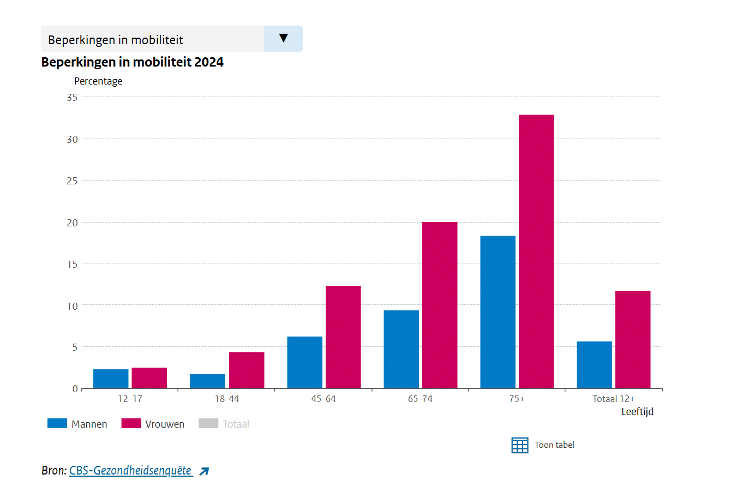
Although many seniors are living at home longer, research emphasizes that it is essential to actively assess the safety of the living environment. Specifically, this means looking not only at care, but specifically at the home itself. Home modifications such as improving accessibility can have a direct impact on preventing falls (RIVM, 2026).
Here a clear tension arises. On the one hand: a group of elderly people with an increased risk of mobility problems. On the other: this very group often has less financial room to adapt their homes. This raises a fundamental question: To what extent can individuals be expected to invest in home modifications themselves, when the risks are related to factors such as income and health? The issue surrounding fall prevention and home modifications affects multiple parties.
Through municipal schemes, support is possible for home modifications. At the same time, this support depends on individual situations and available resources
A large proportion of the elderly live independently. At the same time, research shows that mobility limitations are more common among financially vulnerable groups (RIVM, 2025). This makes the role of housing corporations more relevant than ever. To what extent does housing management and development structurally take into account residents who face mobility limitations?
While personal responsibility plays a role, it is not always feasible in practice. Especially when financial resources are limited, investing in home modifications becomes a challenge. At the same time, the pressure on care is growing, partly due to staff shortages. This is precisely why being able to live safely at home for longer is becoming increasingly important, not only for the resident himself, but also as a way to limit the burden on care.
Although the problem is complex, there are directions in which solutions can be sought.
An important first step is to actively evaluate safety in the home. Not only after an incident, but rather preventively (RIVM, 2026).
Home modifications can make the difference between risk and safety. Consider solutions that improve accessibility and make the home easier to use. For homes with multiple floors, for example, this may mean looking at ways to safely move between floors, such as with stair or house elevator.
Not every resident is aware of the financial assistance options available. Those who look into available schemes may discover that support is available for home modifications in some cases. For example, see what grants are available for home modifications and elevators in the home.
The discussion of fall prevention is often conducted from the perspective of care and treatment. But the figures show that a significant part of the risk already arises in the home itself. As long as home modifications remain dependent on individual financial possibilities, fall prevention will remain unevenly distributed. And with that, the central question also remains: Who will ensure that safe living does not become a privilege, but a basic condition for everyone?
As a specialist in elevator solutions for homes, Aesy Elevators daily the impact of mobility limitations on the daily lives of the elderly. It is striking that precisely the group with the greatest need for home modifications does not always have the means to realize them. Based on this practical experience, Aesy Liften wants to bring this issue to the attention of homeowners, but also to policy makers and housing corporations. Because safe living should not be a privilege, but a basic condition.
Resources