Platform on new construction, renovation, restoration and transformation
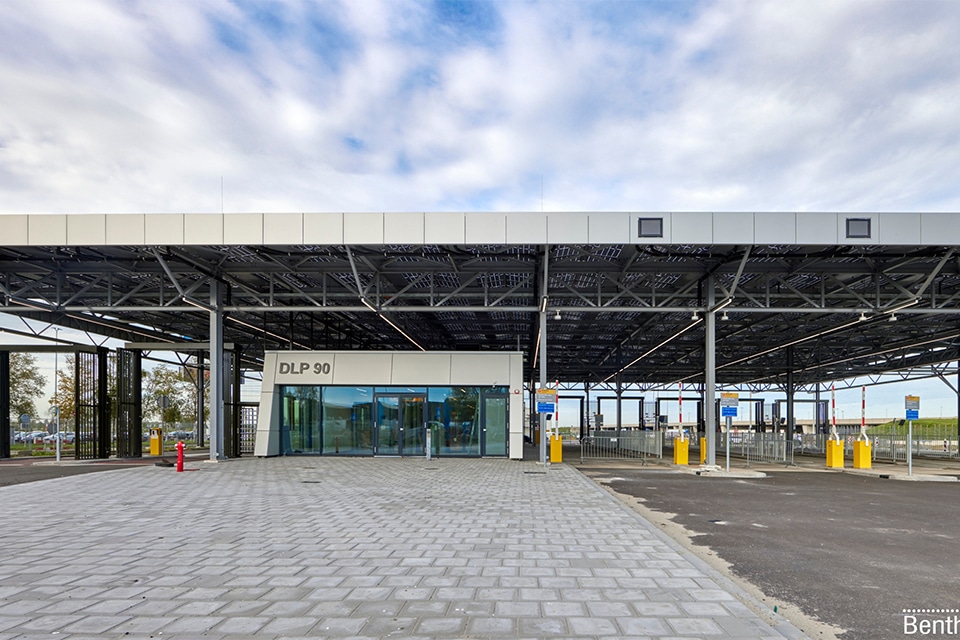
Schiphol takes an important step in sustainable building with Passage Point 90 (DLP 90), a sustainable security post for vehicles and personnel entering airside. DLP 90 is more than a functional building: it is a pilot project for the future of circular construction.
Thanks to the collaboration between Benthem Crouwel NACO, BAM, Peutz and FPC, an energy-neutral building has been realized. Existing steel structures, windows, doors, sanitary facilities, kitchens and LED lighting will be given a new purpose. This brings the design to a Building Circularity Index (BCI) of 68% circular. The highest achievable is 80%; so 68% is a fine achievement. “This project shows that reusing materials is possible and leads to innovative and sustainable architecture,” said Alina Zaytseva, architect at Benthem Crouwel NACO. With a roof of translucent bifacial solar panels, a hybrid construction of reused and biobased materials and a carefully designed working environment, Schiphol is setting a new standard. “Everyone on the team was immensely motivated to make this a success,” adds Alberte van Santen, project manager at NACO.
The construction of DLP 90 was prompted by a broad development: the expansion of Schiphol's taxiway over the A4. This meant relocating the old crossing point. Schiphol saw this as an opportunity to put circular building into practice. Benthem Crouwel NACO therefore examined three scenarios: moving the existing crossing point, a completely biobased building or a building that reuses old demolition materials. In the end, a combination of the second and third scenarios was chosen. “We reused materials from a demolished shed and added new biobased materials,” Zaytseva explains. “This is how we found the balance between sustainability and architectural incorporation.”
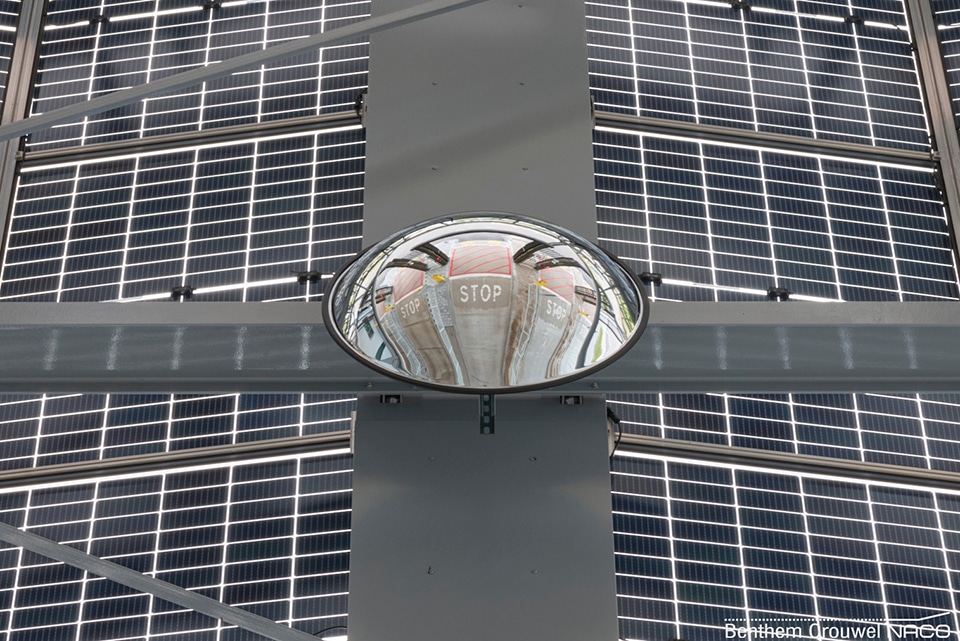
DLP 90 is a model of smart reuse. Existing steel structures, windows, doors, plumbing, kitchens and LED lighting were given a second life. “One of the biggest challenges was to have it established that these materials met the strict quality requirements,” says Van Santen. Biobased materials were also used. The security lodge is wood, with aluminum cladding for a uniform appearance. The overall roof is completely covered with translucent bifacial solar panels, which naturally generate energy, but also create a pleasant working environment. “We used the solar panels directly as roofing,” says Zaytseva. “This saves material as well as making the best use of space.” Much attention was also paid to the building's sound insulation to create a good working environment. Even with air traffic just a few meters away.
DLP 90 is not only a functional transit station, but also a blueprint for future security buildings, such as airport transit stations. During development, a building toolkit was created, which will make it easier to design future projects in a circular way. “We learned a lot about urban mining: how to efficiently reuse materials from demolition,” says Zaytseva. “With this knowledge, circular construction is becoming more and more feasible.” In addition, Schiphol is working on a materials hub, where reusable materials will be temporarily stored for future projects for the airport. Sustainability is also included in the landscaping: low-maintenance plantings such as birch trees reduce heat stress and improve the workplace.
With DLP 90, Schiphol is proving that circular construction is feasible, as the end result is impressive: a circular, energy-neutral crossing point, completely gas-free and with energy label A++++. The combination of reuse, biobased materials and innovative techniques makes this project a milestone in sustainable urbanism. “We have shown that reuse does not have to be a compromise,” says Van Santen. “This project is an important step toward a carbon-neutral and zero-waste airport.” Zaytseva adds: “Everyone wanted to prove that circular construction can work on this scale. And we succeeded. This project fits nicely with Schiphol's ambitions to be fully circular by 2050. And it's wonderful to contribute to that.”