Platform on new construction, renovation, restoration and transformation

Katendrecht, the peninsula between the Maas and Rijnhaven in Rotterdam, is becoming increasingly "hip & happening. The Groene Kaap, a compact but at the same time large-scale development with courtyards and roof gardens, undisputedly contributes to this.
De Groene Kaap is located in the entrance area of Katendrecht. The project consists of 450 new housing units in four sturdy harbor buildings with five towers. Courtyards and roof gardens as well as walkways connect these buildings. The overall development is in the hands of Stebru, which took over the land from the municipality of Rotterdam some three years ago. "An important requirement of the municipality was that we realize the project in one go," says Paul Vernooy, Real Estate Developer at Stebru. "We are doing this in cooperation with Altera. They are taking over 356 homes for rental. We are selling the remaining 94 homes."
Roof garden concept
The municipality was delighted with the public roof garden concept of Stebru and Bureau MASSA. Vernooy explains the concept: "Roof gardens are laid out on the low-rise sections. These contribute to the green look and climate adaptability of the neighborhood. Together with the green courtyards, the roof gardens form a natural whole, where residents can enjoy the outdoors and meet each other. In this way, we give a piece of green back to the city, which is becoming increasingly densified and experiences problems during extreme rainfall or heat, among other things." On one of the artist impressions, Vernooy points out a walking path that meanders through the area like a yellow ribbon. "This is a public walking route for visitors," he explains. "In this way, we encourage encounters in the project. The path is laid out in such a way that residents' privacy is guaranteed."
Diverse and industrial
In addition to the abundance of greenery, the new construction plan is characterized by a wide variety of housing types. From various apartments and penthouses in the towers to avenue, courtyard and quay houses in the lower parts. This great diversity allows family members, for example, to continue living close together. Also characteristic of De Groene Kaap is the industrial look of the buildings. The facades will include lattices and piers of white concrete, just like the original and partly still existing harbor buildings in the area.

Six days per layer
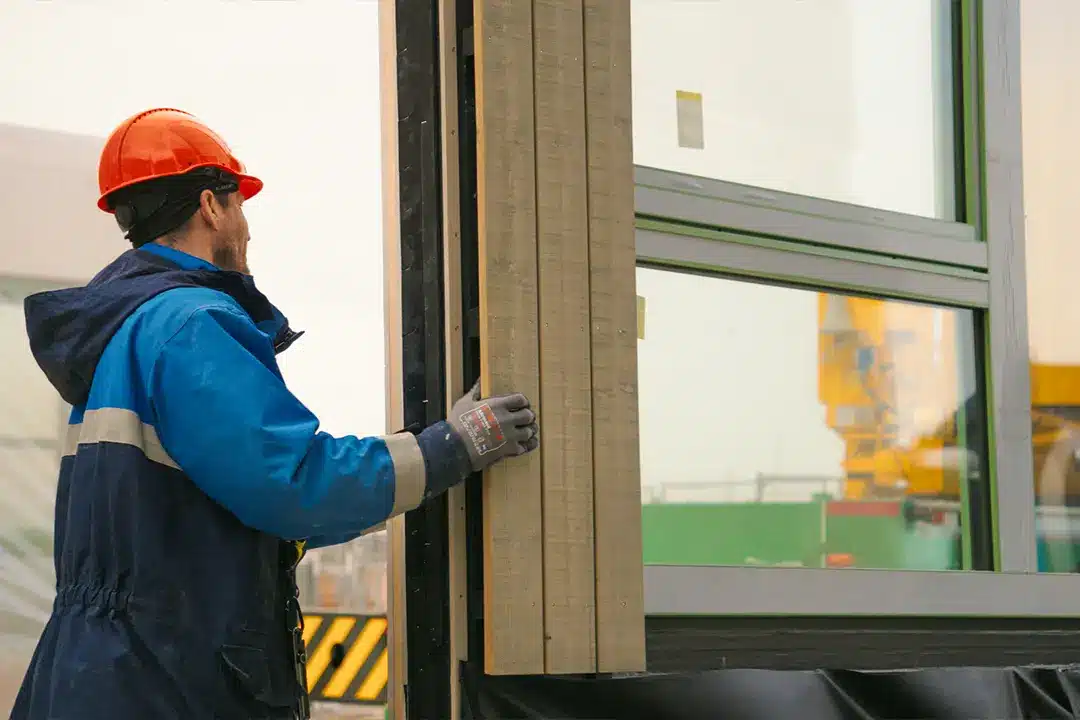
The execution of De Groene Kaap is led by construction site manager Kees Roosendaal of Stebru. He says: "At the end of November 2017, we started the piling work. We are now working on the basement deck and will start tunneling the first tower this year. The second tower will follow six to eight weeks later and the third again six to eight weeks later. After tunneling the first two towers, we will start the last two. We schedule the concrete tunneling so that it never takes place on two towers at the same time. Three of the five towers we close with precast sandwich elements. We include these, along with the provisions for the balconies, in the tunnel cycle of six days per layer. At a later point in the tunnel cycle, we pour on the balconies and assemble single-shell elements and frames of the end walls. This is done from a traditional scaffold. During the lowering of the scaffolding, we assemble the large glazed facades on the balconies."
No square boxes
"This project is more complex than it seems," continues Roosendaal. "At first glance, the buildings look like a few square boxes, but because of the different housing types and many special details, this work is anything but repetitive. For this reason, we are executing two towers in traditional masonry instead of sandwich elements and the work is being divided into two separate construction streams." Another complicating factor is the construction site. As with many inner-city projects, Stebru is building on a postage stamp. Planning and logistics listen very closely and require good agreements between all involved. "We work with many regular partners, with whom we have coordinated the work in advance," says Roosendaal. "That pays off in execution - and certainly later during tunneling." Vernooy is also confident: "In 2020, hundreds of residents here will enjoy a true roof garden oasis on the Maas."