Platform on new construction, renovation, restoration and transformation
The future of building is wood. After all, wood can be built considerably more sustainably, faster and with complete freedom of design. “Wood is a renewable material that is abundantly available, stores a lot of CO2, can be recycled endlessly and has a low environmental footprint,” says Rowan Dekkers, Structural Engineer at Movares Smart Urban Engineering. “Moreover, wood is versatile. You can use it for new construction projects, but also for expanding and topping up buildings, which is currently a hot topic. Because wood is much lighter than concrete or steel, in many cases the additional allowable load on the foundation is sufficient. As a result, functionality, durability and practicability come together nicely.”
Wooden structures are demountable, emphasizes Robbert Jan Schakenraad, team leader of the Den Bosch branch at Movares Smart Urban Engineering. “Because the structures are developed as a construction kit, complete shells can be realized very quickly. Moreover, wood is very beautiful and increases the atmosphere. It is not for nothing that wooden constructions mostly remain in sight.”
So nothing but praise for wood, yet constructing it brings specific challenges, knows Florine Verschuure, Structural Engineer at Movares Smart Urban Engineering. “For example, designing wood structures requires detailed knowledge of the structural engineer. For example, with regard to materials, fire behavior and acoustics. Moreover, with timber structures, the connections are often normative for the dimensions of the columns and beams. This needs to be considered in the preliminary phase.” Schakenraad: “It is important that the shell fits a wood construction and is not only converted in the DO phase. After all, wood requires different frame sizes, span lengths and connections.” Says Verschuure, “The correct timber dimensions, timber qualities and transportable elements must also be determined at an early stage. On this basis, the engineering can be optimized, leading to an economical and efficient design.”
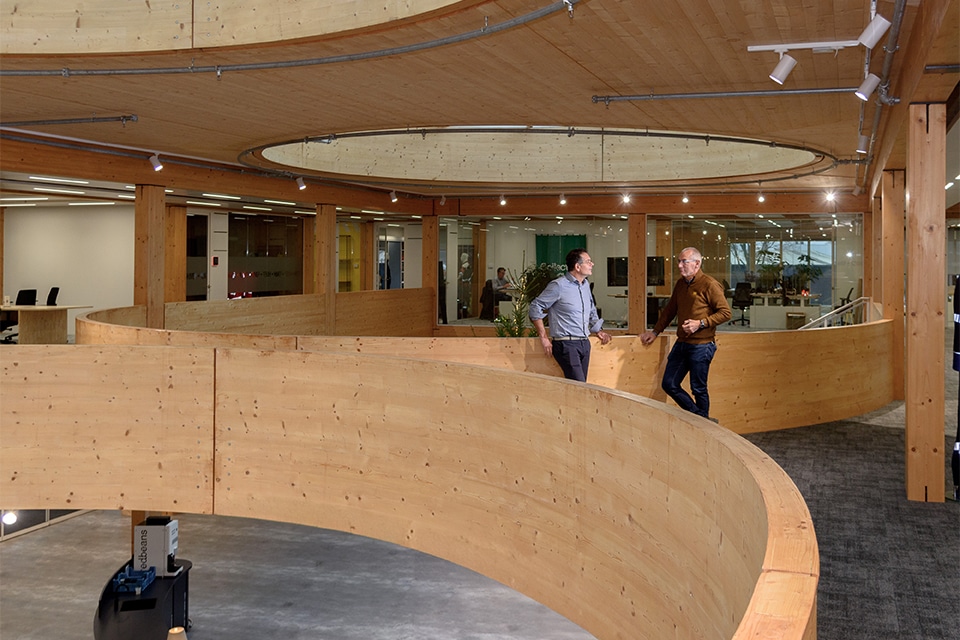
A great reference for building in wood is the new office with storage hall for Havep in Goirle, which excels in all aspects of sustainability, says Schakenraad. “For example, maximum use was made of sustainable, recyclable and recycled materials. Moreover, this project is one of the largest timber construction projects in our country.” Movares Smart Urban Engineering optimized and further developed the structural design with laminated wood and CLT, he says. “We adjusted the timber dimensions so that more efficient production could be achieved. In addition, we determined the correct positions for the installation penetrations and ensured that all junctions were actually feasible.” A special feature is that timber trusses were added, where normally steel is often chosen, says Dekkers: “Moreover, the project has quite large spans.” Schakenraad: “Thanks to a carefully engineered floor construction in the office spaces, the floor feels as comfortable and rigid as concrete.”
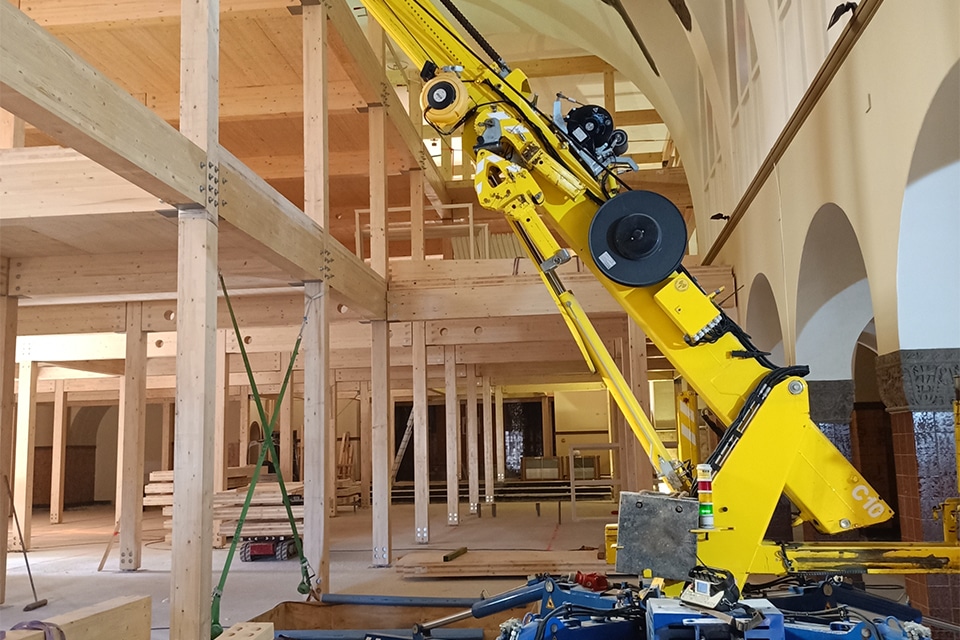
In addition, Movares Smart Urban Engineering designed a wooden structure for the Korvel church in Tilburg to support the development of 2,400 m2 health center possible. “For this repurposing project, we developed a bio-based wood construction with two-story floors, which is completely self-contained,” Dekkers says. “For example, to prevent deterioration of the national monumental church and to guarantee flexible building use in the future.” Schakenraad: “An important requirement was that all wood could be brought in through the front door of the church. This had to limit the maximum size of materials and equipment. The low weight of the wooden structural members came in very handy in this regard.”
Also impressive is the new FoodTech Facility ‘Cibia’ on the campus of Wageningen University & Research, for which Movares Smart Urban Engineering realized the structural design. “Initially, the idea was to implement the entire design in wood, with laminated beams, columns, CLT floors and CLT walls,” explains Verschuure. “In the design phase, however, the change to hollow-core slabs was also factored in. For example, to absorb vibrations even better.” A challenge in the design phase was to get the columns and beams to connect optimally, she says. “In addition, to ensure that all installations can enter the rooms properly, steel beams were integrated into the floor heights in the corridor areas. In contrast, the large spans are made entirely of wood.” By choosing wood, the entire shell could be built in just two weeks.
Movares Smart Urban Engineering works on future-oriented solutions for issues in the fields of buildings, planning & conditioning, energy, infrastructure, water & geo-solutions and rail. “With around 1,500 colleagues, spread across various hubs throughout the Netherlands, we are ready to take on the challenges of tomorrow,” Schakenraad said. “Our unique strength lies in in-depth structural knowledge: we design buildings as complex hubs where architecture, construction and installations come together.” Verschuure: “Our vision is for buildings of the future to be sustainable, healthy, smart and designed for the full life cycle of both the building and its users. With an integrated approach, innovative technology and data, combined with the craftsmanship of our professionals, we create maximum social added value and set the standard in the sector. This is how we build the world of tomorrow together: faster, smarter and more sustainable.”