Platform on new construction, renovation, restoration and transformation

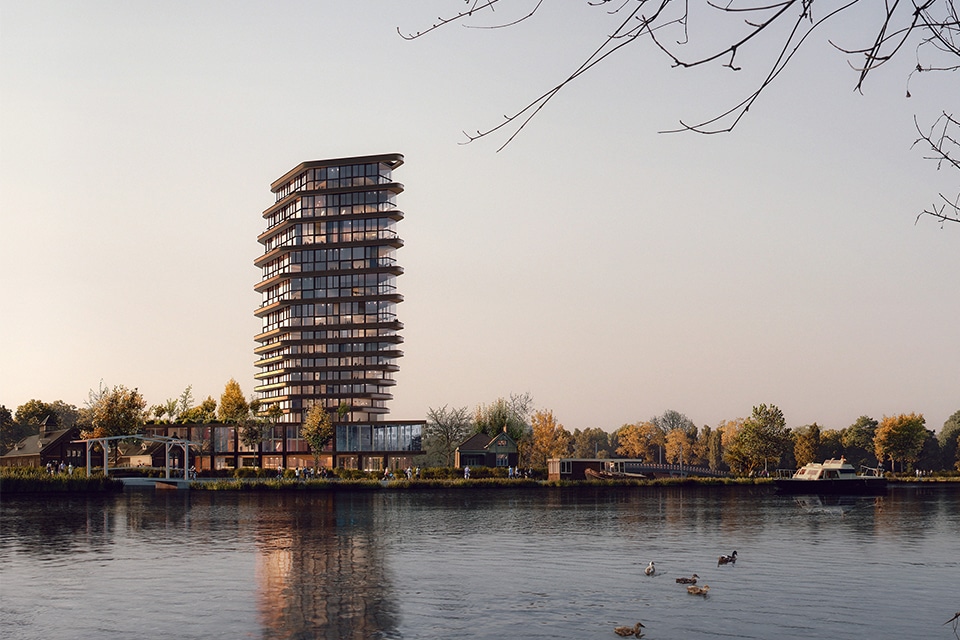
Plus Ultra III in Wageningen sets a new standard for sustainable, flexible multi-tenant buildings for life sciences. It is the first laboratory building in the Netherlands where a hybrid wood building concept was deliberately chosen. An interview with Maurits van Ardenne of Proof of the sum, project architect of Plus Ultra III, about this unique concept with great attention to fire safety.
Plus Ultra III is a development by Kadans Science Partner, a well-known relationship of the architecture firm. “Development began three years ago, building on previous projects Plus Ultra I and II on campus,” Van Ardenne says. “This time with a clear ambition: to accelerate sustainability and push boundaries in a complex building typology. In the preliminary process, concrete and wood construction were therefore explicitly juxtaposed, both technically and financially. Together with Bbl fire safety consultancy, a fire safety agency specialized in timber construction, intensive discussions were held with the municipality and client. Timber construction in this typology requires explanation, trust and addressing concerns, particularly in the area of fire safety.”
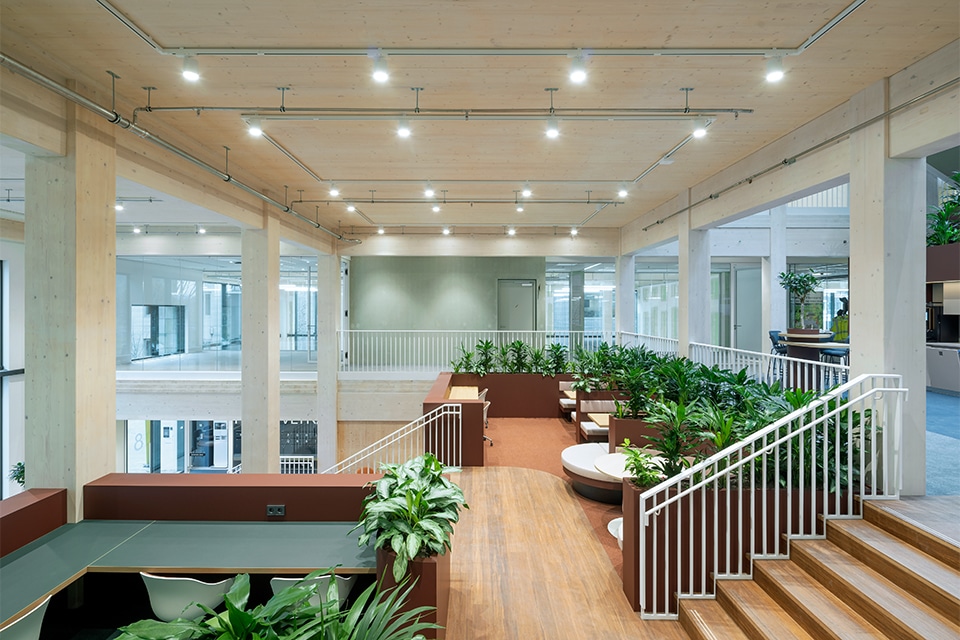
The structural design of Plus Ultra III was worked out in close cooperation with Adviesbureau Lüning, a structural engineer specializing in timber construction. The structure consists of a first floor in concrete and four precast concrete cores housing elevators and stairwells. This choice is both functional and necessary, according to Van Ardenne. “The first floor includes the pilot plants and test kitchens with a double height of about 8 meters. These spaces act as showcases for the campus and literally display what is happening in the building. The floors above are constructed of CLT floors and laminated wood columns and beams. Wooden beams remain exposed wherever possible, including around the atrium and along the facades.”

The floor plans are designed to be very flexible. Tenants can choose the desired ratio of laboratory to office for each floor. “Fitting the installations and maintaining the minimum, net clear height for the lab spaces was made possible by using locally integrated steel beams in the CLT floors. Thus, no additional high floor thickness or higher storey floors need to be realized.
Crucial for laboratories with lots of air ducts,” says Van Ardenne. “The central atrium connects all floors and acts as the social heart. Plus Ultra III is part of a larger ecosystem: users of all three Plus Ultra buildings share facilities and meet on the completely traffic-free plaza between the buildings, designed as an ‘outdoor living room’ in collaboration with landscape architect Atelier Loos van Vliet.”
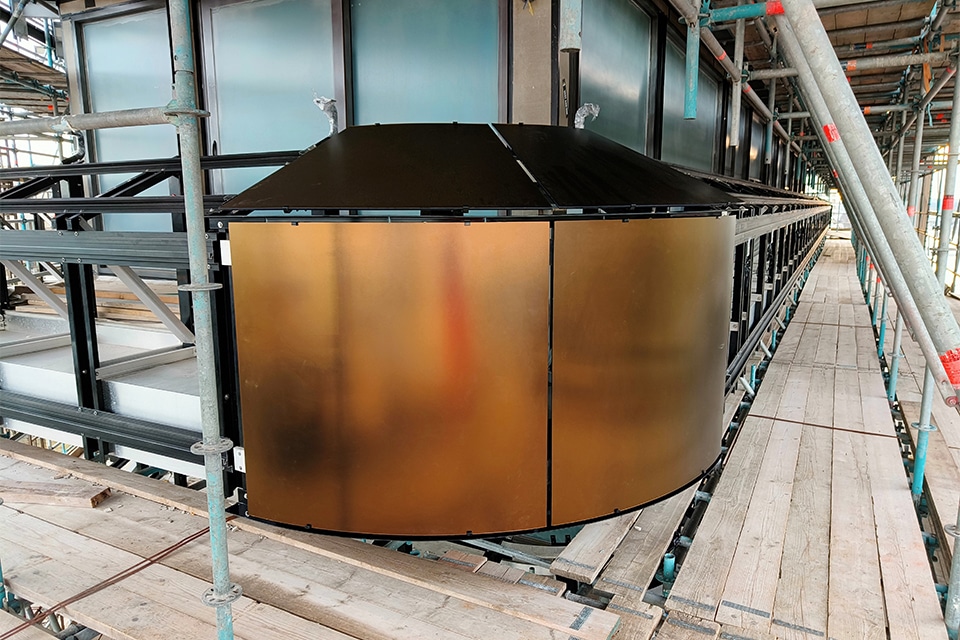
Innovation is also evident in the facade. “Together with startup Pretty Plastic, recycled plastic facade tiles have been developed. The tiles, made from recycled granulate from window frames, among other things, have a layered, almost scaly appearance. Four colors, including three shades of green and a subtle red accent color, are cleverly distributed across the facade via AI to prevent clustering,” Van Ardenne explains. In terms of sustainability, the project focuses on BREEAM Excellent, detachability and flexibility, a WKO installation, smart sensors for occupancy and climate, biodiversity and a nature-inclusive design. Technology is largely hidden from view by patios and continuous facades on the roof.
In November 2025, Plus Ultra III was completed and the first tenants have moved in. They are mainly companies that are taking the lead in the fields of life science, agriculture and sustainability. Plus Ultra III proves that even a technically complex laboratory building can be made future-proof, flexible and in wood.