Platform on new construction, renovation, restoration and transformation
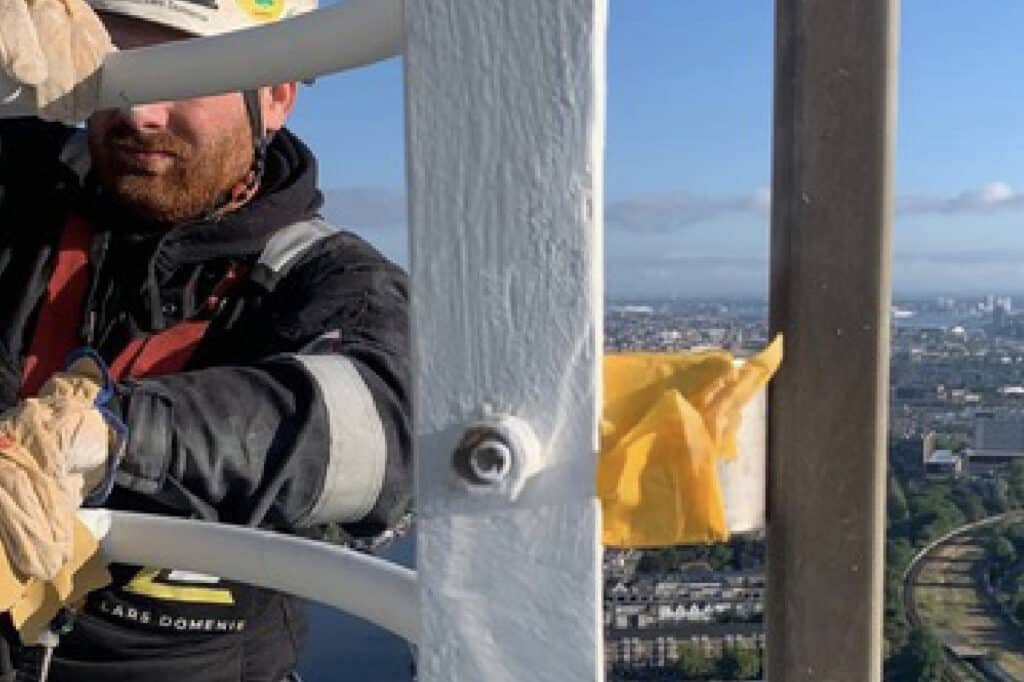
Work on building facades or at great heights is traditionally done using scaffolding or aerial work platforms. But that doesn’t always have to be the case. While it may still sound unusual to many, rope access—working with rope techniques—is gradually gaining ground in the construction industry. Strong In Heights, Lars Domenie’s company, uses this technique for a wide range of tasks in hard-to-reach places.
“Rope access has been around for years, but it’s mainly used in industry,” says Domenie. “In the construction sector, people still often rely on traditional solutions such as scaffolding and aerial work platforms. As buildings become taller and more complex, these aren’t always the most efficient or safest choice.”
In rope access, specialized technicians literally work ‘like mountaineers’ on a building. Using ropes, they descend in a controlled manner along facades or structures to carry out their work. “It’s a fully-fledged profession with training programs and certifications. You don’t just hang from a rope like that,” Domenie emphasizes.
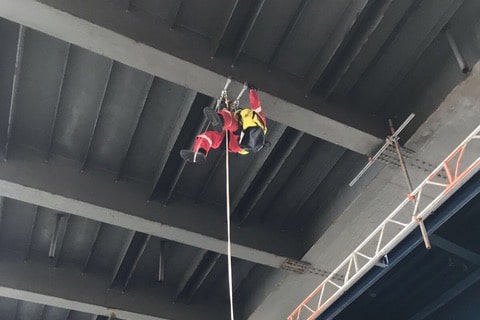
Although rope access is often associated with inspections, the reality is much broader. Strong In Heights is called upon for a wide variety of assignments: from painting and caulking to installing facade elements and replacing glass. “On a construction site, we often find that we’re called in for the final finishing touches,” says Domenie. “When scaffolding has already been removed and aerial work platforms are no longer an option, there are still tasks left to do: caulking joints, making repairs, and performing minor adjustments. That’s where we offer a solution.”
But we’re also capable of handling larger and more technically complex projects. For example, we can hoist and install heavy glass panels or facade components along the exterior of a building. “Using electric winches, we can move loads weighing up to several hundred kilograms in a controlled manner. We often work in conjunction with cranes. Because we’re so mobile, we don’t get in the way of the hoisting operations.”
One of the greatest advantages of rope access is its flexibility. While setting up scaffolding can take days, rope access technicians are often up and running within a few hours. “We’re usually ready to start within an hour and a half to two hours,” says Domenie. This not only saves time but also minimizes disruption to the surrounding area. No road closures or large-scale setups are required, which is a significant advantage, especially in urban settings. Cost efficiency also plays a role. Because less equipment and preparation are needed, rope access can often be a more cost-effective alternative.
Working at heights naturally raises questions about safety. According to Domenie, the bar is set particularly high in this sector. “The safety standards are extremely strict. It is and always will be work at heights, but that is precisely why the procedures and training are so thorough.”
At Strong In Heights, Domenie works as a certified supervisor (Level 3), the highest level in rope access. He supervises and monitors other technicians while they perform their work and is responsible for safety, equipment, and organization.
The demand for rope access is growing, especially in the construction industry, where architecture is becoming increasingly complex. Think of tall buildings, hard-to-reach facades, or innovative applications such as vertical gardens. “The construction industry is evolving, and techniques must keep pace,” Domenie concludes. “Rope access isn’t a replacement for everything, but it is a powerful complement—especially when traditional methods fall short.”