Platform on new construction, renovation, restoration and transformation
The construction industry is undergoing significant modernization. The enormous housing shortage, the lack of skilled technicians, the limited space on our construction sites, and ambitious climate targets call for new ways of thinking and working, with an emphasis on sustainability and efficiency. Prefab and modular construction are responding optimally to this and ensuring the increasing popularity of plasterboard in timber frame construction, notes Nicolas Huysmans, Technical Expert at Etex Building Performance. “Siniat's dry finishing solutions are a perfect fit. With our products, we help architects, engineers, and contractors create warm, dry, quiet, and safe buildings. Fast, rock-solid, and in compliance with current laws and regulations.”
“Prefab timber frame elements are produced in the factory under the best working and climate conditions,” says Huysmans. “This results in a significant improvement in quality. By producing products in advance and delivering them to the construction site just-in-time, it is also possible to achieve an enormous construction speed. By fitting the timber frame elements with our Siniat Weather Defence plasterboard for exterior use or Siniat LaDura Premium plasterboard for interior use in the factory, the required acoustic, comfort, and fire safety standards are immediately met. It is no coincidence that Siniat products are increasingly being chosen, possibly in combination with other Etex Building Performance brands such as Promat and URSA.”
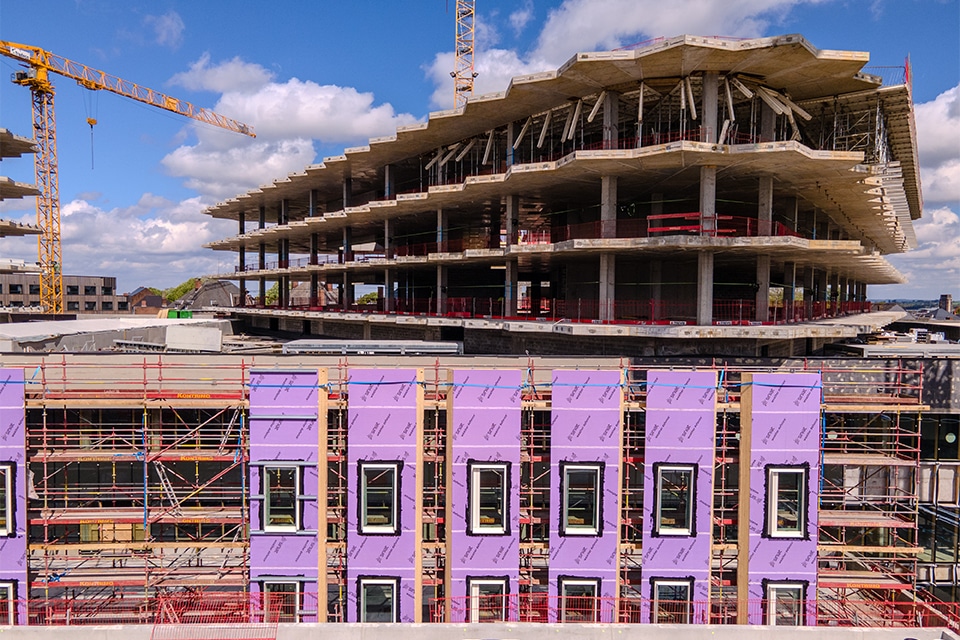
Siniat offers an extensive range of sheet materials for partition walls, false walls and shaft walls, facades, floors, and ceilings, which are continuously developed and periodically tested in accordance with current and future legislation and regulations, says Huysmans. “This allows us to continue to respond to the wishes of our customers and the regulatory authorities. In recent years, we have carried out more than fifty tests. For example, in the field of fire safety, which means we know exactly what possibilities timber frame construction offers in combination with our sheet materials.”
For several years now, Huysmans has seen growing demand for biobased insulation materials. “Driven by innovation and sustainability, we have been researching for some time how our gypsum boards can be combined with biobased solutions for modular or prefab construction. Glass wool insulation, which is a sustainable and recycled product, is already regularly used in the market. In addition, interest in biobased products is increasing. From wood wool to straw, flax, hemp, cork, sheep's wool, and recycled cotton.”
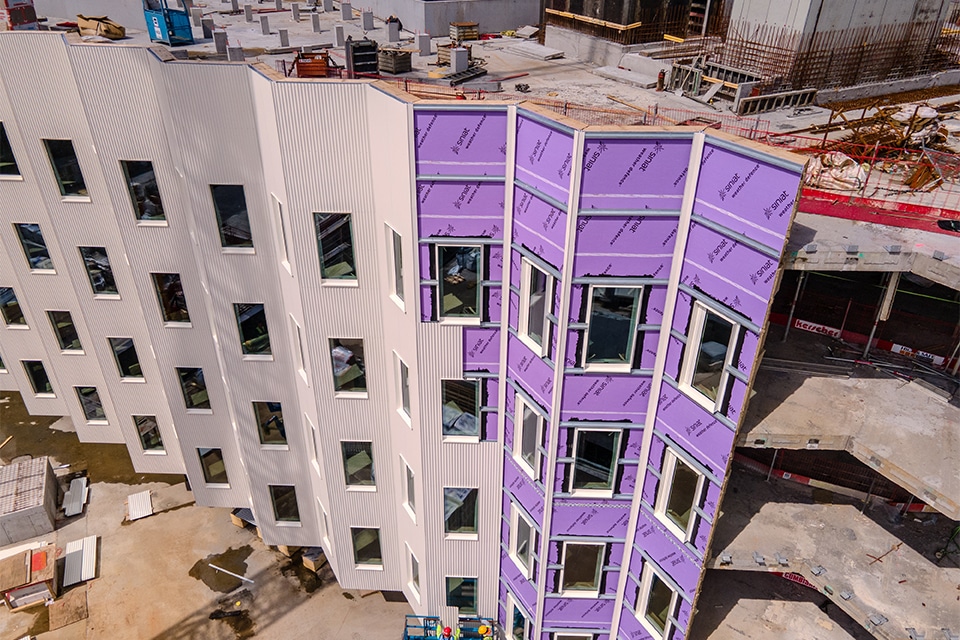
Siniat's tests relate, for example, to the thermal and acoustic properties of bio-based insulation materials. But they also relate to the environmental impact and the challenges that need to be overcome. After all, not all materials are (sufficiently) resistant to moisture, mold, or fire. “However, in combination with our Siniat Weather Defense or Siniat LaDura Premium protective sheet materials, these performances can be significantly improved,” says Huysmans. “In collaboration with renowned institutions such as Efectis, Peutz, Warrington, and other advisory parties, we have already been able to take significant steps, enabling us to offer well-founded systems to the market in this area as well.”
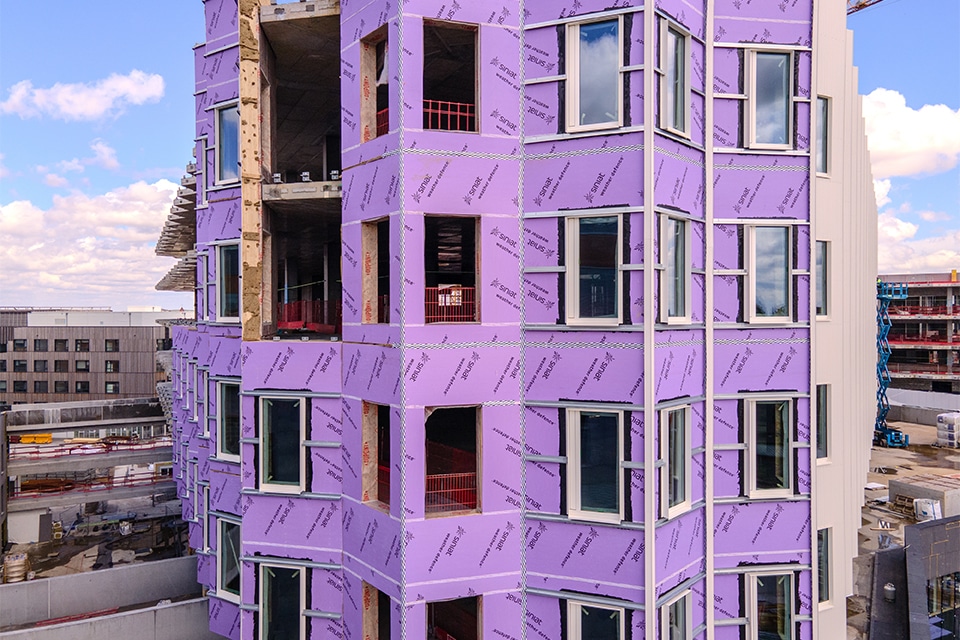
Siniat Weather Defence is an innovative gypsum board for outdoor use that offers excellent moisture resistance, sound insulation, fire resistance, and durability. “While the 9 mm thick board is ideal as a wind barrier, the 12 mm thick board is mainly used to make facades wind and watertight quickly and efficiently,” says Huysmans. “This is not surprising, as Siniat Weather Defence is considerably easier to work with than fiber cement. What's more, when used with the right tapes, the boards can be left unprotected outdoors for twelve months. This gives contractors plenty of time to finish the facade.”
Siniat LaDura Premium is a gypsum board for interior use with a core reinforced with wood and glass fibers, among other materials. “This creates a high-density gypsum core, which provides greater impact resistance, better shock resistance, and better moisture resistance than standard gypsum boards,” says Huysmans. “In addition, the board performs excellently in terms of acoustics and fire safety and promotes the shrink resistance of the entire element.”
Siniat is also currently introducing an innovative Solidtex impact-resistant gypsum board in combination with stone strips. “Another great development is our new design guide for timber frame construction, which makes it even easier to comply with legislation and regulations. The guide clearly lists all our products and their properties. This allows architects, engineers, and contractors to see at a glance which product is suitable for which application and which regulations must be complied with.” The design guide can be easily downloaded from the website.