Platform on new construction, renovation, restoration and transformation

Developments in the logistics sector are moving fast. For example, logistics service provider CB (formerly Centraal Boekhuis) is signaling that the need for small storage spaces is growing. The number of orders is increasing, while the volume of orders is decreasing. It is responding to this with a fully mechanized bin warehouse.
CB's new high-rise warehouse, or "bin warehouse," will be built against the existing premises. It will have an area of 30 x 100 m and a height of 34 m. The extension will be divided into a work area (30 x 17 m) with elevators, conveyors, stairs, a passenger/goods elevator, an office area, a pantry area and sanitary facilities. Recesses in the wall of the work area connect with conveyors to the shuttle area (83 x 30 m). This area will be filled with racking, together accounting for 150,000 "bins" in the first phase and an expansion to 300,000 bins in phase 2.

The expansion will be built against the existing building.
The extension will be constructed of a steel structure, sandwich panels and five storey floors (hollow core slabs) with compression layer in the work area. Because CB intends to install solar panels not only on the roof but also on the facade, sandwich panels of the Karrier type were chosen. These sandwich panels are suitable for attaching cladding to them.
The great height of the new building has an impact on De Vries en Verburg's working methods and logistics. Cranes, elevators, transport and supplies must be adjusted accordingly and safety must be ensured. "Working at great heights always involves more risks," says project leader Gerben van der Glas. "Just think of the wind load at 34 m height. The elevator shaft, equipment shaft and conveyor openings in the building also pose risks. On the top floor, these are holes with a depth of about 26 m. You understand that this has to be cordoned off and secured on all sides."

The height of the new building is enormous.
Since the new building will be built next to the existing high-rise, the existing building had to be carefully measured in advance. These measurements later determined the position of the steel structure. Over a height of 34 meters, the façade of the existing high-rise can easily deviate by 5 to 10 cm. Van der Glas: "These measurements were taken by our measuring engineer using highly advanced equipment."
Once the extension has reached its final height, the two buildings are coupled together at the top. This is done with 6 x 6 cm steel coupling sleeves fitted with end plates at both ends. Once the tubes are bolted between the existing and new steel structure, they secure the stability of the buildings. Van der Glas: "To do this, we first determined the exact position of the existing steel columns, after which recesses were made in the existing facade to make the coupling."
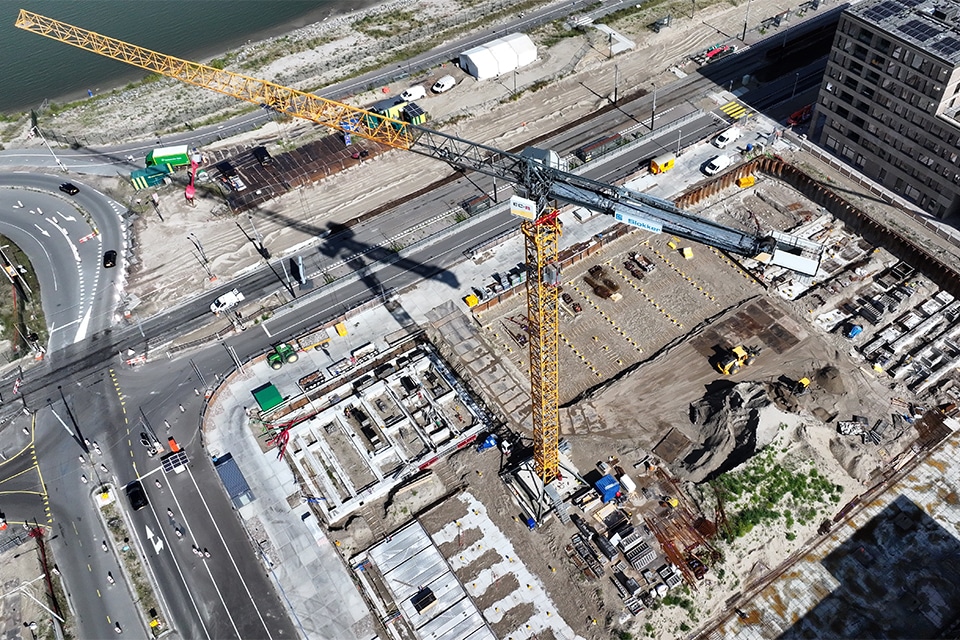
Good logistics require De Vries en Verburg to be smart about the limited construction site. "Not only do we bring our materials, but so do our subcontractors and third parties. In particular, the materials from the conveyor and rack builders require quite a bit of (storage) space. To manage this, each party is assigned a sub-area for a certain period of time, tailored to the schedule. This allows everyone to work as efficiently as possible."