Platform on new construction, renovation, restoration and transformation
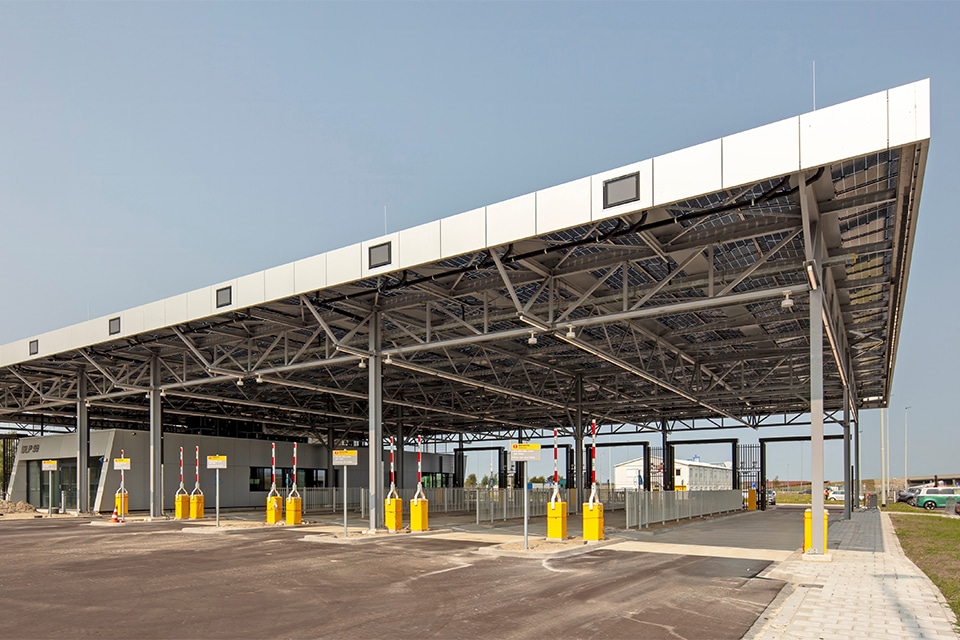
At first glance, Checkpoint 90 at Schiphol Airport appears to be ‘just’ a functional passageway: a place where vehicles are checked from landside to airside. But behind this seemingly modest passageway lies an extraordinary story. A story about circular construction and technical craftsmanship, in which existing steel and recycled aluminum were given a second life.
Passage station 90 consists of two buildings - a security lodge and a pass issue - both of which are placed under a generous canopy as an architectural eye-catcher. “We as Vic Obdam were called in at an early stage to help think about the use of donor steel on this project,” says director-project manager Rick de Keijser. “That turned out to be a hit.”
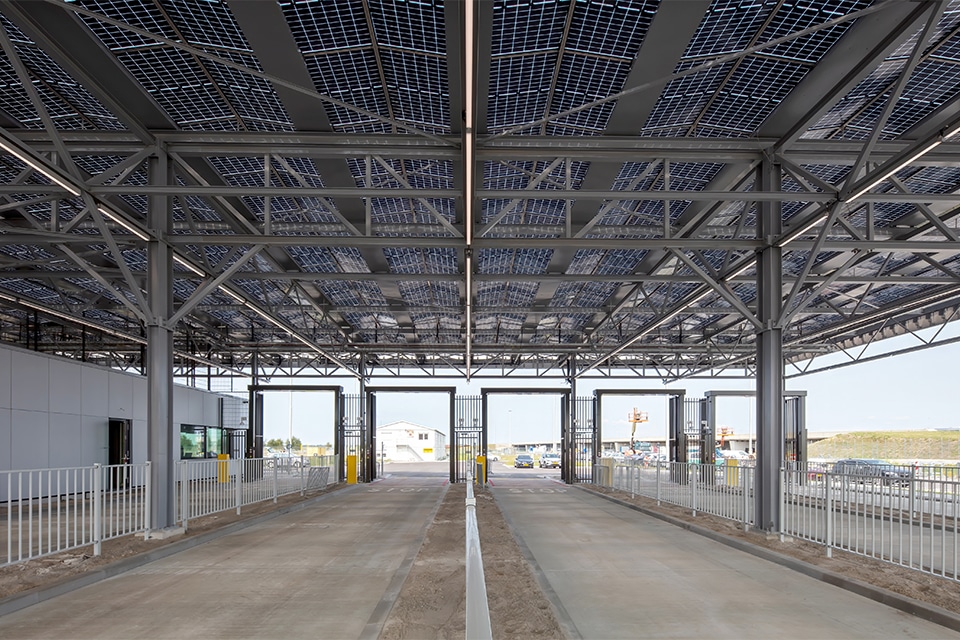
Part of the steel structure of the canopy originates from an existing hall, which was in the same location. Instead of ordering new steel, the old structure was carefully dismantled and stored. Vic Obdam did not proceed overnight. Extensive research into the quality of the donor steel was conducted in an external laboratory. “From Vic Obdam, we assessed the welds, once applied by another party, and replaced them where necessary in order to give a full guarantee,” De Keijser says.
The donor steel underwent a thorough update in the workshop. “The existing preservation was removed, new head and foot plates were welded on and unnecessary joints removed. Holes were welded shut, damage repaired and new steel was added where necessary,” explains De Keijser. An interesting detail is that some of the trusses from the old situation were reused as trusses in the new situation. The result: a construction that technically and visually meets the requirements of today, but partly with the soul of yesterday. Of the 150 tons of steel in the project, approximately 50 percent is donor steel.
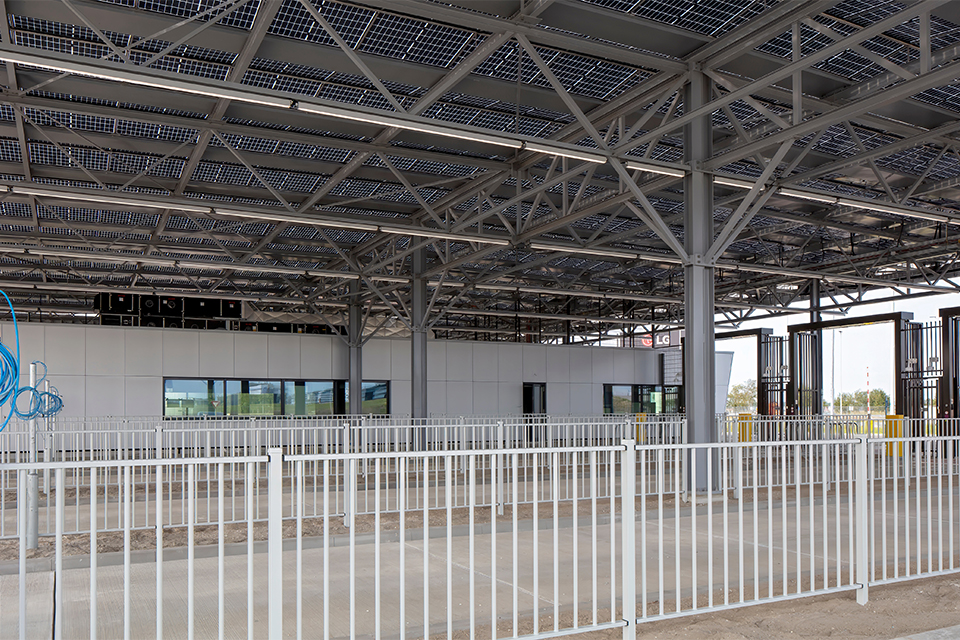
Under the canopy are the security lodge and pass issue. Vic Obdam also used partly circular steel for these, while subsidiary Prince Cladding provided the aluminum for the canopy's canopy edge, frame frames, eaves and aluminum cladding for the end walls. “We used a total of 450 m2 of aluminum with a recycled volume of more than 90 percent,” says a proud Toon Korswagen, project manager at Prince Cladding-Obdam. “The panels were manufactured from flat sheet, with the width matched to the available sheet sizes to minimize material loss.”
Parent and subsidiary company pulled together during engineering, production and assembly. “Because all disciplines were coordinated at an early stage, we were able to have the attachment points for the aluminum canopy edges incorporated directly into the steel structure,” Korswagen exemplifies. “That made the assembly a ‘piece of cake’ for us. Furthermore, the canopy edge and fascias were designed as a smart suspension system, which also made assembly, and possible future disassembly, quick and easy.”
Early involvement allowed both Vic Obdam and Prince Cladding to actively participate in detailing and engineering, making the use of donor steel and recycled aluminum truly possible. “Maximizing the use of available material became almost a sport. What is there, and how can we make the best use of it? That's not the easiest path, but it is the most future-proof,” De Keijser concludes.
Neem dan rechtstreeks contact op met Vic Obdam Steel Construction B.V..
 Contact opnemen
We operate in the steel construction industry, providing complete services for the entire construction chain. Our activities include engineering, manufacturing, conserving, and assembling steel structures for various construction projects. We excel in the process of translating preliminary designs into final designs, using our extensive expertise in steel structures to fully [...] our clients.
Bekijk Bedrijfsprofiel