Platform on new construction, renovation, restoration and transformation
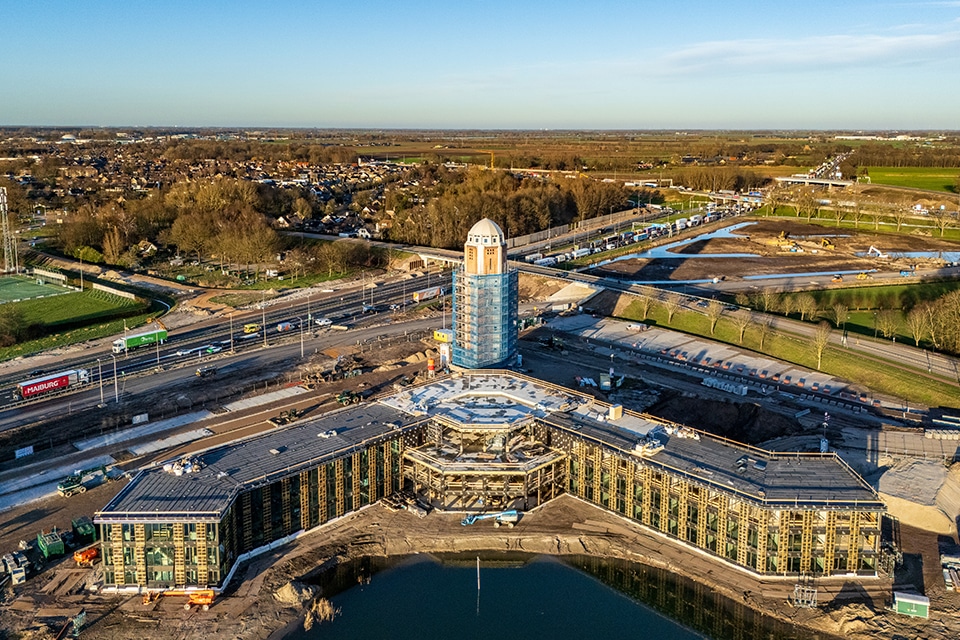
The iconic ‘Veerse Toren’ near the Hooipolder interchange is being repurposed as part of North Brabant’s first Postillion Hotel. The nationally listed water tower, built in 1925, will be restored to its former glory by Oome Raamsdonk wherever possible and will soon form the centerpiece of the hotel, featuring unique meeting rooms and a sky bar with a panoramic view of the region.
Oome Raamsdonk BV, a certified restoration company, is a full-service construction firm with over seventy years of experience in commercial real estate, maintenance, renovation & restoration, schools & education, sports & recreation, residential construction, and healthcare & social services. This combines ‘old-fashioned’ craftsmanship with modern techniques and methods. This is also the case in Raamsdonksveer, where Oome Raamsdonk, as part of a construction team with Bram Polak (owner of the Veerse Toren and founder of the repurposing plan), Postillion Hotels, ASK Architects, and contractor Linthorst, is overseeing the complete restoration and repurposing of the Veerse Tower—from the demolition of the former surrounding office building through to the final finishing touches.
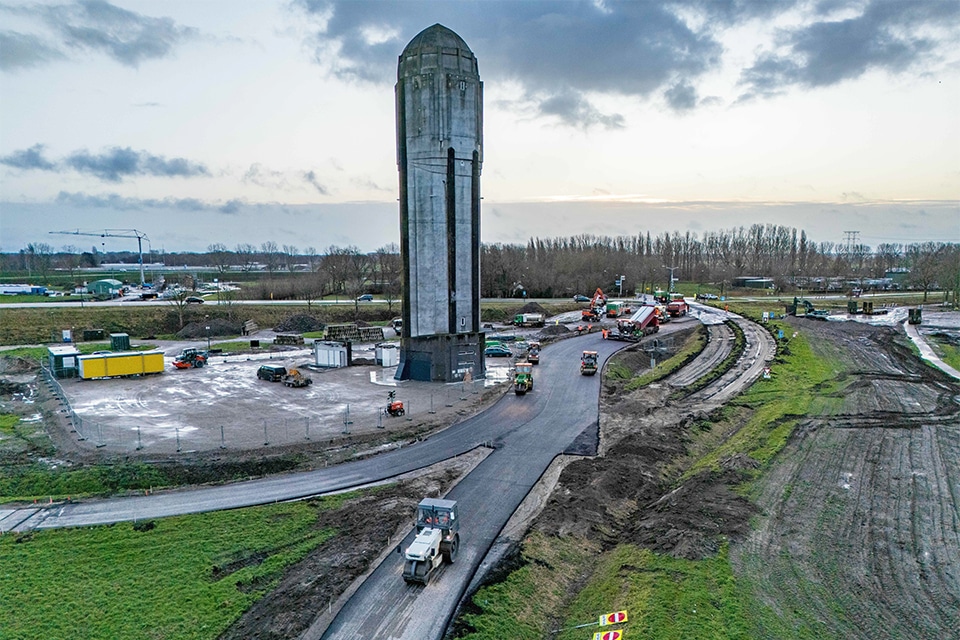
“We began construction in April 2025,” says project manager Malu Kramer of Oome Raamsdonk. “To make the water tower suitable for its new function, the building was carefully stripped down to its concrete shell and rebuilt. We made a conscious effort to use materials (in the style) of yesteryear. For example, regarding the masonry. Research showed that the thick, rock-hard layer of cement applied to the original masonry in the late 1960s could not be removed without causing damage. Furthermore, the masonry was found to be severely damaged by moisture. Therefore, in close consultation with the Cultural Heritage Agency of the Netherlands and Monumentenhuis Brabant, we replaced the entire facades. Specifically for the Veerse Tower, the traditional brick factory Vogelensangh produced a brick whose properties closely match those of the original brick. A suitable recipe was also developed for the mortar.’
The restoration of the Veerse Tower not only respects the building’s former appearance but also restores it. For example, Oome Raamsdonk is reinstating the ornaments that were removed from the building in 1969. “During the demolition of the facade, we chiseled out the original ornament positions to match the shape and positioning as closely as possible,” says Kramer. “The same applies to the window frames. All plastic window frames have been replaced with sleek steel frames, which combine the Veerse Tower’s former glory with significantly improved insulation performance. Finally, the front door and interior door frames are finished in attractive wood.”
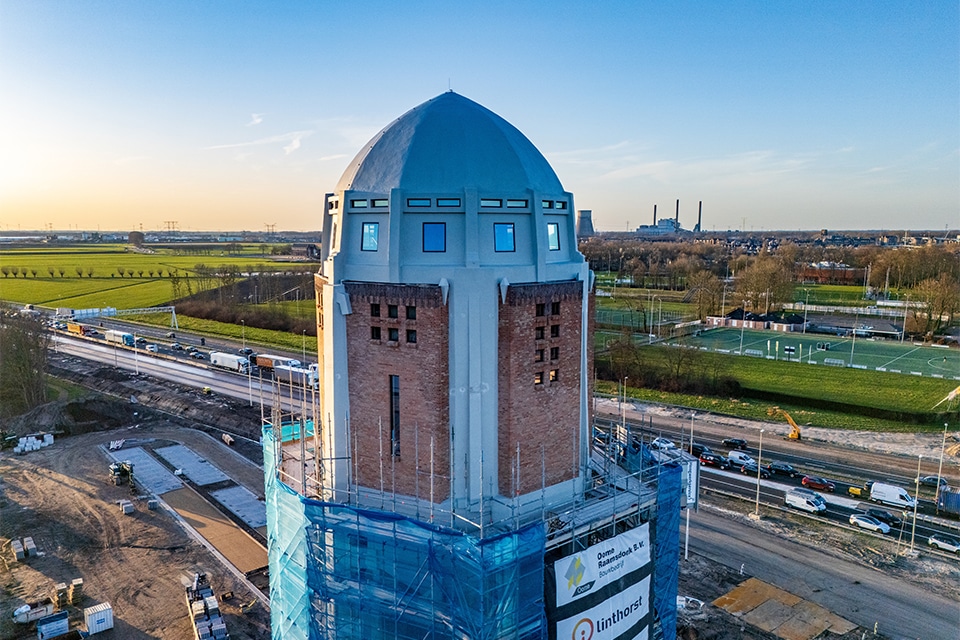
The structural work is currently being completed, and the Veerse Tower is gradually emerging from the scaffolding. A lot of work has also been done inside. For example, the old floor slabs have been removed and replaced with new lightweight slabs, which make the Veerse Tower suitable for its conference facilities and skybar, Kramer explains. “Right now, the drywall is being installed. In addition, we are busy installing all the interior walls, staircases, and the elevator system, after which Postillion Hotels will handle the final finishing touches in-house. We plan to complete our work this summer, after which Postillion Hotel Breda-Biesbosch will open its doors in September.”
According to Kramer, it is the logistical process in particular that makes this project special, given its historic character. “We’re dealing with a 43.85-meter-tall water tower on a limited floor area, which means we have to work primarily at height,” she explains. “This requires careful attention during construction. The entire building has been encased in scaffolding, and scaffolding is also being used inside in some areas due to the non-standard floor-to-ceiling height of approximately 5 meters. A height that will soon give the Veerse Tower the right character from the inside as well.”