Platform on new construction, renovation, restoration and transformation
A (nearly) energy-neutral and Paris Proof office building with a high BREEAM certification. To realize these ambitions, an integrated project approach is essential. For this reason, Edge likes to work with regular supply chain partners, such as HC KP for the climate ceiling islands and closed climate ceilings and Barcol-Air for the air accessories, control technology and the building management system. Following on from the EDGE West, EDGE Stadium, EDGE Olympic, EDGE Eindhoven and EDGE Berlin projects, these companies from Swegon Nederland are joining forces during the circular renovation, expansion and refurbishment of the ABN AMRO office on the Foppingadreef in Amsterdam, where HC PS - also part of Swegon Nederland - is providing the parking garage ventilation.
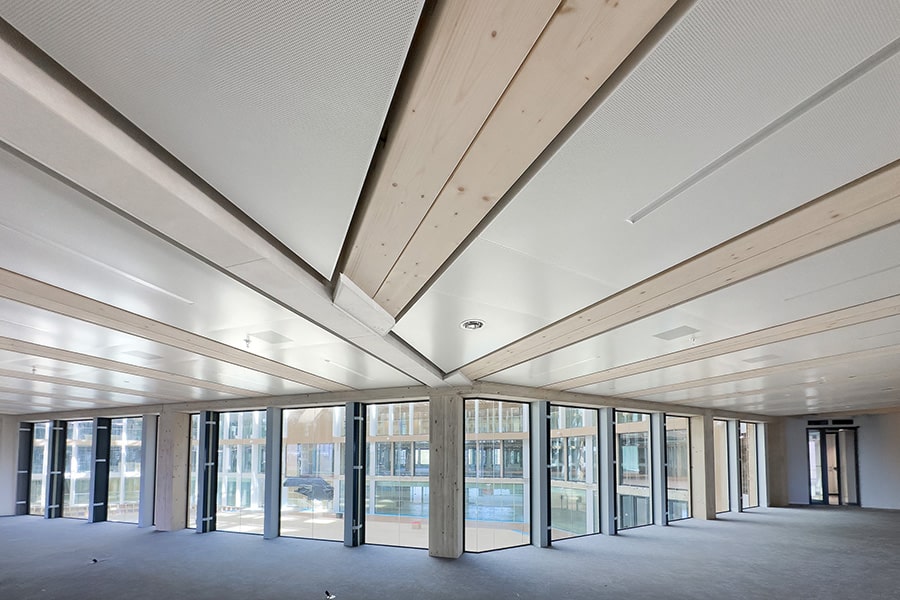
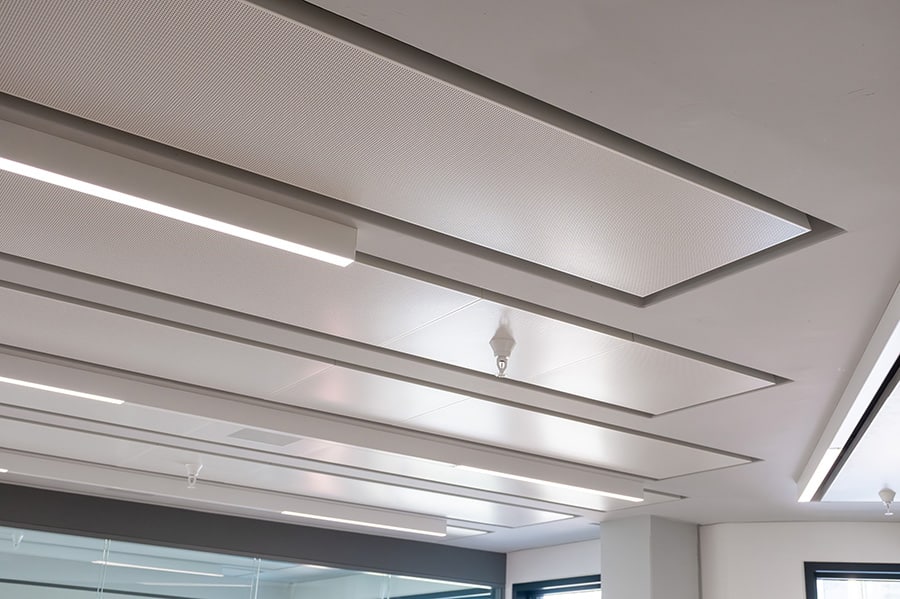
Approximately 21,000 m2 of climate ceiling islands and 8,000 m2 of closed climate ceilings from HC KP will soon provide comfortable and energetic heating and cooling of the ABN AMRO offices. “Characteristic of climate ceilings is that they cool or heat spaces based on radiation rather than with ventilation air,” explains technical director Paul Steneker. “The climate ceiling panels are cooled or heated with water. Thanks to the four times higher heat content of water as well as the favorable temperature ranges (low temperature heating and high temperature cooling), air-conditioning is very energy-efficient and comfortable. Layering and drafts are not an issue. Because the climate ceilings have an insulating blanket on top, they also have a sound-absorbing function, which improves speech intelligibility.” Because the climate ceilings are free of moving parts, they have a long service life and virtually no maintenance requirements. “Combined with the efficient integration of, for example, LED lighting, sensors, sprinkler heads and air distribution equipment, the climate ceilings deliver high BREEAM energy and comfort credits.”
“We sat down with developer Edge and installation consultant DWA early on to discuss possible solutions for this project,” Steneker says. “Moreover, before we started production and assembly, we made a mock-up to check all the details.” The climate ceilings are distributed over 74 building sections, assembled in close consultation with BBC (Bosman BAM Combination) and on a tight schedule, he says. “Because of ABN AMRO's desired high spatial experience, ceiling islands that are installed in the concrete ‘rolls’ of the structural floor have been chosen in most areas. By adopting the radius of the concrete in the process, the ceiling islands fit in very tightly with the existing building forms.” The new wooden structure also follows this principle. “Here, the ceiling islands are inserted between the wooden beams of the structure, making them a bit larger and also allowing the lighting fixtures to be neatly integrated.”
Some of the existing ‘old’ climate ceilings were dismantled and temporarily stored for reuse, Steneker says. “Based on the available panels, we worked with BBC to create new ceiling layouts for reuse in the company restaurant, entrance area and the executive wing, among others. We also integrated LED lighting, sensors, sprinkler heads and air distribution equipment into the ceiling plan and replaced the existing hydraulic components such as piping and connection hoses, ensuring leak-free operation and new longevity in these locations as well.”
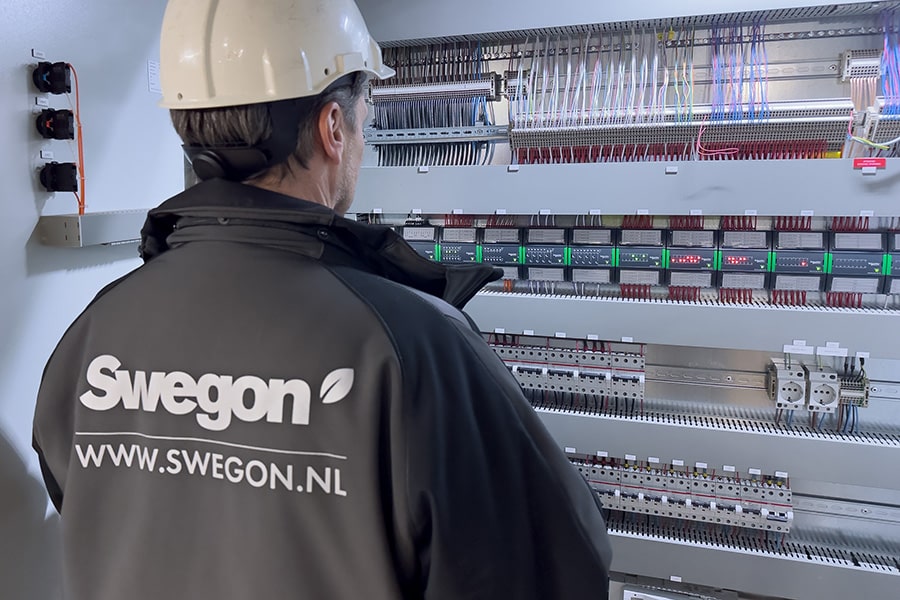
For the air distribution technology in the ABN AMRO office, HC KP sought cooperation with sister company Barcol-Air. A unique party in the market, as it supplies both the air distribution equipment and control technology, says project manager Stefan Sneekes. “This allows both techniques to be optimally tuned and ensures continuous quality control. For the ABN AMRO project, we supply variable volume (VAV) systems, which provide demand-controlled and draft-free ventilation of the building based on air quality (CO2) as well as presence.
Here, the accumulated control technology ensures balanced air distribution and comfortable climate control. Because the system is fully demand-driven, air is supplied and thus energy consumed only when needed.”
Thanks to VAV controllers in the main ducts of the ventilation system, the central supply and return air is balanced, making the air handling units energy efficient, Sneekes says. “Moreover, because the VAV controllers on the units control both the ventilation system and the air conditioning ceilings, half as many controllers are needed. This not only results in less material, but also in less energy consumption for climate control as well as less cabling, which perfectly matches our high sustainability ambition in this project.”
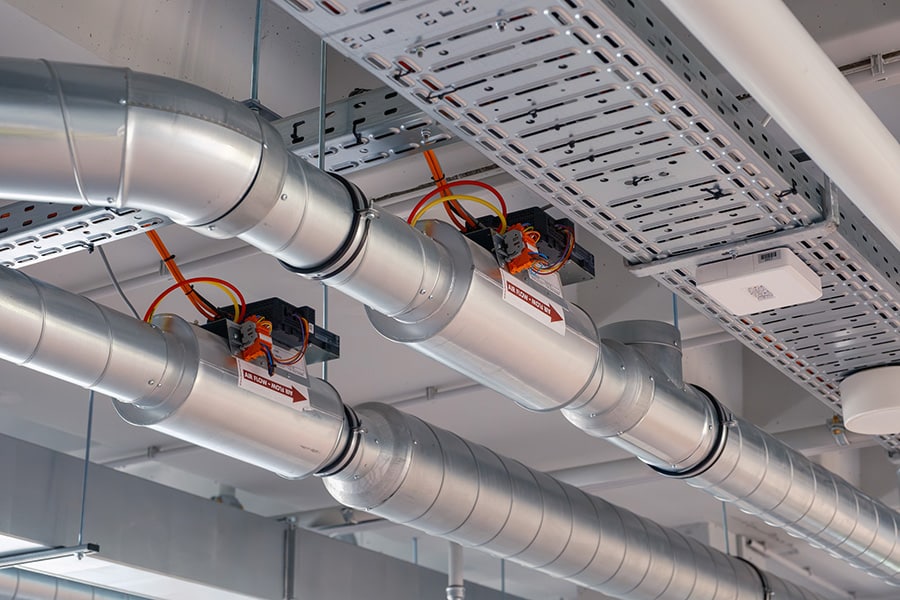
The air distribution equipment is adjusted so that the air is distributed in the rooms as well and as comfortably as possible and annoying drafts are avoided, Sneekes says. “Special in the ABN AMRO project is that pen tests were carried out in advance with our control equipment to demonstrate cyber security. But also that the building management system is linked via BACnet to the lighting system, which is equipped with sensors that signal presence and measure temperature and relative humidity. This creates a Smart Building in which the measurement data can be optimally utilized for energy-efficient building operation. Because the office is also equipped with extensive energy metering, connected to the BMS, the consumption is visible in real time. This enables continuous optimization of consumption and demonstrates that the building is actually Paris Proof.”
Following the offices, the ventilation in the three enclosed parking garages of the ABN AMRO project is also being addressed. For this, BBC partnered with HC PS, part of Swegon Netherlands. “The main purpose of parking garage ventilation is to effectively remove harmful smoke, toxic fumes and exhaust fumes that are released when cars are started and driven,” says project manager Gerwim Schreuders. “Based on the surface area and use of the parking garages, we determined the required ventilation capacities, expressed in m3/h, in accordance with the Bbl. In combination with gas detection sensors, the ventilation will operate demand-driven, adjusting the ventilation capacity based on the actual measured CO and LPG concentrations. Instead of continuously ventilating at maximum level, it is reduced to one-third of the established required ventilation capacity and switches on demand-controlled.” Thanks to an innovative use of intelligent components, the fans are controlled individually by the sensors, he says. “By intervening earlier than the standard indicates, we create an even safer environment. Moreover, this results in considerable energy savings for ABN AMRO. At the same time, it prevents the fans from running at high capacity unnecessarily or for long periods of time.”
“A total of 27 induction fans (thrust fans) are mounted on the parking garage ceilings, which ensure proper air mixing and prevent CO, NOx, particulate matter from accumulating in the ‘blind spots,’” Schreuders says. “These were specifically selected and sized based on the contents of the parking garages and the required static pressure in the shafts. Axial fans efficiently exhaust contaminated air and automatically rev up when concentrations are elevated.” Both fan types are linked to a central control system, which also integrates the gas detection system. “The use of intelligent components and unique software ensure and better climate in the parking garages and also save energy compared to a conventional system.”