










Future-proof homes with bespoke biobased walls
Text faay
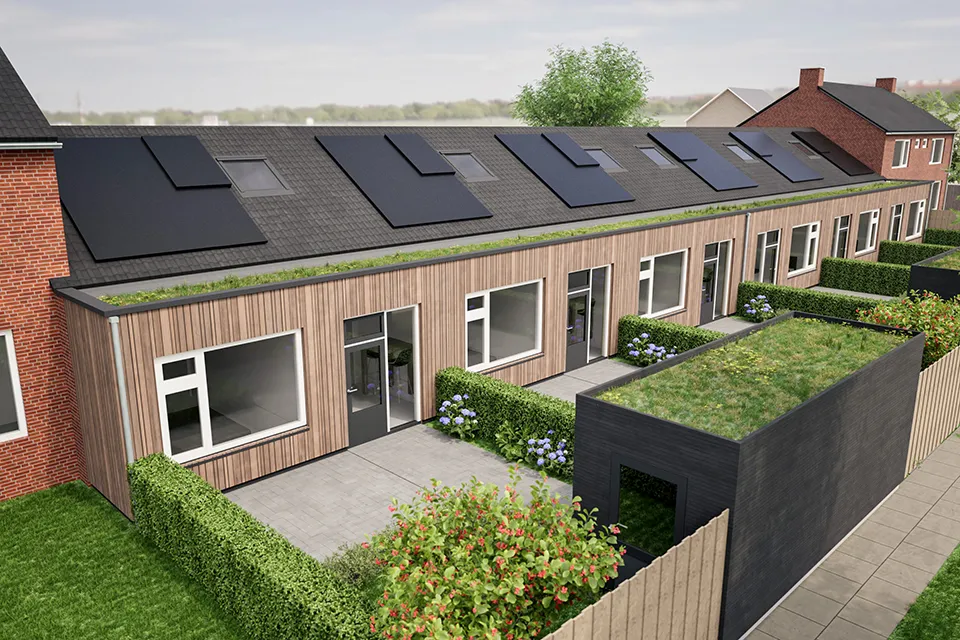
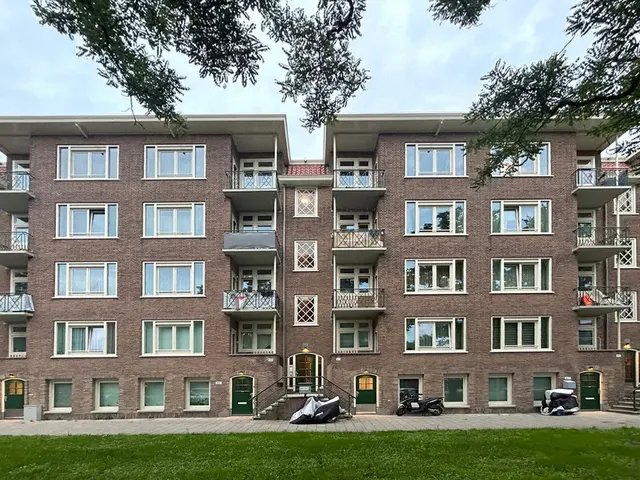
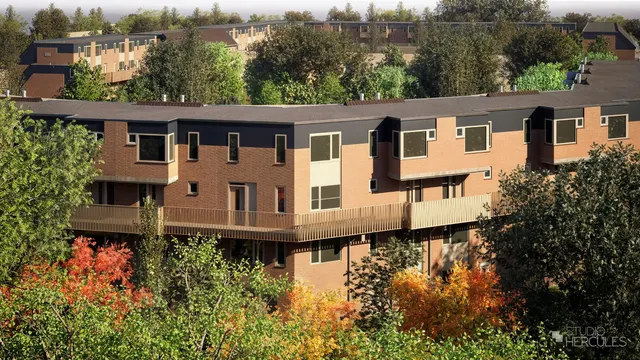
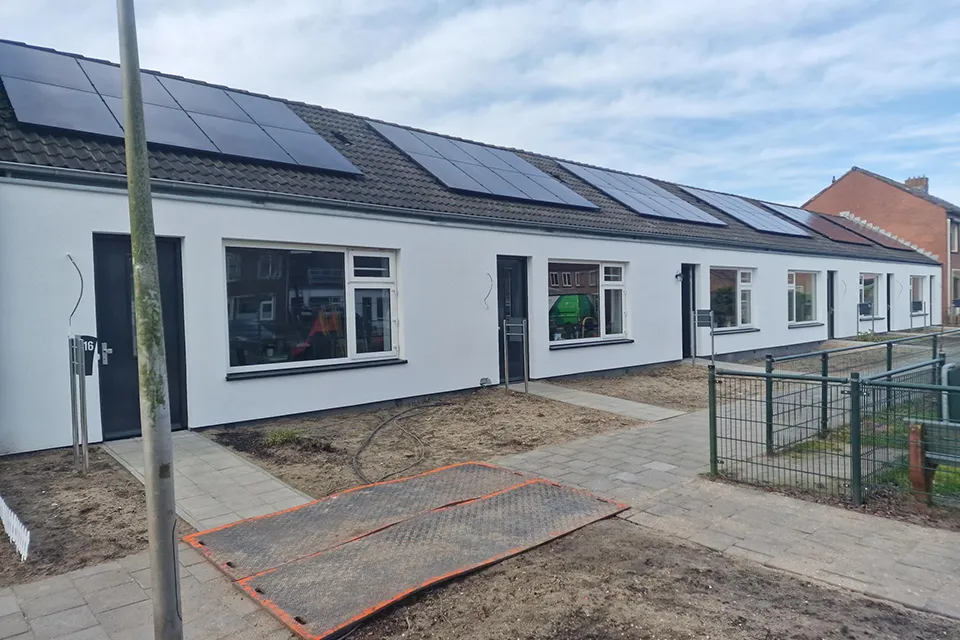
At Oranjeplein in Meerkerk, Fien Wonen managed a development of nine small homes, including homes for older people, each with a single storey and a pitched roof. In 2020, the housing association decided to review the development and assess its long-term suitability. Adding an extension at the rear would bring all the living functions onto the ground floor. This would create fully fledged, future-proof homes suitable for one- or two-person households, without demolishing the existing homes. To make the homes future-proof, Fien Wonen set high targets across four key areas: energy, circularity, emissions reduction and climate adaptation. The contract was awarded to Hagemans Vastgoedonderhoud, with the decision based on maximising the reuse of materials and using biobased materials.
Biobased and certified
“During the early planning stages, Faay quickly emerged as the preferred choice for the internal walls,” says Jay Kuppen, project manager at Hagemans. “We had Alba Concepts advising us on the sustainability of materials, and they recommended Faay. The product is biobased because it has a flax core. It is also a proven product in terms of quality, fire safety and ease of installation. All kinds of biobased products are coming onto the market at the moment, but many are not certified. Faay walls are. Almost all Faay walls have undergone extensive testing, including numerous fire and acoustic tests by organisations such as Efectis, LBP Sight, Nieman®, DPA, Equipe Adviseurs, SKH and SHR. The first home was completed as a trial and show home. For the next eight homes, Hagemans decided to talk to Faay about working together to find an efficient approach. This resulted in Faay-made-to-measure. “The walls were delivered cut to the required height and width, and numbered in installation order,” says Kuppen. The electrical boxes had also been pre-fitted in the factory in the correct positions. This made for a fast and efficient installation process, with no waste on site. Faay regional manager Johan van Bijsterveld says: “We make the elements to size in the factory. Any waste generated there can easily be reused. By the end of this year, we’re even aiming for zero-waste production. With our new machine, we’ll be able to produce continuous lengths and cut them straight to size.”
Only two elements per home still had to be cut to the correct width. “They meet a column that we installed in the opening in the rear façade. The exact position of the column can vary slightly, so it’s better to cut those elements to size on site,” says Kuppen.
Easy to handle
Hagemans used Faay VP54 for the internal walls. This 54 mm-thick wall element has a solid flax core with a plasterboard sheet on each side. The elements are 400 mm wide and around 2,800 mm high in this project. “That makes them easy to handle, both in terms of size and weight. They’re quick and easy to install. You position a bottom rail and a top rail, then slot the elements into place in the correct order using a tongue-and-groove joint. Finally, we filled the small gaps between the elements.”
Kuppen is more than satisfied with Faay, its wall system and how it is installed. This was the first time Hagemans had worked with Faay walls, so the extra support and guidance from Faay employee Erwin during the initial phase was very welcome. “We’ve had a very positive experience. It’s a system we’ll certainly use again.”
Circularity
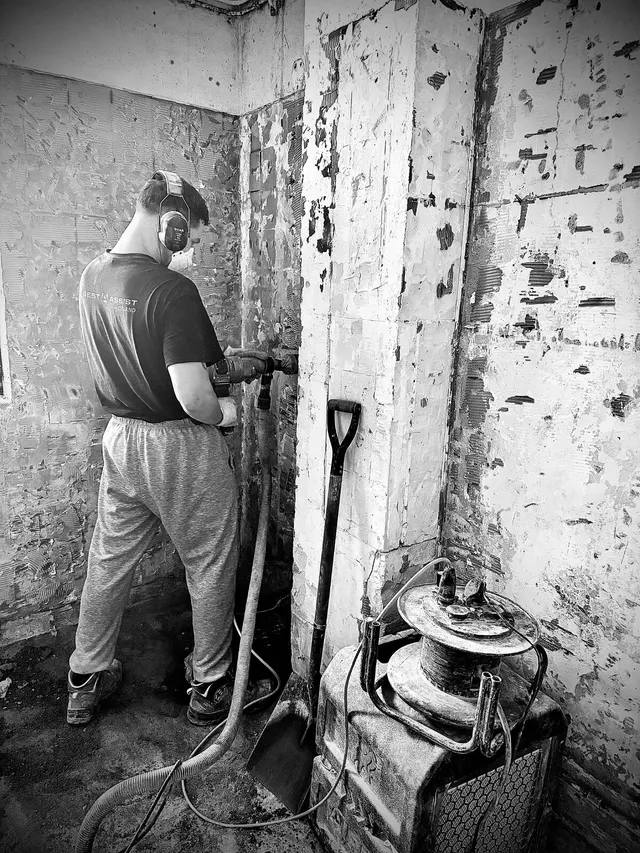
All the internal walls in this project were replaced with Faay’s biobased walls. With their favourable environmental score, the Faay flax walls were an excellent fit for the housing association’s ambitious brief. The old internal walls were removed in part because the entire ground floor had to be replaced. Kuppen says: “To make the homes accessible to people using a walking frame, we had to lower the existing timber floor by 30 centimetres. We reused the joists for the new floor, which is insulated with recycled PIR. We reused the floorboards that remained intact during demolition to fill in missing sections of the loft floor and at the eaves.” This all contributed to a strong circularity score, with a building circularity index of 57% for the materials brought into the project.
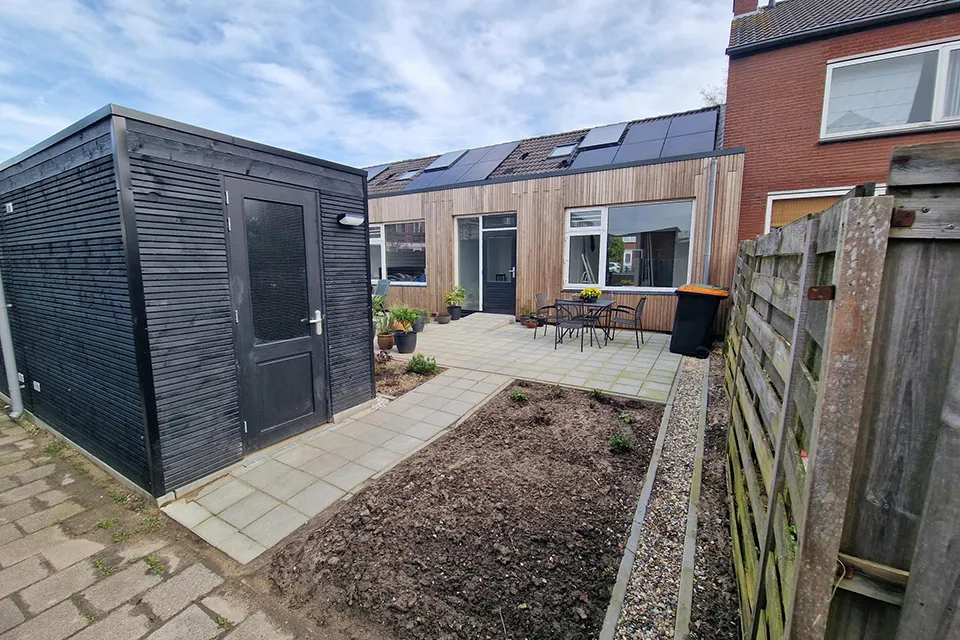
Hagemans built the new rear extension, measuring 2 metres deep and 6 metres wide, using timber-frame construction. The front façade was fitted with 220 mm of external wall insulation. The roof was insulated with flax from the inside, allowing the roof structure and tiles to remain intact. The homes have mechanical ventilation with heat recovery, a solar water heater, electric radiators and 13 PV panels. Following the work, the homes are more comfortable, gas-free and have an A++ energy rating. The first six homes are now occupied, while the last three are at the finishing stage.
A business enquiry for Faay Vianen B.V.? Get in touch
Companies in this story

Keep following this
Get an email when a new story is published. No account needed.
- SubjectRenovation & conversion
- CompanyFaay Vianen B.V.