‘Industry has to deliver’
As an advocate of performance-based construction, including NOM new build and renovation, the Stroomversnelling association is making an important contribution to the recently concluded agreement on NOM new build and renovation, which includes a so-called ‘renovation accelerator’ as a subsidy measure. “We said: don’t give that money to the party asking for it”, says chair Leen van Dijke. “Give it to the manufacturing industry so it can invest and innovate.”
Van Dijke, recently reappointed as chair for a three-year term, is no less enthusiastic after seven years with Stroomversnelling. “In 2019, we passed the milestone of 10,000 NOM renovation and new-build homes, and we have also demonstrated our value in developing quality standards. For example, together with Aedes and Bouwend Nederland, we developed a new contract model for housing associations, based on a standardised list of specifications with uniform, performance-based requirements.”
Stroomversnelling chair Leen van Dijke on a site visit. (Image: Contentpoint)
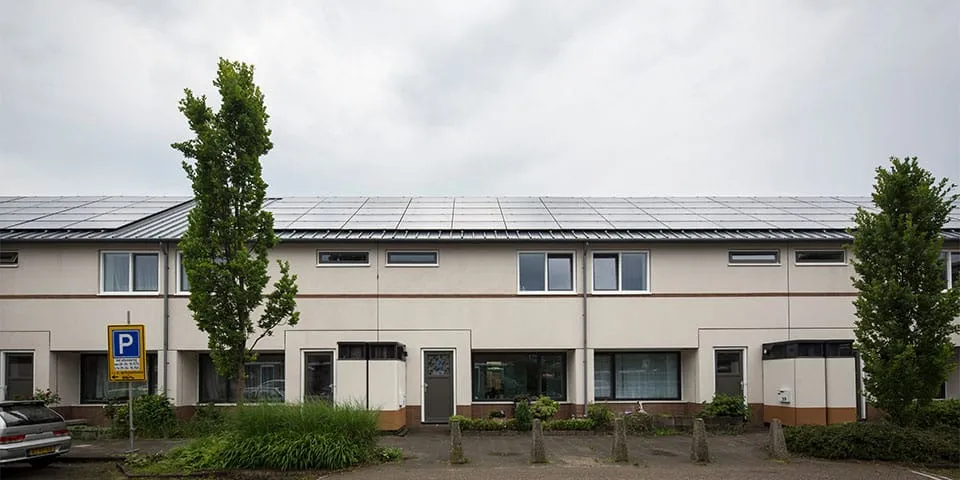
De Alliantie, which joined Stroomversnelling last year, devised its own lean concept for making homes more sustainable, also taking a process-based approach. NOM renovation and NOM new build using industrialised methods, activities that Stroomversnelling is committed to promoting as a non-profit organisation, are in step with recent social developments, says Van Dijke. “Robotic production reduces the number of working hours, both in the factory and on site. When it comes to emissions, it has a double benefit: off-site production means fewer transport movements, while NOM homes themselves reduce energy demand and consumption. NOM concepts are also demonstrably less vulnerable to price rises than traditional construction methods.”

Stroomversnelling needs housing associations to help pick up the pace, and is expanding its remit to include a neighbourhood-based approach, with a development forum focused on municipalities’ neighbourhood strategies. (Image: Frank Hanswijk)
‘Measures you won’t regret’
When bringing a home to Net Zero on a step-by-step basis, the aim is obviously not to make changes that later have to be undone in order to improve the home’s sustainability further. A quality mark that includes ‘measures you won’t regret’ could help, says Van Dijke. “The NOM Keur ‘step-by-step’ label is now being introduced, making it possible, for example, to achieve ‘Net Zero’ in stages under the quality mark. We should not fixate on a single method, but reducing demand is the starting point whatever the energy source. At the moment, people sometimes sit on the sofa with a blanket over their knees. Reducing heat demand should also increase comfort, with no increase in housing costs as the guiding principle. At our urging, the latter was included in the Climate Agreement, so that the energy transition is and remains accessible to private homeowners and owners’ associations, including those with fewer financial resources.”
Stroomversnelling needs housing associations to help pick up the pace, and is expanding its remit to include a neighbourhood-based approach, with a development forum focused on municipalities’ neighbourhood strategies. Van Dijke: “Municipalities face a lot of questions, such as ‘how do I get an entire neighbourhood off gas?’. We are keen to help with our development forum and the so-called ‘neighbourhood guide’. This includes questions such as ‘how do we deal with homes in mixed ownership?’. We are proud of what has been achieved. The rules of the game are still being fine-tuned, and our activities are expanding. Construction capacity also needs to increase. It is under pressure in part because countries such as Germany are making greater use of our construction industry’s expertise. But the core message remains: industry has to deliver.”
Question about this story? Ask your question
Keep following this
Get an email when a new story is published. No account needed.
- SubjectRenovation & conversion