The next step in circularity
Text Lieke van ZuilekomPhotography Kingspan Insulation
Sustainable processing of insulation waste on the construction site
Kingspan Insulation provides construction clients with high-performance rigid foam insulation and advice on its use, with a focus on a sustainable lifecycle, efficient use of materials, and reducing energy, CO2 and water consumption. All without compromising on unique properties and design. “As a manufacturer of high-performance insulation products, we feel responsible not only for the quality of our products, but also place great value on the sustainable and proper processing of the leftover material,” says David Braam, Business Development Manager at Kingspan Insulation. “With our Kingspan LIFECycle Service, we are actively addressing this. Together with various partners, we ensure that leftover material from our Kooltherm® and Therma™ insulation products does not end up in construction waste skips and ultimately in landfill. In this way, we are working together towards a sustainable world!”
The construction sector is responsible for around 30 per cent of all waste worldwide and is a major consumer of raw materials. “What is more, the built environment accounts for 39 per cent of our CO2 emissions. This means that construction has a considerable ecological footprint, which must be drastically reduced if our planet is to remain liveable in the future,” says Braam. “As a market leader, we are taking responsibility. In recent years, we have launched various initiatives to improve our products and processes, without losing sight of the current and highly important product criteria for building insulation and installation.”
Minimum material, maximum reuse
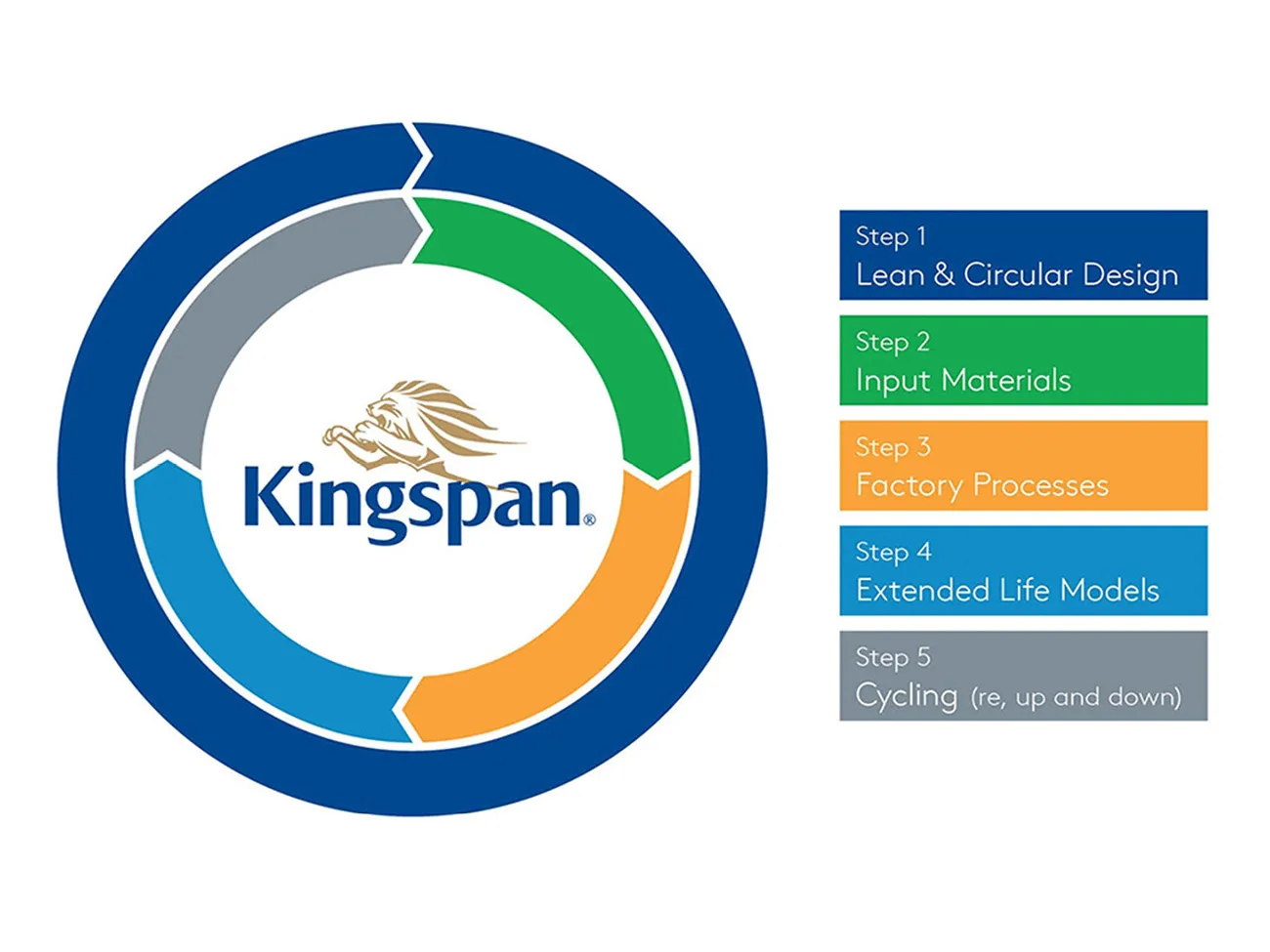
In 2020, the Kingspan Group launched its Planet Passionate sustainability programme, setting out ambitious targets for the next 10 years. Its focus is on circularity and reducing energy, CO2 and water consumption. A key principle is to keep products and raw materials in the loop for as long as possible. Kingspan Insulation’s research is based on the LIFECycle model, which considers every aspect of a product’s lifecycle. “We look beyond recycling, because it is by no means always the most sustainable solution,” Braam stresses. “It is much better to reduce or even prevent the use of raw materials. Since our insulation products are considerably thinner than the alternatives available, we have already taken a major first step towards sustainability.”
Towards waste-free construction
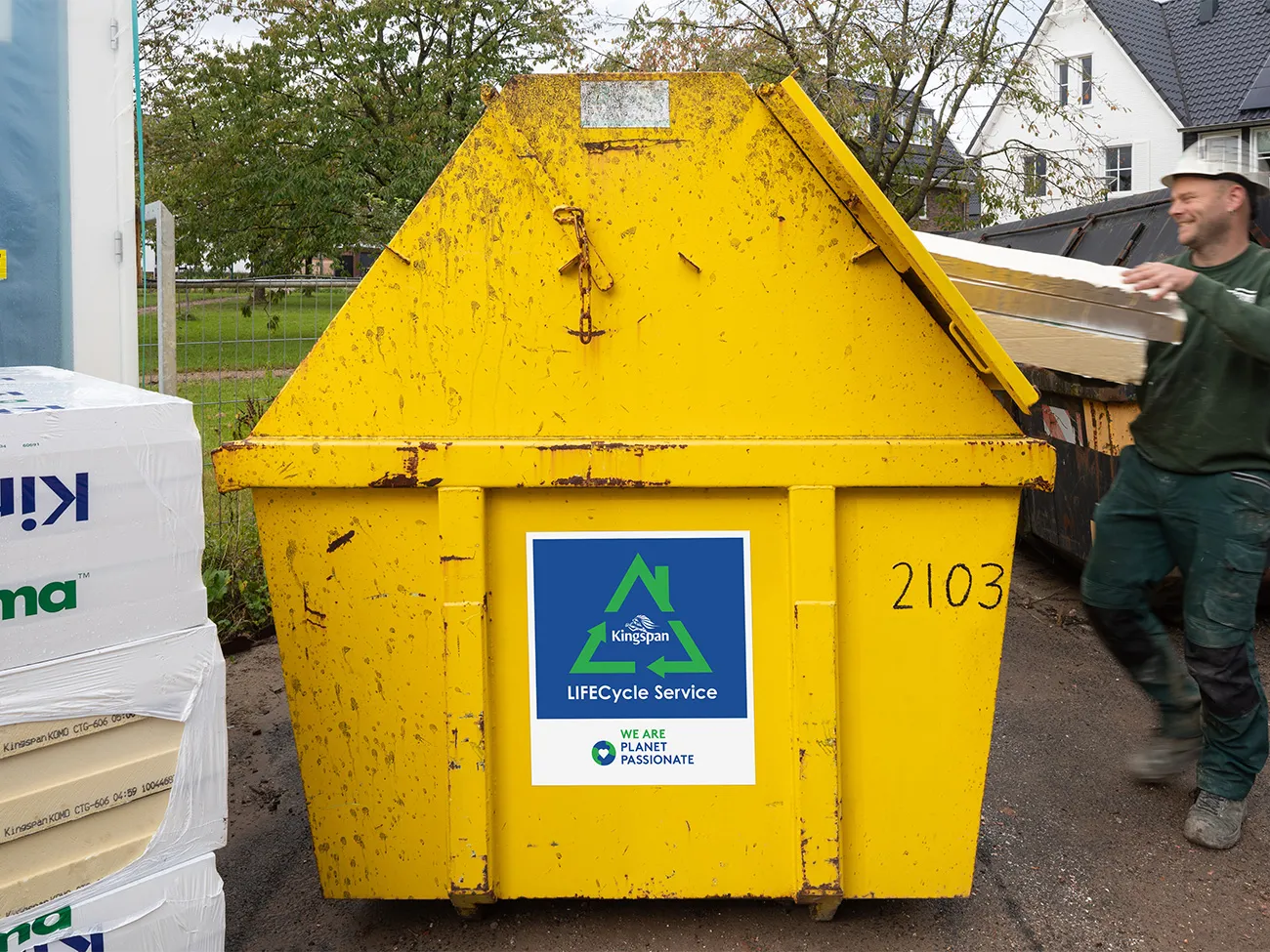
A second step is the Kingspan LIFECycle Service, for which Kingspan Insulation has partnered with Rondo Afvalbeheer. “Small and large contractors, roofers, prefabrication factories and other processors can collect unused Kooltherm® and Therma™ insulation boards, offcuts, EPS or Therma™ pallet strips, and plastic packaging materials in the designated big bags or 6 or 9 m3 containers,” says Braam. “This is how we are taking the first steps towards waste-free construction and more efficient use of raw materials, significantly reducing our environmental impact. We are also responding to an important trend in tenders, where sustainable initiatives are increasingly rewarded. Several leading construction companies, including BAM Bouw en Techniek and Nijhuis Bouw, have already embraced the Kingspan LIFECycle Service.”
Three processing streams
At present, Kooltherm® and Therma™ leftover materials are processed sustainably in three ways. “First, they are shredded and processed into new board materials,” says Braam. “Other leftover materials are also shredded and processed into floor insulation products. The residual materials that are unsuitable for these uses are used as fuel in the cement industry. As the residual products are burned under high pressure at around 200°C, no chemical gases are released. There is also hardly any ash left over.” By collecting insulation waste separately, Kingspan Insulation encourages sustainable reuse. “What is more, our service is on average 20% cheaper than a construction or demolition waste container! We combine convenience, a tidy construction site and lower costs for our processors, while also contributing to a sustainable and cleaner world.”
Closing the loop
With the LIFECycle Service, Kingspan Insulation aims to get a stream of material flowing. “We are also using this phase to map the quantity and quality of the leftover materials,” says Braam. “In 2023, a recycling machine of our own will be brought into operation at our factory in Winterswijk. From then on, we aim to use the residual streams in our own production process to manufacture new insulation products. That will close the sustainable loop.”
In the future, Kingspan Insulation may also take back insulation boards removed during conversions or when a building reaches the end of its life. Open collaboration and information-sharing across the chain are essential for this, according to Braam. “A circular economy is not something a manufacturer or supplier can create alone. For example, buildings need to be designed for disassembly so that insulation boards can be removed and retain a high residual value. Clear agreements also need to be made on separating and collecting the products. We would be happy to contribute our ideas. We welcome discussions with the market to develop possible solutions.”
Have a business enquiry for Kingspan Light + Air? Get in touch
Companies in this story
Keep following this
Get an email when a new story is published. No account needed.
- SubjectYearbook
- CompanyKingspan Light + Air