










A16 extension | 10,000 piles beneath the tunnel
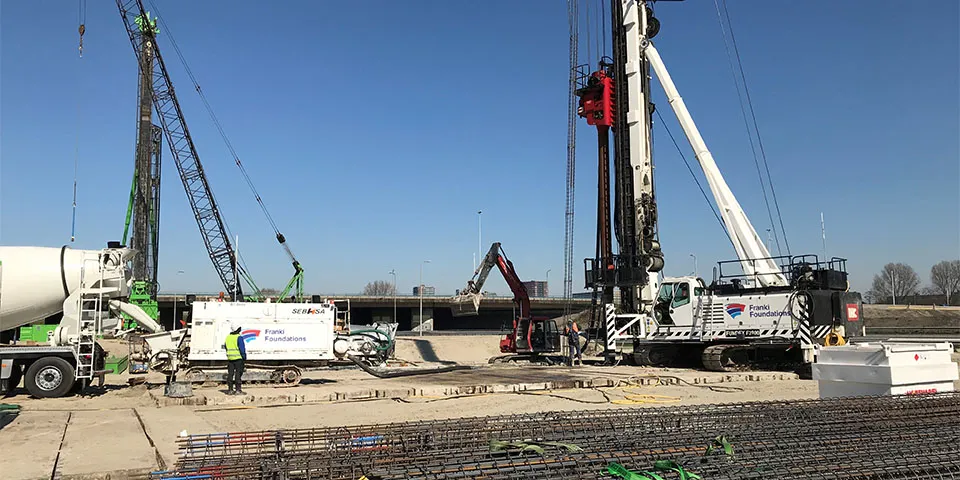
Building with trusted partners works well. Franki Grondtechnieken and Voorbij Funderingstechniek have been active on the Theemwegtracé in the Port of Rotterdam for some time. The two companies are once again working together on a major infrastructure project, this time to the north of Rotterdam. Funderingscombinatie FCVF is providing the foundations for the motorway linking the A16 with the A13 on behalf of the De Groene Boog consortium.
‘Major projects are built on collaboration’
Jan-Wim Verhoeff, Managing Director of Franki Grondtechnieken: “The collaboration on the Theemstracé is going very well. Since our parent companies Besix and TBI/Mobilis are also part of the construction consortium for A16 Rotterdam, continuing our collaboration was the obvious choice. Both projects are so vast that they require such a large commitment of people and equipment that collaboration is essential. We complement each other well: Franki specialises in vibration-free drilling, while Voorbij is strong in sheet piling.” Total number of piles: 12,500; total weight of sheet piles: 20,000 tonnes.
16 rigs
The new A16 route includes 25 temporary and 35 permanent structures, including the sunken tunnel section, which is more than 2 kilometres long. Verhoeff: “At peak times, 16 rigs will be operating in the tunnel. Franki and Voorbij are supplying some of them, and if necessary we will source additional rigs from the market. That way, we don’t let down clients on our other projects. We are currently working on the abutments for the flyover at Terbregseplein and preparing the tunnel section, where sheet piles are being installed.”
Noise
To minimise disruption to people and nature, the work is generally carried out using vibration-free, low-noise techniques such as soil-displacement screw piles, with or without a precast element. Sheet piles are pressed into the ground wherever possible. This minimises the impact on the surrounding area and on nature.
More than 10,000 piles
The largest volume of work will be beneath the tunnel section. Verhoeff: “More than 10,000 piles, each 25 to 30 metres long, are needed for the tunnel section, which is more than 2 kilometres long and partly sunken. We use combination piles, first drilling a tube, for example 25 metres deep, into which a 20-metre precast element is placed. Once the tube has been withdrawn, you can easily excavate 5 metres to create a construction pit. The first open sections of the tunnel will have the same foundations. The piles also serve to resist uplift. The ground here is so boggy, it feels as though you’re walking on water. As a result, the enclosed tunnel section would tend to float.”
High-speed line
Another challenge lies further along, where A16 Rotterdam has to cross the high-speed line. This railway is founded on a sand layer 25 metres below ground. Verhoeff: “We are not allowed to use that layer for the overpass, because doing so could affect the stability of the rail tunnel. That’s why we will drive 60-metre piles through the first layer to reach the next sand layer. Safety first.”
The foundation consortium will be working for De Groene Boog until the middle of next year. Verhoeff: “We have a very tight schedule. By working closely with De Groene Boog, we are doing everything we can to stick to the project schedule and deliver a good project together. That is where our strength lies!”
Question about this story? Ask your question
Keep following this
Get an email when a new story is published. No account needed.
- SubjectGeneral