










Fall prevention at home is becoming increasingly urgent: who will make safe housing affordable for financially vulnerable older people?
Since a change in the law in 2015, more and more older people have been living independently, including at an advanced age. While this supports independence and quality of life, it also brings a new reality: independent living requires a home environment that is safely adapted to physical limitations. And this is where tensions are growing.
More older people are living independently, but that does not automatically mean they are safe
The rise in the number of older people living independently is clear. More people aged 85 and over are also continuing to live at home. At the same time, their care needs and level of independence have not changed significantly. This leads to an important conclusion: living independently is not the same as living safely. The home itself plays a crucial role. Without adaptations, the home can become a place where risks accumulate (RIVM, 2026).
Limitations are increasing, and do not affect everyone equally
Limitations are not exceptional, but an increasingly common part of ageing. What stands out is that these limitations are unevenly distributed across society.
Financial vulnerability increases the risk
Research shows that limitations are more common among older people:
- with lower levels of education (such as primary education, pre-vocational secondary education and level 1 vocational education)
- who struggle to make ends meet
This makes the issue about more than health alone. It is also about access to the resources and opportunities needed to adapt the home environment (RIVM, 2025).
Age and gender play a clear role in mobility limitations
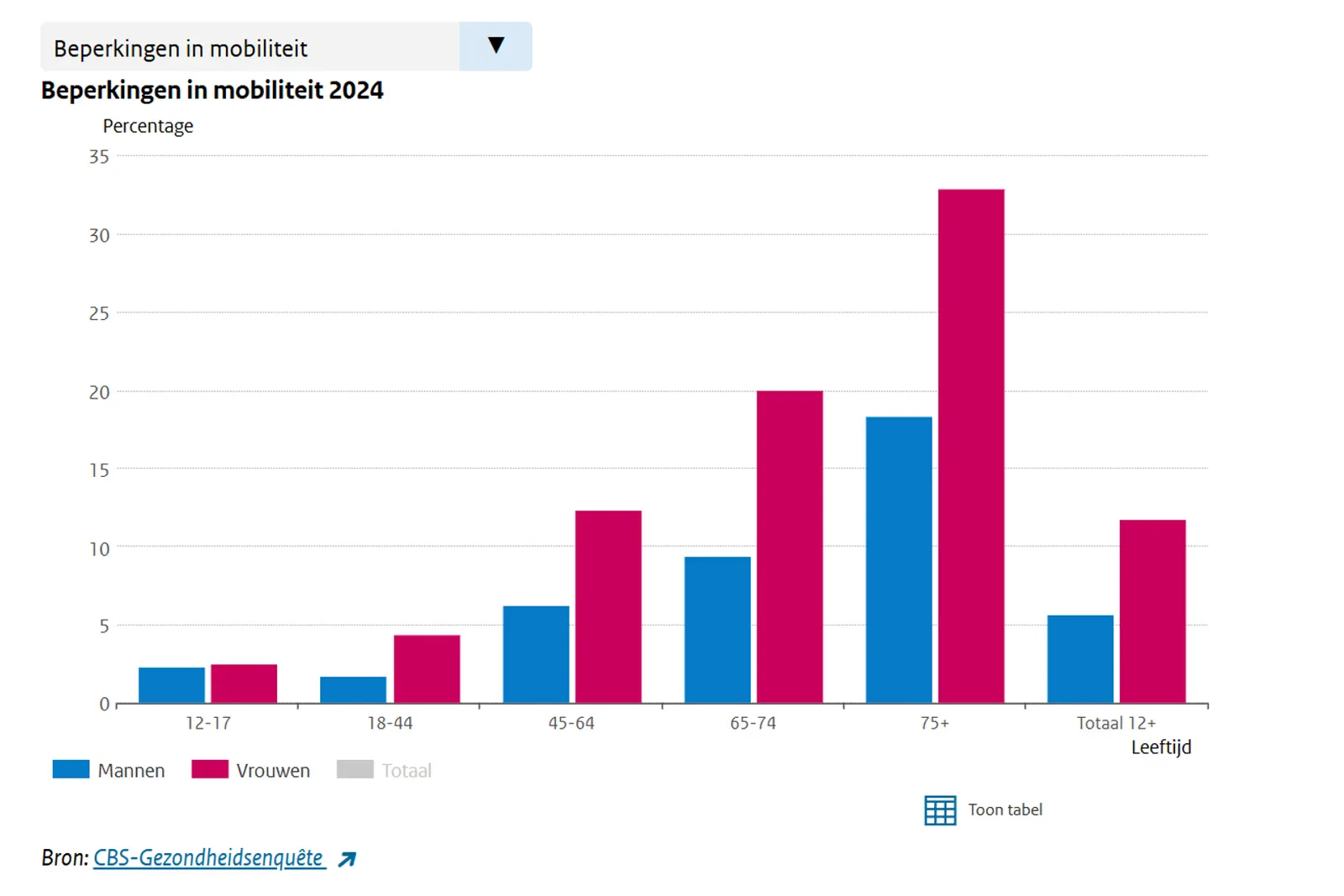
Another study also shows clear differences in mobility limitations by age and gender:
- Nearly one-third of women aged over 75 have a mobility limitation
- Limitations increase sharply with age
- Across the population as a whole, 8.8% experience one or more mobility limitations
These figures show that the risk of limitations is not random, but to some extent predictable (Volksgezondheid en Zorg, 2025).
The risk lies in the home environment
Although many older people continue living at home for longer, research emphasises the importance of actively assessing the safety of their home environment. In practical terms, this means looking not only at care, but also at the home itself. Home adaptations, such as improving accessibility, can have a direct impact on preventing falls (RIVM, 2026).
The gap: who pays for a safe home?
This is where a clear tension arises. On the one hand, there is a group of older people at increased risk of mobility problems. On the other, this group often has less financial capacity to adapt their homes. This raises a fundamental question: to what extent can individuals be expected to invest in home adaptations when the risks are linked to factors such as income and health? The issue of fall prevention and home adaptations affects several parties.
Municipalities and support
Municipal schemes can provide support for home adaptations. At the same time, this support depends on individual circumstances and the resources available.
Housing associations: a growing challenge
A large proportion of older people live independently. At the same time, research shows that mobility limitations are more common among financially vulnerable groups (RIVM, 2025). This makes the role of housing associations more relevant than ever. To what extent do the management and development of homes systematically take account of residents who develop mobility limitations?
Homeowners themselves
Although personal responsibility plays a role, it is not always feasible in practice. Particularly when financial resources are limited, investing in home adaptations becomes a challenge. Meanwhile, pressure on care services is growing, partly because of staff shortages. This makes it increasingly important for people to be able to live safely at home for longer, not only for the residents themselves, but also as a way to reduce the strain on care services.
Solutions
Although the problem is complex, there are certainly ways to explore solutions.
1. Assessing the home environment in good time
An important first step is to actively assess safety in the home. Not only after an incident, but proactively (RIVM, 2026).
2. Targeted investment in home adaptations
Home adaptations can make the difference between risk and safety. This includes solutions that improve accessibility and make the home easier to use. In homes with multiple floors, for example, this could mean looking at ways to move safely between floors, such as installing a stairlift or home lift.
3. Understanding financial schemes and support
Not every resident is aware of the financial support available. By looking into the schemes on offer, people may find that support for home adaptations is available in some cases. For example, find out which grants are available for home adaptations and lifts.
Fall prevention starts not with care, but with housing design
The discussion about fall prevention often focuses on care and treatment. But the figures show that a significant part of the risk already arises in the home environment itself. As long as home adaptations depend on individual financial means, fall prevention will remain unequal. And the central question will remain: who will ensure that safe housing is not a privilege, but a basic requirement for everyone?
Aesy Liften
As a specialist in home lift solutions, Aesy Liften sees every day how mobility limitations affect older people’s daily lives. What stands out is that those most in need of home adaptations do not always have the means to make them. Drawing on this practical experience, Aesy Liften wants to bring this issue to the attention of homeowners, as well as policymakers and housing associations. Safe housing should not be a privilege, but a basic requirement.
Sources
- Rijksinstituut voor Volksgezondheid en Milieu. (2026, 22 January). Monitor ouderenzorg: Beweging in de samenleving (web summary). https://www.rivm.nl/publicaties/monitor-ouderenzorg
- Rijksinstituut voor Volksgezondheid en Milieu. (2025, 1 October). Beperkingen en valongevallen bij ouderen: Gezondheidsmonitor volwassenen en ouderen 2024. https://www.rivm.nl/sites/default/files/2025-09/016454-Beperkingen-en-valongevallen-bij-ouderen-DT.pdf
- Volksgezondheid en Zorg. (2025, 18 December). Beperkingen naar leeftijd en geslacht. https://www.vzinfo.nl/beperkingen-horen-zien-mobiliteit-adl/leeftijd-en-geslacht
Question about this story? Ask your question
Companies in this story

Keep following this
Get an email when a new story is published. No account needed.
- SubjectGeneral
- CompanyAesy Liften b.v.