










Fine-tuning the circular, modular construction supply chain
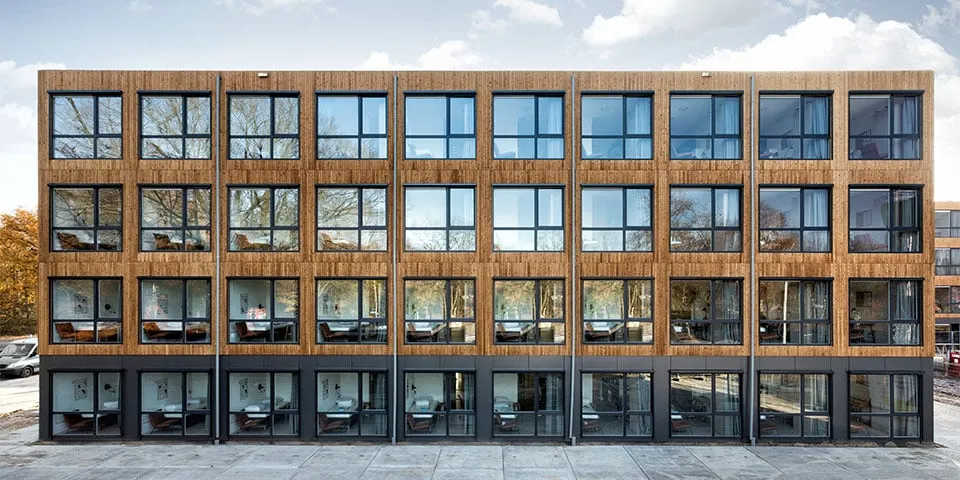
As a market leader in modular construction, Jan Snel is at the heart of international developments. Demand is growing worldwide for flexible, sustainable solutions to accommodation challenges. The rise of circular real estate offers major opportunities, given that modular units can largely be reused. “95% of construction materials are reused. The greatest gains lie in making our production chain more sustainable,” says circularity project manager Daan Kosterman.
From hundreds of stacked student homes in Dutch university cities to modular projects in the United States, where the units are shipped as semi-finished products, Jan Snel is further strengthening its position as a manufacturer and contractor. This dual role in a growing niche offers opportunities, as innovative manufacturers are the future. With a product that incorporates many circular features, Jan Snel adds value. Kosterman: “Some modular units have, for example, been in use for as long as forty years, serving various purposes, from school or office to residential unit. And the same applies to these units: only a tiny proportion of the materials is eventually discarded. Modular construction has, of course, developed enormously, including in terms of sustainability requirements. That is why we began examining all the possibilities for making our supply chain more sustainable.”
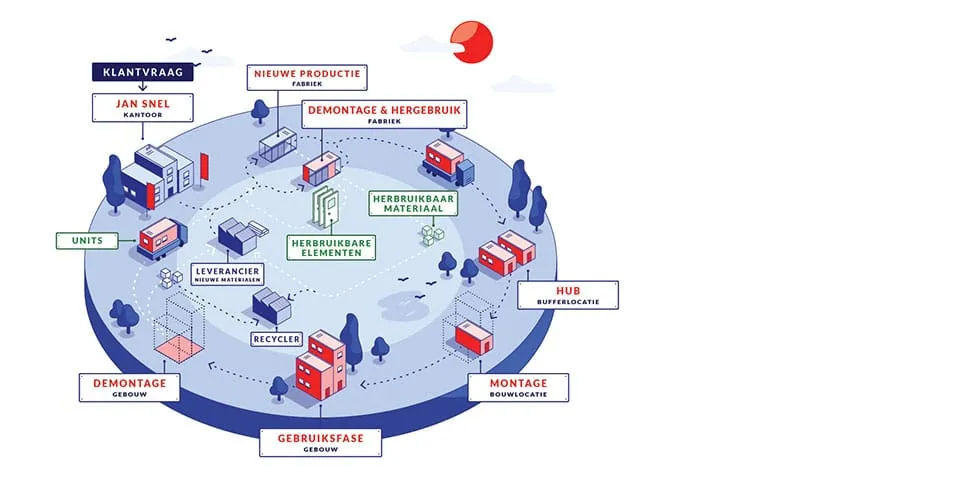
The production chain was reviewed using the Ecochain software programme.
Recycled steel
When can you call construction circular if your product is already reused to a large extent? Kosterman: “Using the EcoChain software programme, we reviewed total annual production in terms of CO2 emissions. Producing 1 unit has an impact of 3 tonnes of CO2. Half of that is attributable to the steel used, and the other half to the walls, window frames and floors.” It makes sense, then, that the greatest sustainability gains can be sought in the steel production chain. “We are talking to the manufacturer about the percentage of recycled steel used in production, and it turns out that there is still plenty of scope for improvement, even when the unit is reused, including in the way it is recorded. For example, if it turns out that the steel purchased contains more recycled material than stated, this needs to be recorded more accurately. That is how we make further progress.”
STIP certification
The same applies to waste processing. “Every month, 80 cubic metres of polystyrene foam are returned to the factory. We are trying to gain insight into what is happening throughout our entire production chain.” Kosterman acknowledges that more work is needed in the production of façade panels that use PIR. “We are looking for a more sustainable alternative, and we are also developing timber structural frames. Timber is currently a good option, particularly for low-rise buildings, but achieving the 120-minute structural fire resistance required for multi-storey construction takes time. We expect to obtain STIP certification from May, based on a fully sustainable production chain. Starting from units that are already largely reused, you cannot get much more sustainable than that, we are looking for further gains in the supply chain.”
Question about this story? Ask your question
Keep following this
Get an email when a new story is published. No account needed.
- SubjectGeneral