









Keeping a close eye on construction of the NACH excavation pit
Text Tjerk van DuinenPhotography CRUX Engineering
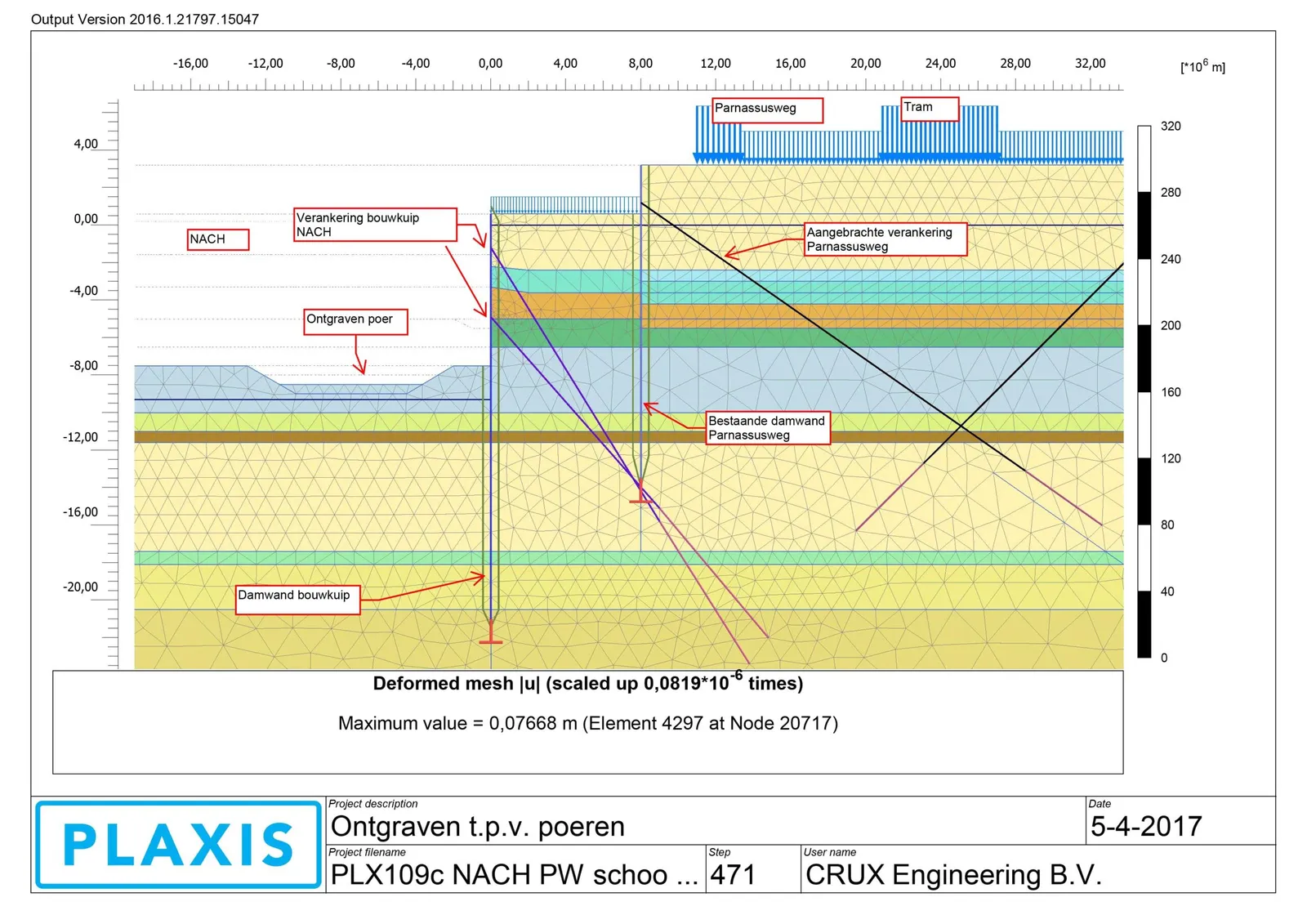
A 9-metre-deep excavation pit was constructed in 2017 for the two-storey basement of the new NACH courthouse on Parnassusweg.
Because the construction site is in a densely built-up and vulnerable urban area, a comprehensive risk analysis of the effects on the surrounding area was essential. The excavation pit is bordered to the south by the A10 and the future Zuidas DOK construction site, while Parnassusweg runs along its eastern side, with a tram line that emerges from an underpass beneath the A10. The temporary courthouse is to the north. Parnassusweg in particular is also full of cables and large-diameter gas and water pipes. There were more than enough reasons to carry out a comprehensive risk analysis in advance and monitor construction of the two-storey excavation pit.
For this task, Bouwbedrijf De Nijs, the contractor that built the excavation pit, approached CRUX Engineering, a leading consultancy with extensive experience in geotechnical engineering, hydrogeology and managing the effects of construction on the surrounding area in complex urban environments. Guido Meinhardt, Senior Specialist/Partner at CRUX: “When factors relating to the surrounding area play a major role, as they did at NACH, we can carry out a comprehensive risk analysis. We also ensure that monitoring takes place at the right time and in the right locations. Done properly, this means deep excavations and foundations can be built in a controlled way in almost any environment, without damaging neighbouring properties.”
Sonic vibration
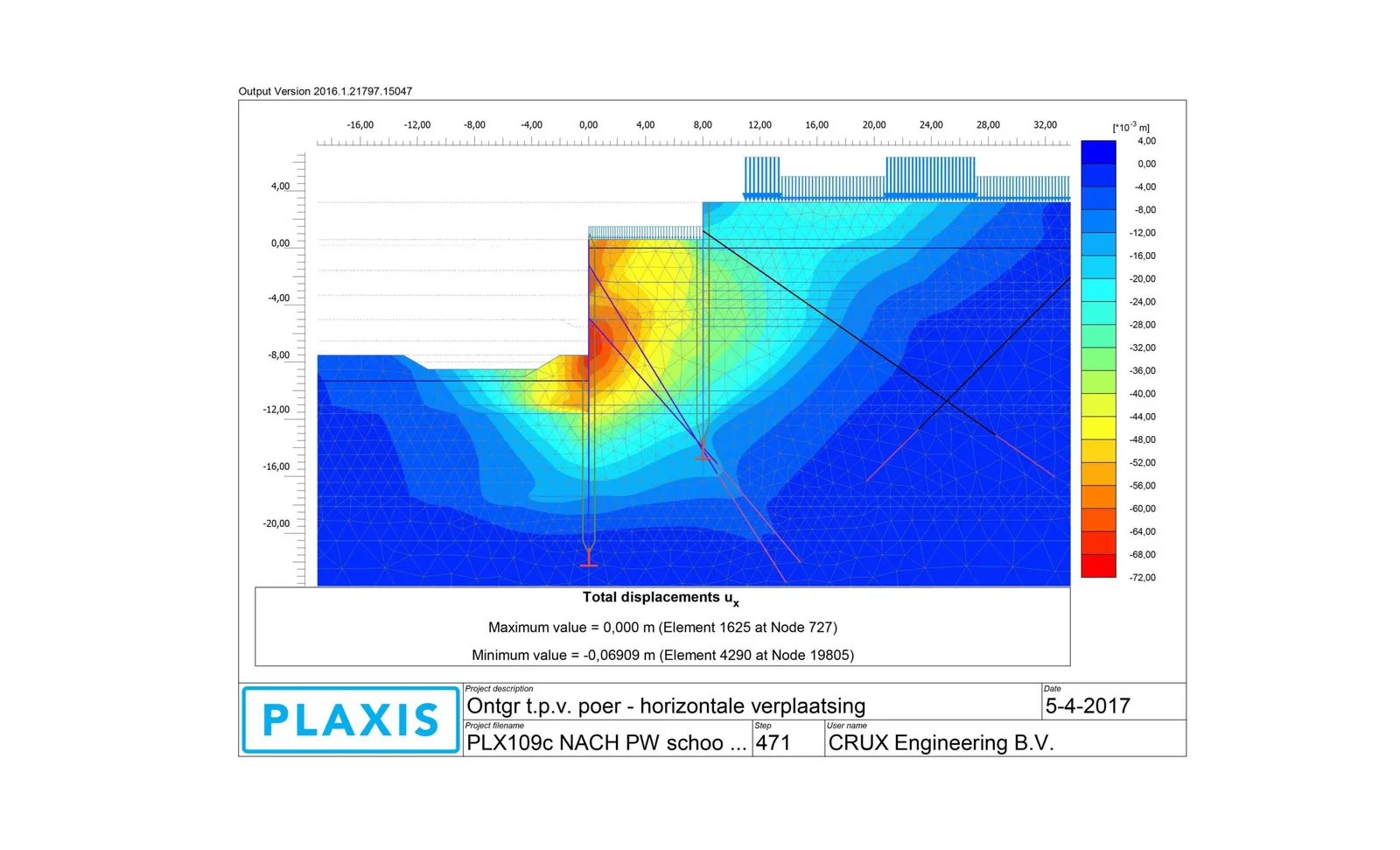
The 9-metre-deep excavation pit was designed with sheet piles, stabilised by prestressed anchors around its perimeter. One important requirement set by the municipality was that no (metal) anchors could be left in the ground. Meinhardt: “Struts were not an option: the excavation pit was too large, and they could significantly hinder the concrete work. We therefore designed an excavation pit with grout anchors. When the anchors are extracted, sonic vibration breaks up the grout body, allowing the entire tube, including the drill bit, to be removed. This prevents future projects, such as foundations and excavation pits, from encountering obstructions.” The anchors were prestressed to prevent strain and, consequently, deformation in the soil behind the wall. They were also hollow, with the grout flushed out, so that grout could be applied during extraction by sonic vibration and settlement caused by volume loss could be limited.
‘We ensure that monitoring takes place at the right time and in the right locations’
Plaxis
When a large excavation pit is built in a sensitive area, monitoring the excavation walls, neighbouring buildings, surrounding infrastructure, and cables and pipes plays a major role. Jefta Bouma, Senior Geotechnical Adviser at CRUX: “The design parameters were clear, but there is always a small chance of deviations. Using the Plaxis design software, we calculated the allowable vertical and horizontal deformations and translated them into a monitoring plan. We fitted the sheet piles with inclinometers to track horizontal deformations. Along the A10, survey markers were installed on the embankment. Only if the readings there exceeded safe limits would we take measurements on the carriageway, which would have to be closed for that purpose. Fortunately, that was not necessary.”
Being able to respond quickly
Proactive monitoring was therefore used for every relevant element in the area around the excavation pit. Meinhardt: “This also applies to the cables and pipes. We draw up risk profiles with their operators, determine what is acceptable and propose taking them temporarily out of service where necessary. By taking this approach to the surrounding area and then monitoring it, you set measurable ground rules for the construction work in advance. If things do not go as calculated, you can respond quickly because you have already identified the possible measures to take in the event of different types of exceedance.”
Question about this story? Ask your question
Who worked on NACH
- Builder of the stadium bowlBouwbedrijf De NijsIn this story
- consultancyCRUX EngineeringIn this story
- sand and cement screedsVloerenbedrijf van den HeuvelMentioned in A major job, no problem. More than four hectares of sand-cement screed
Keep following this
Bij een nieuw verhaal krijg je een e-mail. Geen account nodig.
- ProjectNACH
- SubjectGeneral
- CompanyBouwbedrijf De Nijs
- CompanyCRUX Engineering