Interview with Onno Dwars for Velox magazine
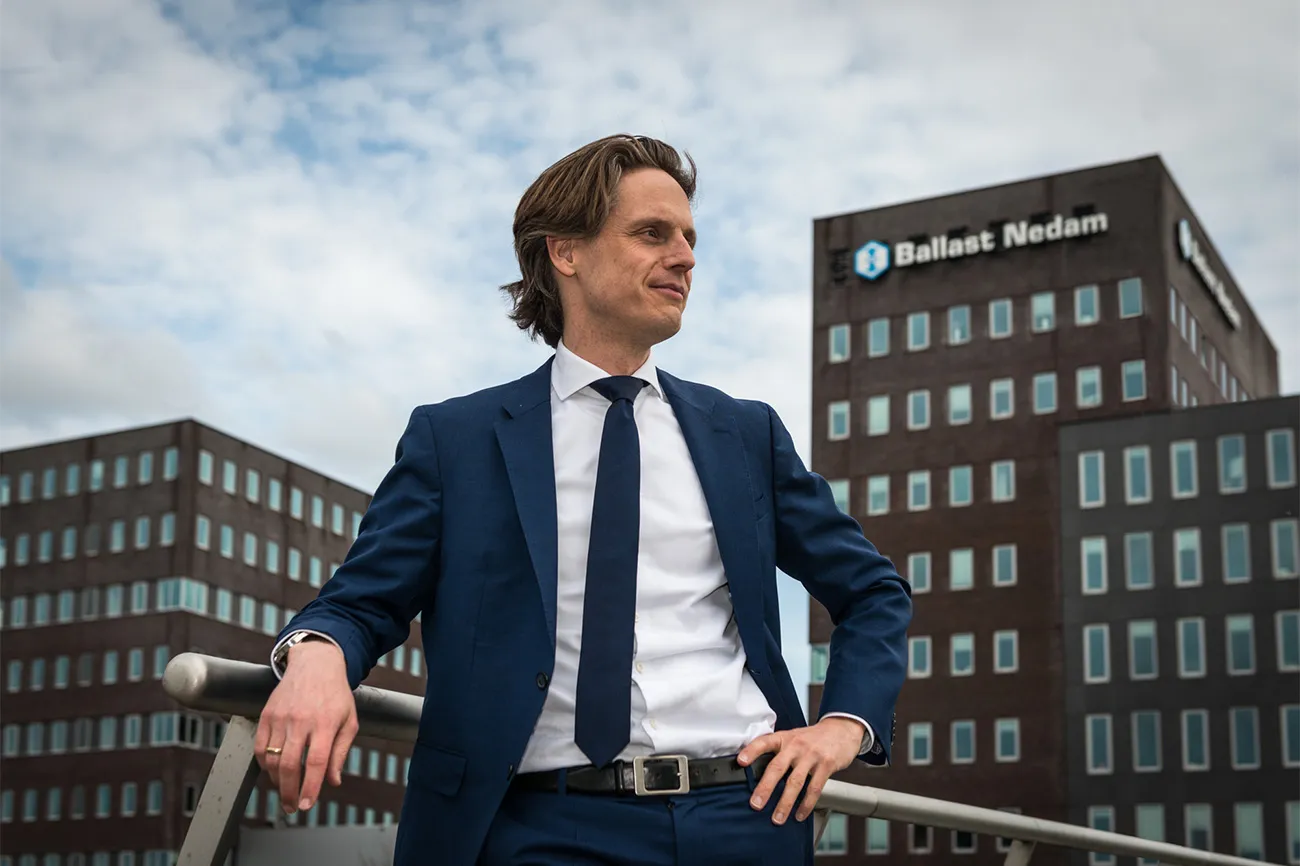
Onno Dwars (1980) is CEO of Ballast Nedam Development, the area developer of Ballast Nedam. Velox talks to him about the leading role he is playing in accelerating the energy transition. “Our motto is that we can bring back the Ice Age.”
How optimistic are you about the state of the energy transition?
“I’m optimistic, because I have to be. The transition isn’t happening fast enough, and the climate is changing faster than we thought. But the prospect ahead is so promising that I hope once we see the light, things will move very quickly.”
What needs to happen to genuinely accelerate the transition?
“Binding regulations will get everyone into action. I believe the government should set much stricter rules and take much greater account of the total CO2 budget available to us. The small steps the government is taking now are too slow, so the remaining CO2 budget is being used up very quickly. The government could therefore do much more to manage the CO2 budget. Business leaders are already showing that it can be done.”
Can you give an example of something that has been possible for a long time?
“When I became director of Ballast Nedam Development in 2017, I immediately said: ‘We will no longer take on any projects that use gas.’ That ultimately gave the government a way to say: we’ll include it in the coalition agreement. It became law in 2018. Property companies complained for another three months, and then that was it. Everyone found a solution. It really is that easy, I dare say.”
Could it also be that construction companies are simply unwilling?
“No, that has nothing to do with this transition. If a client wants something, construction companies will simply build it. But clients won’t commission different work until the laws change. That’s why I believe so strongly in laws. They have nothing to do with dictatorship, but with collectively safeguarding shared interests. It is in all our interests that temperatures don’t exceed 40 degrees this summer and that biodiversity is maintained. And it is in all our interests to reduce CO2 emissions. So we need to make collective agreements to create a level playing field. It’s really not rocket science .”
Is it necessary to create an ecosystem in which knowledge is shared?
“Yes, that’s very important. Our government, and I emphasise ‘our’ because the government serves the interests of us all, lacks the knowledge and expertise to understand exactly what’s happening in the market. That means the market has a responsibility to share its knowledge and expertise with the government. I don’t see that as lobbying, but as fulfilling a civic duty. When we went gas-free, I contacted the House of Representatives about it. And recently I met with Minister Hugo de Jonge to explain what we already routinely do in terms of nature-inclusive design. Shortly afterwards, news emerged that the Building Decree would be amended to require a basic level of nature in the living environment. I see a lot of our own approach reflected in this initiative.”
How innovative is Ballast Nedam Development?
“We constantly run pilots on our own projects, without anyone asking us to. For example, we launched a competition to design the climate-positive, biobased Ballast Nedam Development Natuurhuis. The homes will soon be built from straw. We are also working with the university on research into the effect of green roofs on the energy generation of solar panels. And in Utrecht, we have launched a bidirectional car charging system with Hyundai and We Drive Solar. In the end, 40 cars will be based there, storing energy and supplying it to the built environment. We do these things simply because we see the opportunities. We also employ someone to explore exciting new developments and assess their costs and returns, both in terms of marketing value and future value. Then we simply give them a try. We’re constantly looking at how we can reduce the environmental impact of our buildings, preparing for the future so that we’re ready for it. Take our Horizons project: a building that is CO2-negative by 3,600 tonnes of CO2. Compared with the CO2 offsetting value of Shell, that building has a social value of more than €1 million. By quantifying the value of buildings in this way, you can approach the discussion differently.”
So buildings really can play a positive role in the transition
“Absolutely. Our motto is that we can bring back the Ice Age. It sounds very presumptuous, but it’s true. With our buildings, we can ultimately create an environment that is CO2-negative rather than CO2-neutral. We can generate more energy across the built environment than it uses, allowing the rest to become sustainable more quickly. In this way, we all create social value that is still not sufficiently recognised in the world today.”
Don’t projects like these cost a lot more?
“They cost us more, but their social value is also much greater, so when considered as a whole, they are actually cheaper. We still need to do a better job of organising the integrated business case and the incentives. That’s also why we’re so involved in the CO2 budget: to encourage a different approach to carbon pricing.”
Does the construction sector need to become less hierarchical to speed up the transition, as Jan Rotmans says?
“Maybe I’m too much a part of the system, but I don’t see that as the biggest obstacle. We can accelerate this transition by putting the right incentives and legislation in place. Our ability to go gas-free was linked to the extensive lobbying for different valuation methods by the investment sector. A whole financial system has been built around this, creating different incentives that reward sustainability. That’s why I’m so keen to see carbon pricing introduced. It would create huge incentives within the system to do things differently. I’ll leave it to Jan Rotmans to decide whether construction companies need to become less hierarchical to make that happen.”
What does the labour market shortage mean for accelerating the energy transition?
“The shortage is a major problem. The entire built environment needs to be transformed to achieve the huge reductions in energy use required. And our new-build target has never been higher. As well as building in a climate-resilient way, we also need to adapt the infrastructure: the streets and sewer systems. We want to maintain the high standard of wellbeing we have created in the Netherlands, even as the climate changes. The task is immense. So yes, the labour market shortage is a major threat to the transition. But in the end, we always find solutions to challenges. It helps to remain ambitious and hopeful. If the frontrunners lose heart, we’re doomed.”
This article first appeared in Velox Magazine
A business enquiry for Velox? Get in touch
Companies in this story
Keep following this
Get an email when a new story is published. No account needed.
- SubjectGeneral
- CompanyJP van Eesteren
- CompanyVelox