‘The 22nd century begins today’
Text Jan-Kees VerschuurePhotography Arenda Oomen Fotografie
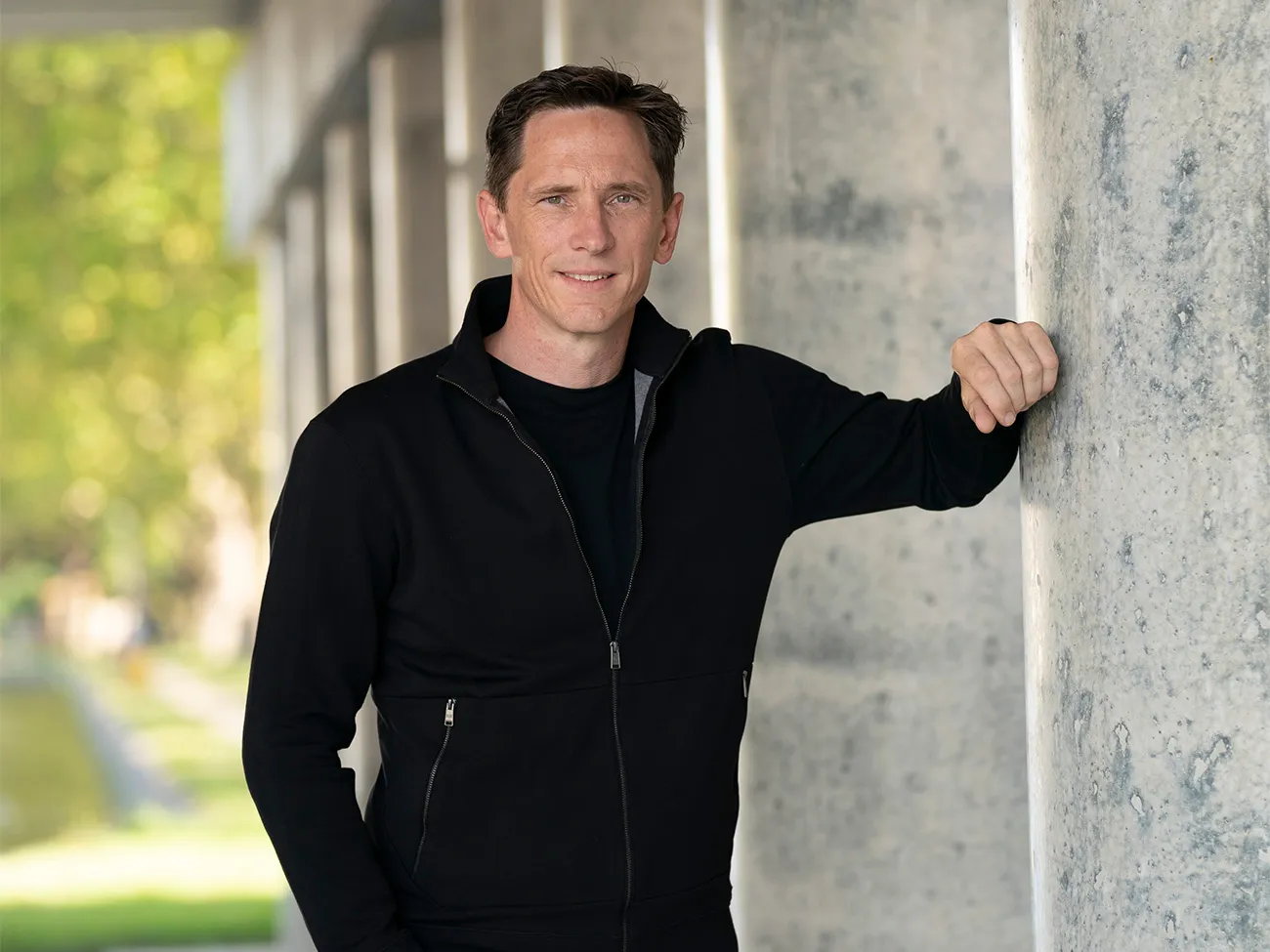
Francesco Veenstra took up his post as Government Architect on 1 September. The co-designer of, among other projects, Delft railway station is determined to turn the ‘path paved’ by his predecessors into action. “We need decisive action on the climate crisis and a long-term vision to address the complex challenges of the future,” he says. “The 22nd century begins today. And good design is always a prerequisite.”
His predecessors Mels Crouwel and Floris Alkemade broadened the Government Architect’s role from that of an adviser to a more integrated approach, and also made the Board of Government Advisors more ‘robust’. Veenstra will serve on the board for the coming years alongside landscape architect Jannemarie de Jonge and urban planner Wouter Veldhuis. Born in Friesland, he made his mark, among other things, as co-owner of Mecanoo. He has been a partner at Vakwerk Architecten since 2017, and for the past two years Veenstra has chaired the Royal Institute of Dutch Architects (BNA).
Different and better
There is plenty to do when it comes to spatial planning in the Netherlands. “The recently published IPCC report once again underlines that we can no longer put off the transition to sustainability. That calls for a different perspective: instead of more and bigger, we need different and better,” says the newly appointed Government Architect. “We need to move towards a society more focused on ‘sustainability’, quality and wellbeing. The built environment must contribute to that.”
An integrated vision
“The Netherlands is not full yet, but we really will have to use our space differently, simply because the competing demands and requirements will soon no longer be compatible,” says Veenstra. “I’m not keen on targets expressed as absolute figures, such as ‘1 million new homes by 2030’. What I do favour is an integrated long-term vision. Let’s look a century ahead and ask ourselves: what kind of country do we actually want to live in? Not to dream up attractive visions of the future, but precisely to work backwards: what do we need to do now?”
Veenstra immediately identifies the construction of new homes as one of the key challenges in his field. “An adequate supply of affordable homes is essential for society, but that doesn’t mean we should simply ‘build, build, build’. The debate should not be about numbers, but about the country and city of the future, and the contribution homes can make to them. Country and city are two sides of the same coin: in villages and small towns too, perhaps especially there, homes can help drive liveability and vitality.”
Looking ahead
To avoid making decisions now that we will later regret, we need to look ahead. “A hundred years may seem a long way off, but much of the structure of the Netherlands as it is today was established at the end of the 19th century. Decisions made at the time about the construction of rivers, canals and roads still form the backbone of our country. The same applies to the networks we are building now. Energy companies are scouring the Netherlands for unused land on which to install solar farms. There’s nothing to worry about, they argue, because the solar panels will only be there for twenty years. After those twenty years, the soil will be depleted and an electricity network will be in place that will attract new activities to the site. Such far-reaching decisions call for an integrated perspective.”
‘Everyone is needed’
Spatial designers are capable of setting out a shared vision for the future, the Government Architect says when asked. Veenstra points out that design quality is no magic bullet. “Design thinking is a tool for exploring new directions. Real change requires decisive action from everyone: architects, developers, builders, clients and government. It’s time to get our hands dirty.”
Question about this story? Ask your question
Keep following this
Get an email when a new story is published. No account needed.
- SubjectYearbook