









A puzzle of permits, history, engineering and public interests
Text Roel van GilsImage Meranda Spanjer
Building Groningen’s Hoofdstation
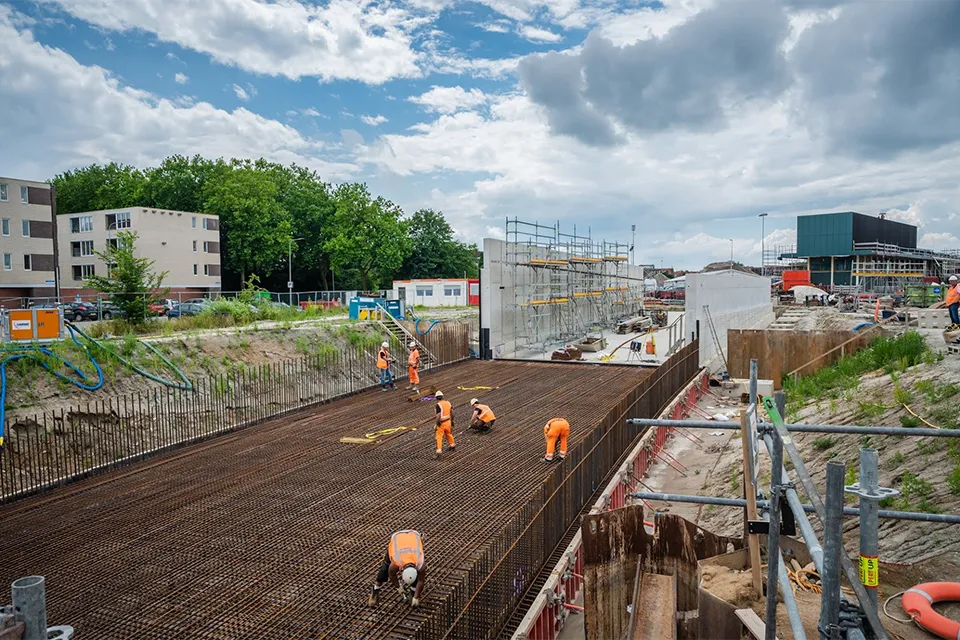
Groningen’s Hoofdstation is taking shape. Although the station has reopened, work is still under way to complete it. For Antea Group, it has been and remains a complex interplay of engineering, permits, archaeology and public interests, in an area steeped in history and home to listed buildings.
Permits
Permitting manager Mae Roumen sees every day how important it is to bring disciplines together and coordinate them as effectively as possible. “Permits are never straightforward, but the challenge is even greater on a project with as many interfaces as Groningen station. Because Antea Group has all the expertise in-house, from archaeology to ecological surveys, we can respond quickly and take an integrated approach. That really makes a difference here.”
Archaeology
The area’s history plays an important role in the project. As early as 2021, Antea Group carried out extensive desk-based archaeological research across the designated project area. “Some of the work fell outside the defined project area, and it was precisely there that something remarkable came to light during excavation of the construction pit,” says Martha de Jong, archaeologist at Antea Group. “Remains were found of the so-called Gracht van Alva, a 16th-century defensive work. The moat was later filled in with all kinds of waste, from horse manure to textile scraps and everyday objects. This makes it archaeologically very valuable. In close consultation with the municipality and construction partners, the finds were secured in bulk bags, allowing construction to continue without losing this heritage.”
Engineering challenges
Antea Group project manager Menno Brinkman highlights the scale and complexity of the construction work. “The project covers a very broad range of work for us: from designing the cycle tunnel to developing structural solutions for the bus underpass beneath the railway. We work closely with organisations such as Haskoning and the Strukton companies. We are also working on a related project, a charging station for electric buses. But one of the biggest remaining challenges is completing the final section of the cycle tunnel, which runs beneath the listed station building. We are literally building a concrete box beneath the floor of a building that was not constructed using modern techniques. We have to take account of utilities, crawl spaces and, above all, the vulnerability of the listed building.”
Time pressures and public impact
Alongside engineering and archaeology, time was also a major factor, particularly during the 64-day closure of the railway. “In a short space of time, tracks were removed, a construction pit was excavated, structures were moved into place and archaeological finds were recovered. At times like these, it is not just about engineering, but also about balancing public interests, safety and history,” says Roumen. “That only works if you act as one team.” Brinkman adds: “We are often involved in major projects, but this really is a megaproject. There is little in the Netherlands to compare with it.” The combination of archaeology, permits, heritage conservation and modern infrastructure makes it a textbook example of how past and future literally come together in Groningen. “It is great that we at Antea Group can contribute to this through an integrated approach drawing on all our disciplines.”
Question about this story? Ask your question
Keep following this
Get an email when a new story is published. No account needed.
- SubjectModular construction