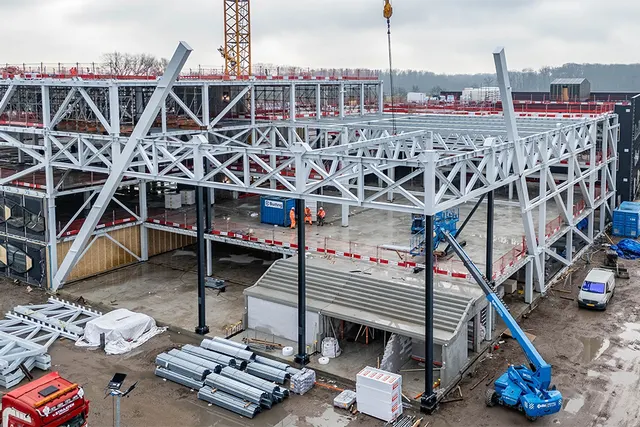











Genuinely circular construction with aluminium scrap
Text Lieke BousemaImage Hydro Building Systems Benelux
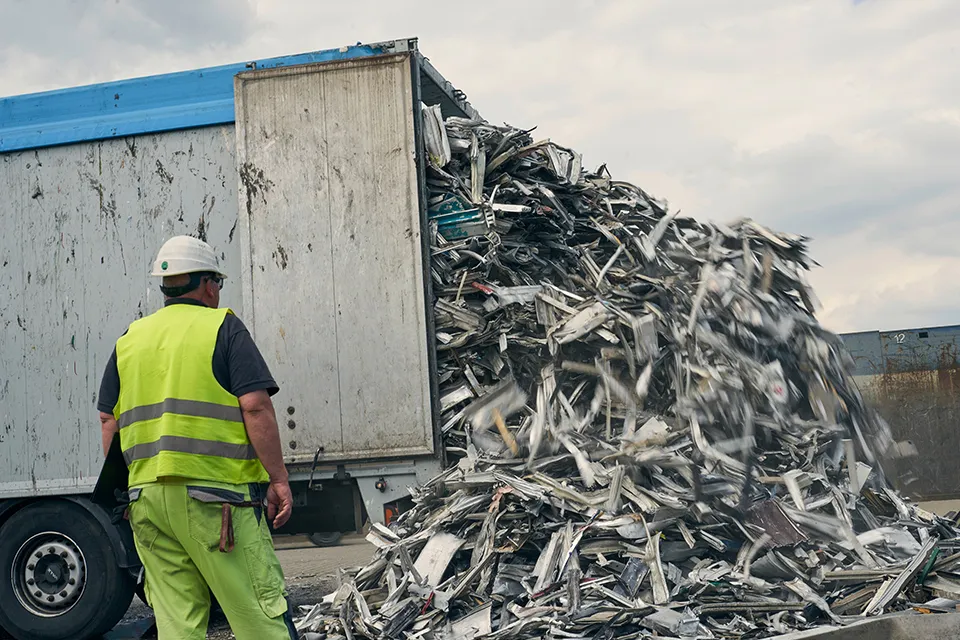
The ‘Close the Loop by Hydro’ project actively involves SAPA customers in recycling old aluminium and fabrication scrap. The first step is to buy up aluminium scrap from projects. The first projects in the Benelux are now under way. The scrap recovered from these projects goes directly to Hydro’s recycling plant in Dormagen. Here the aluminium is purified, then melted at a Hydro smelter and processed into Hydro CIRCAL billets. These are used, for example, to produce new, high-quality SAPA profile systems. A second step will involve processing post-consumer scrap, followed later by SAPA customers’ production scrap.
“By recycling all these aluminium waste streams to a high standard in Europe, we significantly reduce damage at extraction sites, the depletion of non-renewable resources, the consumption of non-renewable energy and greenhouse gas emissions,” says Danny Decaluwaert, Project Manager and Circularity Specialist at Hydro Building Systems Benelux. “This makes our aluminium products much more environmentally friendly than primary aluminium.”
Sustainability is key
“Sustainability is key to our organisation,” stresses Decaluwaert. “We take responsibility across the entire aluminium production value chain and aim to contribute to a fair society and a circular economy through responsible production, circular products and the complete decarbonisation of our processes by 2050 or earlier. To achieve this, we want to further increase renewable energy production, the use of externally certified low-carbon aluminium, and the recycling of post-consumer and pre-consumer scrap.”
Significant CO2 savings
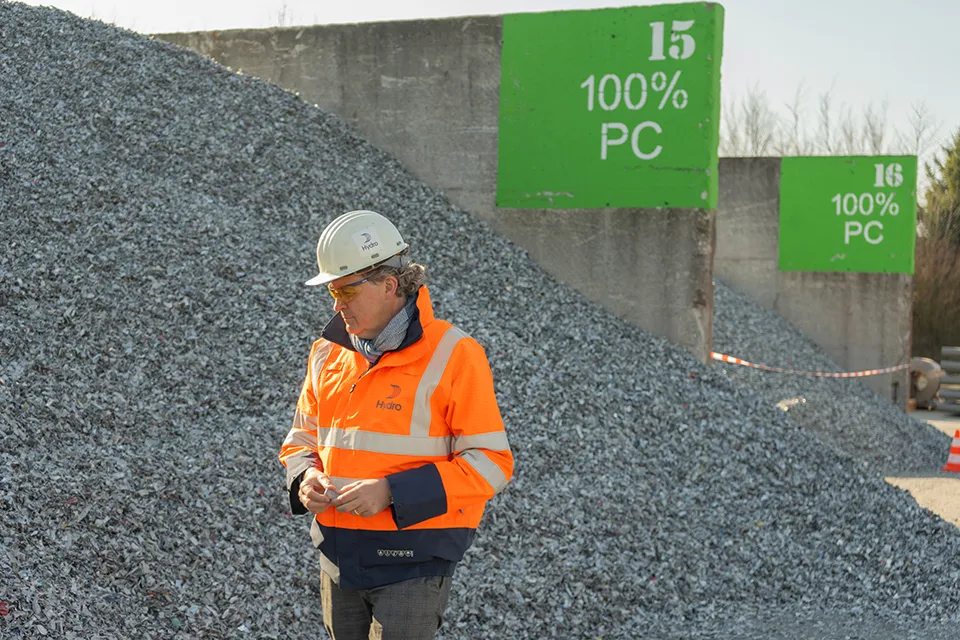
The production of primary aluminium can generate significant CO2 emissions when energy is produced using fossil fuels, Decaluwaert explains. “Hydro, by contrast, produces primary aluminium in Norway using renewable energy, achieving an extremely low carbon footprint. Melting post-consumer aluminium can also save up to 95% of the energy, while high-quality recycling yields a raw material of exactly the same quality.” The average carbon footprint of aluminium consumed in Europe is 8.6 kg CO2 per kg of aluminium, he says. “Hydro goes a step further. We use Hydro CIRCAL 75R as standard for our profile systems. It contains 82.1% post-consumer scrap and has a carbon footprint of just 1.9 kg CO2 per kg of aluminium. Hydro CIRCAL 100R is also available for projects on request, with a carbon footprint of less than 0.5 kg CO2.”
Closing the loop
High-quality recycling of post-consumer aluminium has long been core business for Hydro. “What’s new is that we are now also buying post-consumer and pre-consumer scrap directly from our customers,” says Decaluwaert. “This makes us a pioneer in the market once again and enables us to involve our partners more actively in our circular ambitions. It also lets them see just how valuable aluminium scrap really is.” Buying post-consumer scrap directly ensures a steady supply of valuable aluminium scrap, he says. “It also gives us the opportunity to keep large volumes of aluminium in the EU and give them a second life of equal value. To get recycling started and keep it going, we pay customers a fair price based on the daily aluminium price on the London Metal Exchange (LME). Take-back guarantees are also increasingly becoming part of project agreements. Our supply chain is clear, transparent and visible to everyone, and can be traced right back to its source. That’s how we close the sustainability loop.”
Easy identification
Correct identification is crucial when using circular materials and components, Decaluwaert stresses. “External joinery has to meet a wide range of requirements, for example in terms of thermal performance, acoustics, and airtightness and watertightness. If we are ever to reuse complete components, such as windows, doors and façades, we need to be able to identify them. Identification is also important for proper and timely maintenance, as well as for recycling at the end of a component’s life. That is why, with the new SAPA Techdesign calculation software, we offer the option of assigning a QR code to each individual joinery element for identification.”
EPDs at product or project level
Product EPDs are also becoming increasingly important. “Unlike ‘simple’ products, a single EPD for a window system is never accurate unless it is generated dynamically on the basis of the calculation,” says Decaluwaert. “That is exactly what the new SAPA Techdesign calculation programme makes possible. The certified software can generate an EPD for an individual element or an entire project. The EPD is then precisely accurate for the composition of that system.”
Have a business enquiry for SAPA by HYDRO BUILDING SYSTEMS? Get in touch
Companies in this story
Keep following this
Get an email when a new story is published. No account needed.
- SubjectModular construction
- CompanySAPA by HYDRO BUILDING SYSTEMS