Fenemaplein Zandvoort: From paved car park roof to green amenity roof
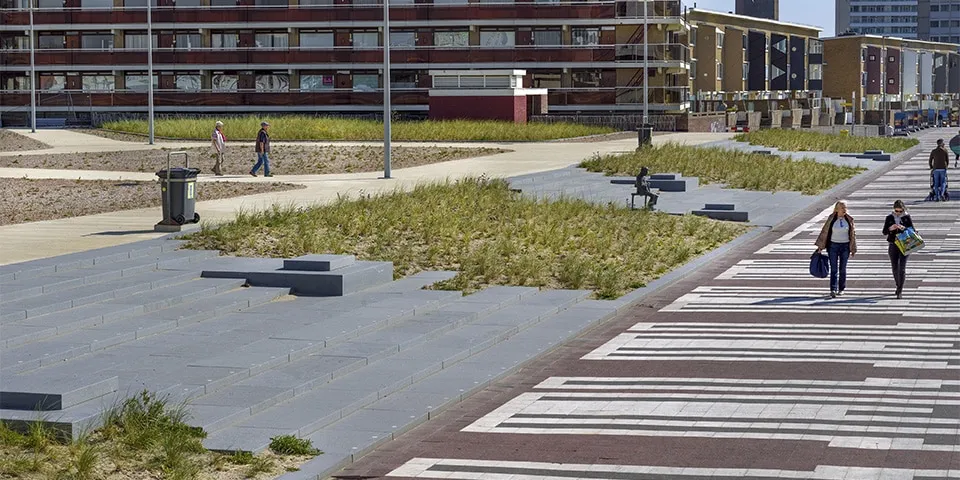
Fenemaplein in Zandvoort has been redeveloped as a dune landscape that can accommodate events. It was a challenging project, for which Nophadrain, a developer of green and amenity roof systems, provided the technical solutions. Sales Director Pieter Wesselink says: “In collaboration with the municipality, landscape architect and contractor, we selected drainage systems tailored to the final design: planting areas with marram grass, semi-paved paths and concrete paving accessible to pedestrians and cars.”
Fenemaplein is one of the oldest amenity roofs in the Netherlands. It was originally a 5,000 m² paved square on the roof of a car park dating from the 1960s, located on Zandvoort’s seafront boulevard. The starting point for the redesign, completed last winter, was to create an organic dune landscape that could accommodate events and have a strong relationship with the boulevard.
Designed by MTD Landschapsarchitecten, the scheme features organically shaped planting areas with marram grass and areas with shell-like semi-paving, framed by clean lines of sand-coloured concrete paving in a wave pattern. Three broad staircases provide access to the square from the lower-lying boulevard.
Before the tender process, Nophadrain, a specialist in green and amenity roofs, was already involved in developing the technical design for the drainage system and the complete build-up of the amenity roof. “We start where the roofing contractor leaves off. They make the roof watertight by installing a roofing system. We then advise on the best way to drain and retain rainwater, based on the desired final appearance, the structure and the roof falls.”
Sustainable use of space
The ND 600 Drainage System was selected for the build-up of the trafficable area: a dimpled membrane with an extremely high compressive strength (approximately 1,200 kPa), bonded to a monofilament filter fabric. The specific composition of this drainage system prevents hydrostatic pressure from building up on the roofing system and protects it from mechanical loads caused by cars or large groups of pedestrians. The ND 5+1 Drainage System was used for the build-up of the planting areas with sand and marram grass. “This product can retain approximately 5.8 l/m² of water in its deep dimples. In addition, on roofs with little or no fall, the deep dimples prevent excess water from remaining on the roofing system. ND WSM-50 Water Reservoir Boards were installed on top of the drainage system. These mineral wool boards provide additional water storage capacity (approximately 40 l/m²) and deliver rainwater to the vegetation by capillary action. On this project, the boards also act as a filter for the fine dune sand above them, preventing the roof drains or filter layers from becoming clogged.”
“By providing tailored advice, we were able to use our knowledge and expertise to achieve the desired result for the architect and client,” says Wesselink. “Amenity roofs are becoming increasingly desirable because of urban densification and climate change.”
Question about this story? Ask your question
Who worked on it
Fenemaplein in Zandvoort
- landscape architectMTD Landschapsarchitecten
Keep following this
Get an email when a new story is published. No account needed.
- ProjectFenemaplein
- SubjectGeneral
- CompanyMTD Landschapsarchitecten