








No ‘hanebalk’ escapes inspection
For many buildings, the ‘hanebalk’ is an essential feature for removals and the vertical transport of goods to upper floors. It may be a horizontal lifting beam projecting from the façade at its highest point, a steel three-point lifting device or a lifting hook beneath a gutter. For commercial use, the lifting structure must comply with the Dutch Working Conditions Act, while private use is subject to legislation concerning liability for the property.
The mandatory safety inspection of this type of lifting structure is carried out by inspectors from the independent inspection institute Aboma. “An inspection is an absolute requirement,” says Peter van Luijk, plant inspector at Aboma. The company, based in Ede, is recognised as a specialist in safety in the construction industry and vertical transport, and offers inspection and certification services, among others. “Our focus is on improving safety, quality and sustainability in construction and the vertical transport sector. We do this with a team of around a hundred specialists with expertise across all disciplines.”
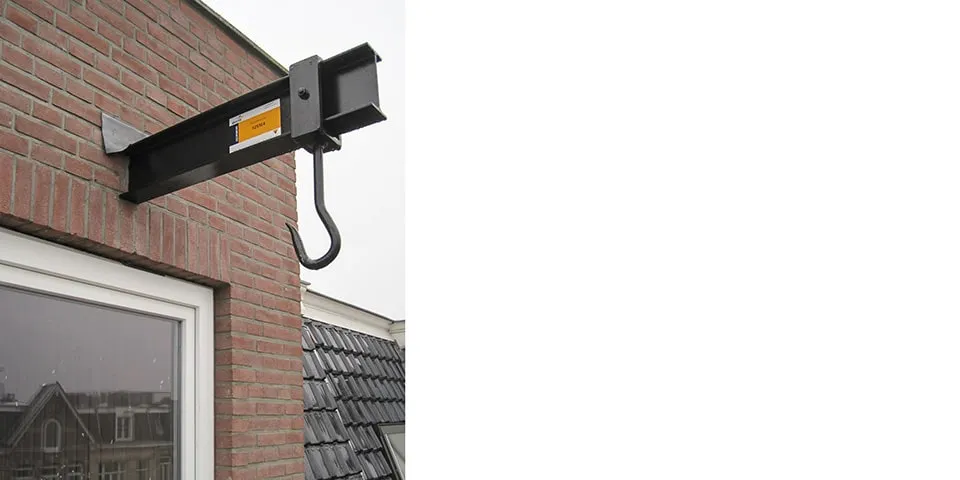
Examples of modern and traditional hanebalks.
Case study
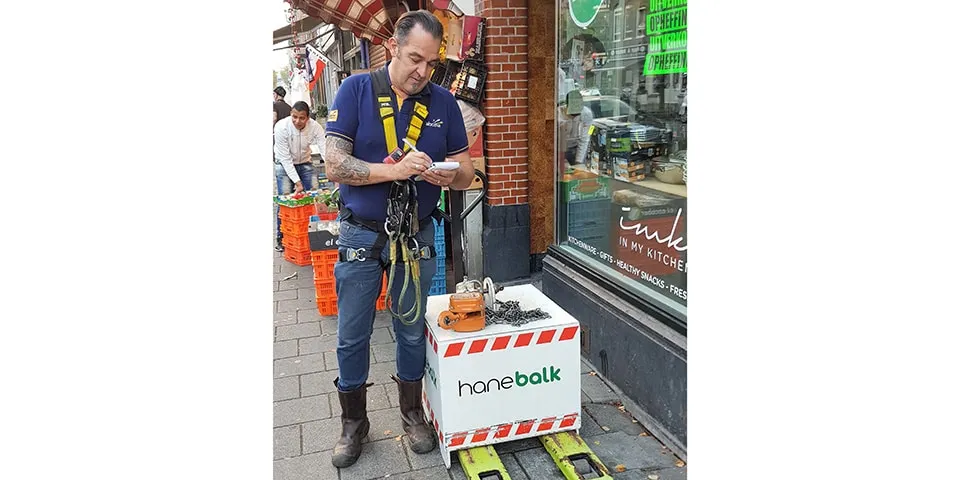
At a residential building on J.P. Heijestraat in Amsterdam-West, he demonstrates how the inspection works in close collaboration with Amsterdam-based Hanebalk BV. Hanebalk BV, the only official provider of inspections for this type of lifting structure, facilitates the inspection by first conducting a site survey to assess access to the lifting structure. Hanebalk BV arranges the necessary traffic management measures and ensures that the test weight is positioned correctly beneath the hook. The inspection is entirely independent: neither Aboma nor Hanebalk BV has any interest in the outcome.
In this case, the inspection comprises a visual assessment from a mobile elevating work platform of a wooden hanebalk that forms part of the roof truss. This can already reveal, for example, whether there is any wood rot. Van Luijk says: “This is most common where the beam enters the wall. There is no protective treatment at this point, and rainwater is not adequately kept out.”
The visual inspection is followed by a pull test using a 500-kilogram test weight. The weight is attached to a cable with a hoist, after which the tension in the cable is gradually increased until a pulling force of 500 kilograms is applied to the beam and lifting hook. Van Luijk says: “The beam must pass this test, or it will not be approved. The user may hang a load of 400 kilograms from the lifting hook as the safe working load. When using a rope and pulley block, this means you can actually hoist 200 kilograms, because you also need 200 kilograms on the pulling side to create balance.”
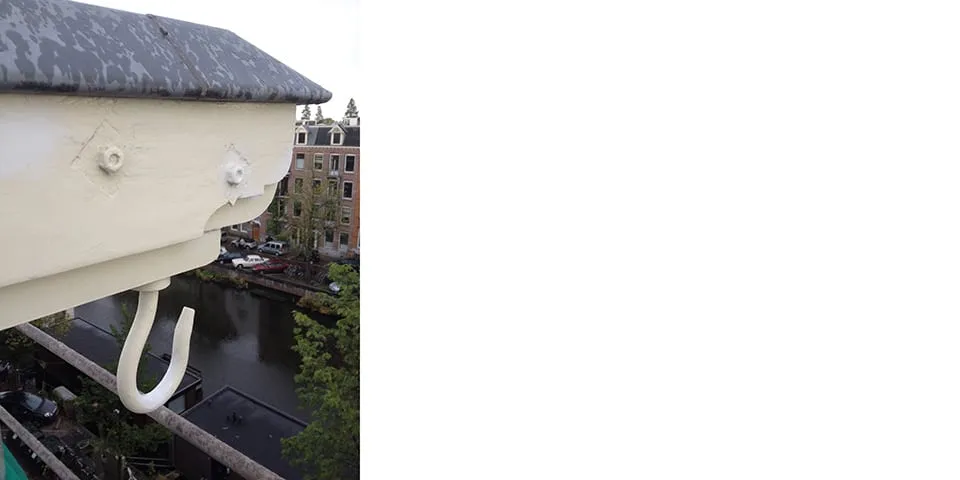
Examples of modern and traditional hanebalks.
Inspection report and certificate
One of the beams on J.P. Heijestraat does not meet the requirements: it deflects too much. Van Luijk says: “It was clad with wooden battens, so someone has already tampered with it. A label will be attached to this beam warning that it must not be used. Following the inspection, the client receives a warning letter informing them that the beam has been taken out of service.” It is up to the client to decide what action to take. “If the beam is approved, the client receives the Aboma inspection report and a certificate,” says Hanebalk BV managing director Frans Krabbenbosch. “An Aboma-approved removal beam is valid for seven years for private use and one year for commercial use. Hanebalk BV has linked insurance to the inspection, providing seven years of cover if the lifting structure meets the requirements set by Aboma.”
Question about this story? Ask your question
Keep following this
Get an email when a new story is published. No account needed.
- SubjectInnovation & technology