









Residential and non-residential construction
Historic splendour restored on the Grote Markt in Haarlem
Text Els HekkenbergImage Ossip van Duivenbode en Heiko Hulsker Architecten
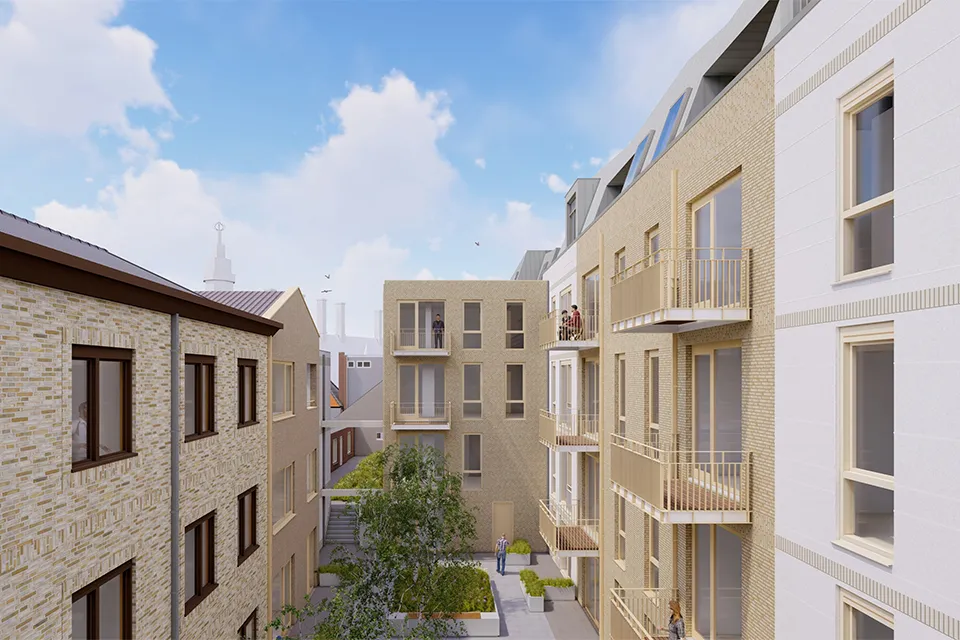
Brinck: a city block steeped in history
On the Grote Markt in Haarlem, a forgotten passageway is giving way to a lively residential setting with monumental character. Behind the façades of the former Brinkmann complex, Brinck Haarlem is taking shape: a housing project bringing together design, history and urban structure. “You have to listen to the building,” says Robbert van der Lee, project architect at Heiko Hulsker Architecten. “That already tells you what it can accommodate.”
The building on the Grote Markt in Haarlem had stood empty since the municipality of Haarlem left it years ago. The client appointed Heiko Hulsker Architecten to convert the city block into 100 unique homes. It was a challenge, in a building whose oldest section dates back to 1620 and which has been altered countless times since.
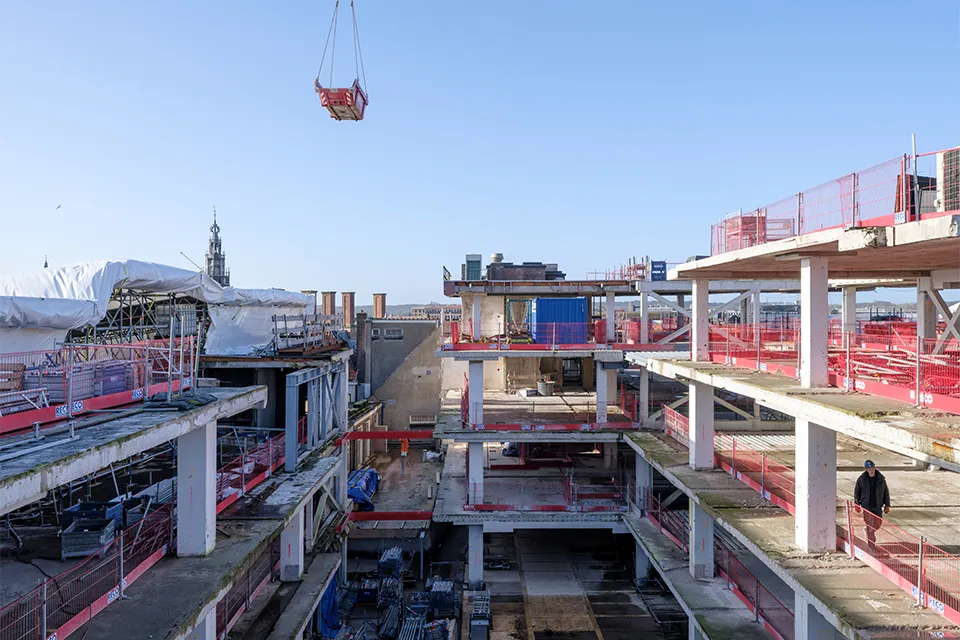
“You start with a building that you have to explore in person,” says Van der Lee. “It was a maze. We know Haarlem’s history well, but we also wanted to get to grips with this part of the city.” This exploratory phase was essential. What the drawings showed often differed slightly from the reality on site.
The building as a design constraint
The first major challenge was to bring in daylight. “Offices in the 1970s had clearly different requirements,” says Van der Lee. “We wanted to let in more light to give the homes a good standard of living.” The former offices had several light courts. These were enlarged and connected to one another, creating a number of small courtyards. “Haarlem is a city of courtyards, so we made use of that.”
As the development did not include the entire property, demolishing the whole building was not an option. Instead, the team opted for a comprehensive conversion. “The structure was therefore fixed too,” says Van der Lee. “A heavy concrete frame, with columns every six to eight metres in a kind of regular pattern that doesn’t match the standard dimensions for a first-time buyer’s home. So how do you fit the homes in properly? In the end, every home has a slightly different floor plan.”
Respecting the city’s rhythm
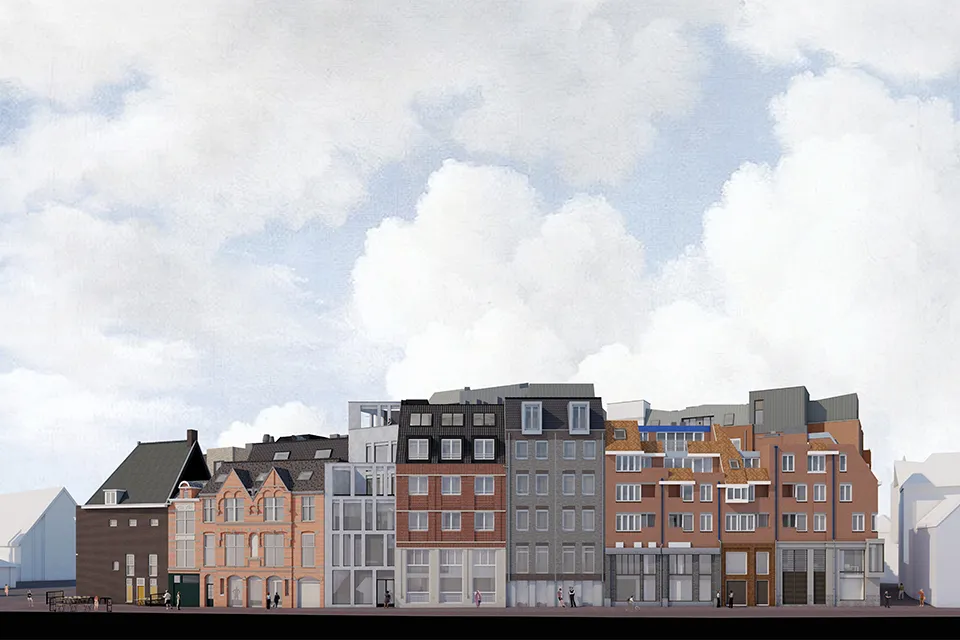
The design takes its cues from both the building and its location in the city centre. The façades on the Grote Markt are regaining their historic character, partly thanks to extensive colour research. “We consulted more than 150 historical images,” says Van der Lee. “On that basis, we selected a colour scheme for each building that reflects its original appearance.”
“We have tried to create homes for future residents, but because you’re working in such a prominent location, you also want to make a genuine contribution to the city,” he says. “We didn’t want to be the architects keen to show what they can do. Instead, we wanted to take our cue from the immediate surroundings and their distinctive pattern of buildings. That is reflected in the courtyard façades too.” The rooftop extension also fits in with the cityscape, with a continuous roofline and subtle variations that respect the scale of both the city and the building. “We really wanted to give it a proper finish, so that instead of a flat roof, the building would have pitched roof planes.”
Vraag over dit verhaal? Ask your question
Wie aan Brinck werkte
- prefab hsb wand- en dakelementenKroonhout Prefab HSBGenoemd in Tailored solutions in the heart of Haarlem
- architectHeiko Hulsker ArchitectenIn dit verhaal
Blijf dit volgen
Bij een nieuw verhaal krijg je een e-mail. Geen account nodig.
- ProjectBrinck
- OnderwerpResidential and non-residential construction
- CompanyHeiko Hulsker Architecten