Carrying out checks and coming up with creative solutions
Text Liliane VerwooldePhotography Rots Bouw
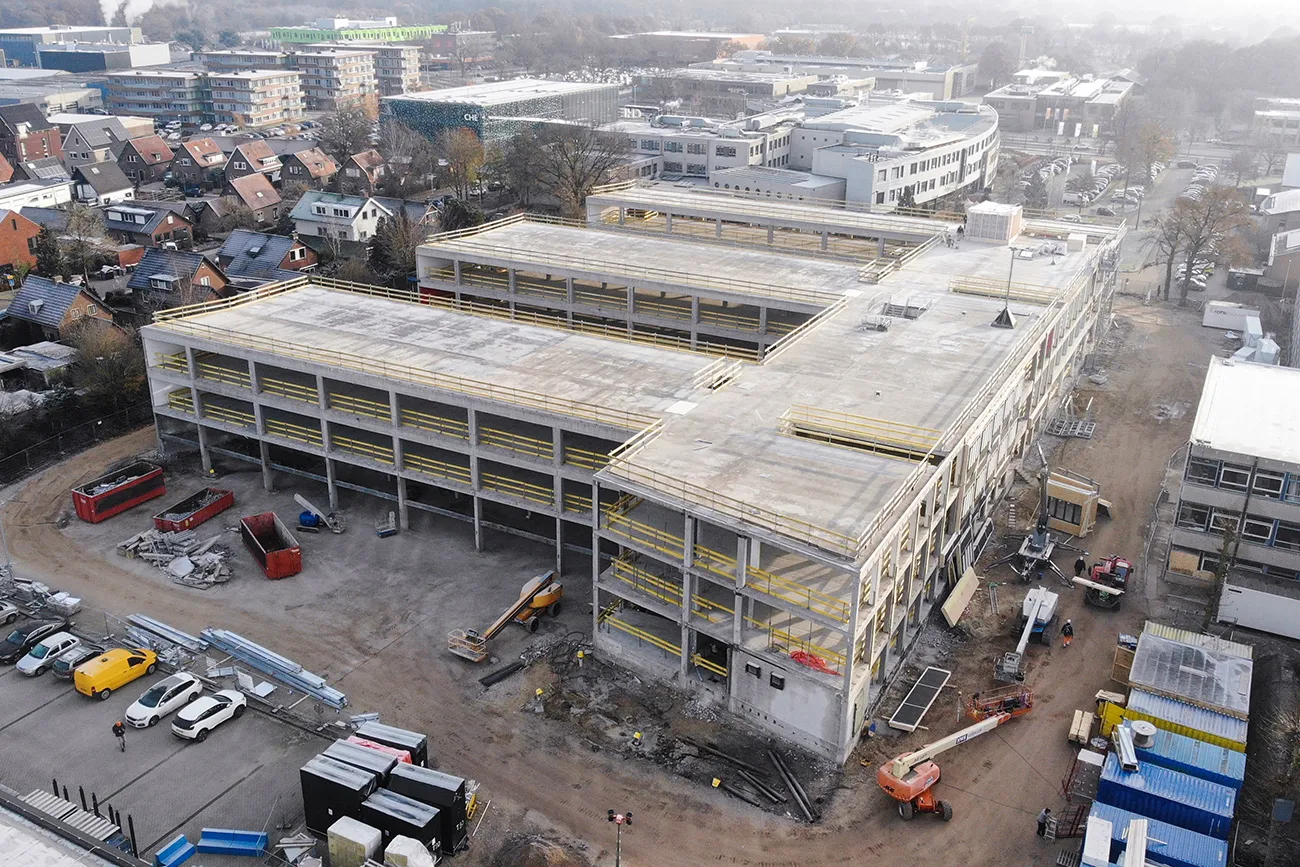
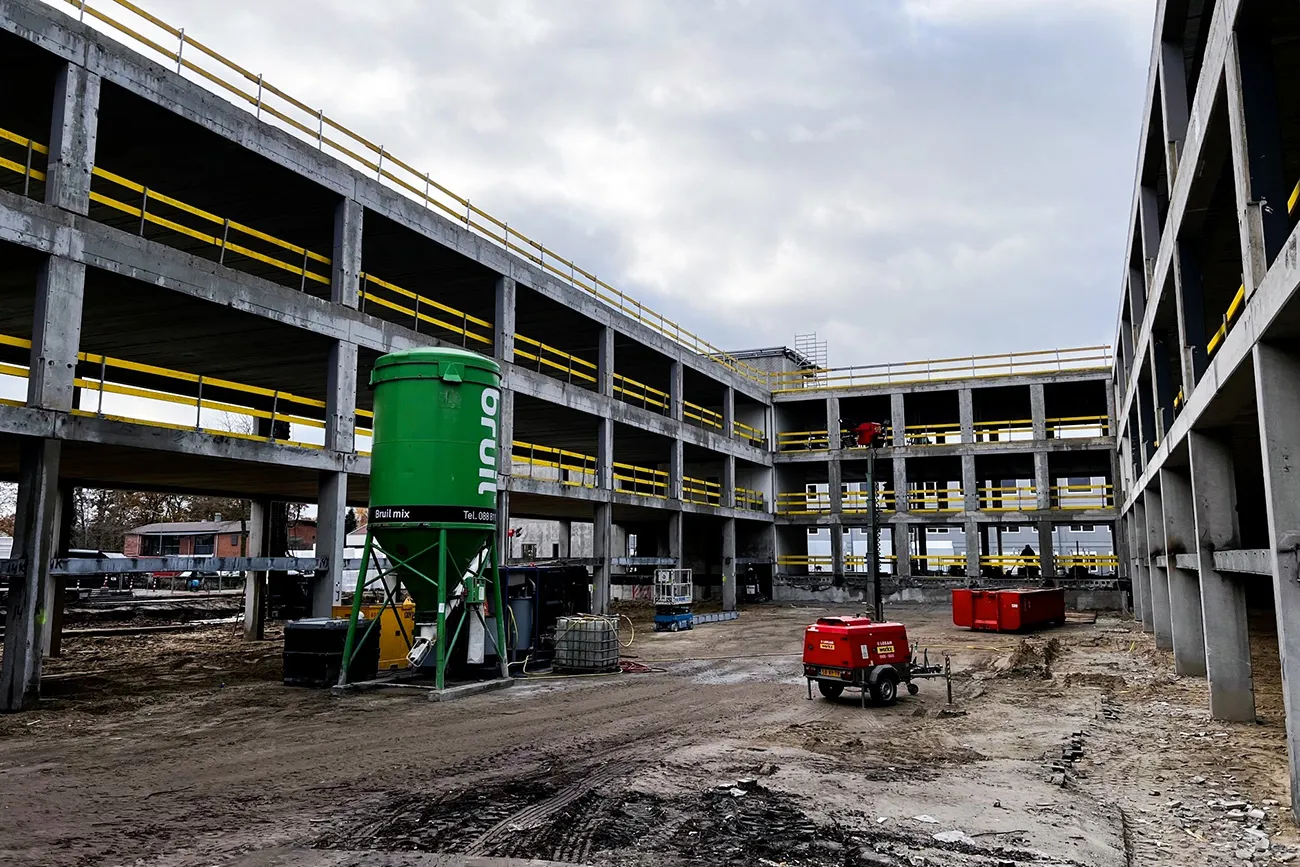
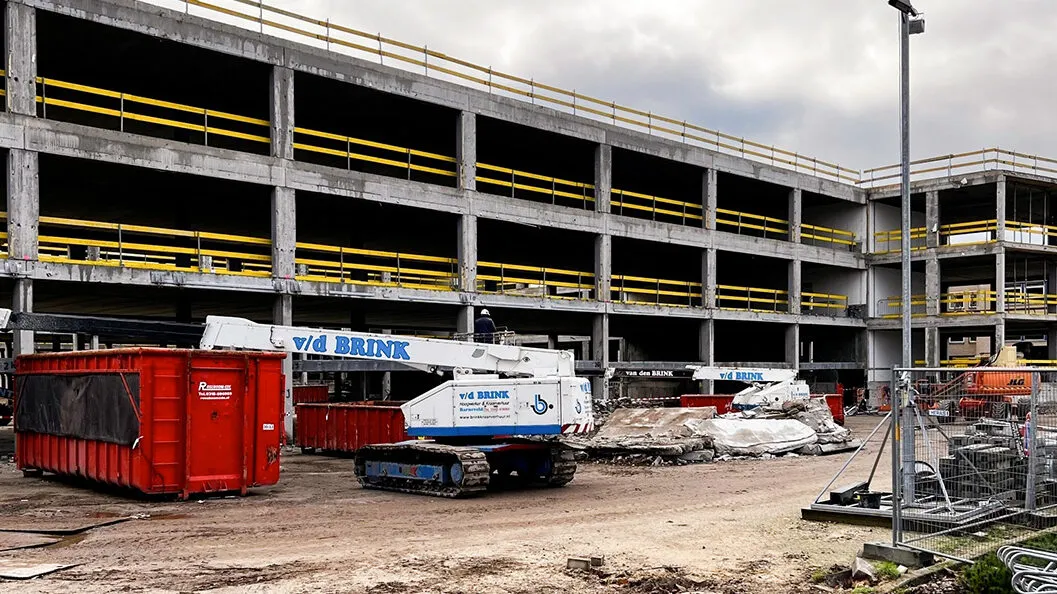
Sustainability is a leading consideration in the redevelopment of Dulon College in Ede. For this reason, the old college building is being stripped out rather than demolished, allowing its existing concrete frame to be reused for the new educational building. This calls for considerable creativity.
Reusing the existing concrete frame
Through the redevelopment of Dulon College, part of Christelijke Onderwijs Groep Vallei & Gelderland-Midden (COG), the school board aims to create an educational building that better reflects the school’s educational vision. To achieve this, the wings at either end of the former school building are being linked, creating logical circulation routes and giving the school a coherent, natural layout. There is also an ambition to make the redevelopment sustainable and future-proof.
Drawings versus reality
“For a project of this size, around 14,500 m2, you start ordering building materials straight away,” says Gerben Jan van Harten, project manager at Rots Bouw. “The old drawings and our own observations formed the basis for this. After the demolition work, we used a drone to create a point cloud showing the actual dimensions. In some places these differed from the existing data, meaning several elements had to be adjusted. Since these discrepancies only came to light after the demolition work and we had already started rebuilding, this caused some stress.”
Differences in levels and values
There are also other issues that Rots Bouw has encountered during the construction phase. One key point is checking the existing concrete structure. Van Harten explains: “It has to meet the values used in current calculations, even though it is an existing structure. For example, in some places the sand-cement floor is higher than shown on the drawings, making the required thickness impossible. That would make it too heavy. We still need to come up with a solution. On the other hand, these are the challenges that make the work enjoyable.”
Delays caused by bats
To prepare the building for renovation, the school board began taking measures several years in advance to deter the bats living in the façades. Unfortunately, these were not enough. When Rots Bouw and ITN were ready to start, bats were still present in several places. Van Harten explains: “Work came to a halt for thirteen weeks as a result. The overall programme had to be revised, machinery hire contracts had to be amended and all kinds of temporary facilities had to be put in place. It came as a complete surprise.”
But although COG’s sustainability ambitions do bring surprises, Van Harten is happy to deal with them. “You know this is the only right way to do things. Sustainable construction is already standard practice at Rots Bouw. High-quality insulation, solar panels, thermal energy storage systems, underfloor heating and airtight construction are all part of our day-to-day work.” Students are expected to move into the new Dulon College building in early 2024.
Question about this story? Ask your question
Who worked on Dulon College
- clientChristelijke Onderwijs Groep Vallei & Gelderland-Midden (COG)In this story
- architectCepezedIn this story
- structural engineerZonneveld Ingenieurs bvIn this story
- contractorRots Bouw bvIn this story
- installerITN Installatietechniek B.V.In this story
- steel structureW. ten Ham Constructie bvMentioned in Brand new yet reused: the redevelopment of Dulon College
Keep following this
Get an email when a new story is published. No account needed.
- ProjectDulon College
- SubjectGeneral
- CompanyChristelijke Onderwijs Groep Vallei & Gelderland-Midden (COG)
- CompanyCepezed
- CompanyZonneveld Ingenieurs bv
- CompanyRots Bouw bv
- CompanyITN Installatietechniek B.V.