










Architectural gem with impressive atrium earns four-star sustainability certificate
Text Johan DebaerePhotography Team RSG
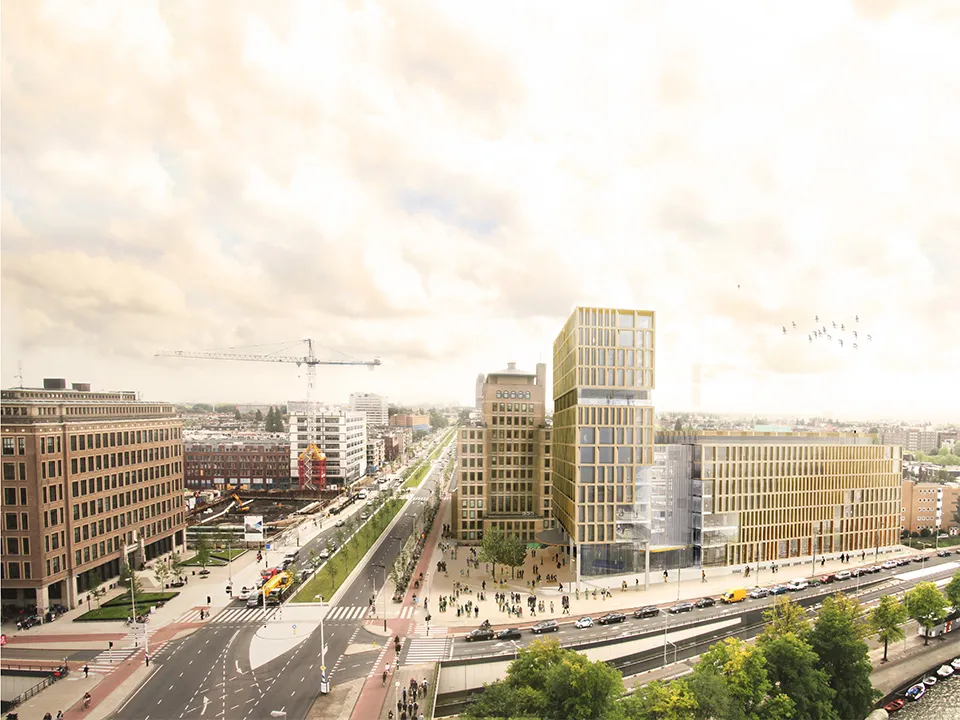
The Conradhuis for the Amsterdam University of Applied Sciences completes the Amstelcampus, at the junction of the busy Wibautstraat and Mauritskade in Amsterdam.
Designed by Team RSG, a collaboration between Powerhouse Company, de Architekten Cie and Marc Koehler Architects, the project combines a fourteen-storey tower with a low-rise building connected to Theo Thijssenhuis by a glass roof, creating an impressive atrium. Built by Visser & Smit Bouw, the project received a BREEAM ‘Excellent’ certificate and meets the requirements of the Frisse Scholen (Fresh Schools) Programme of Requirements.
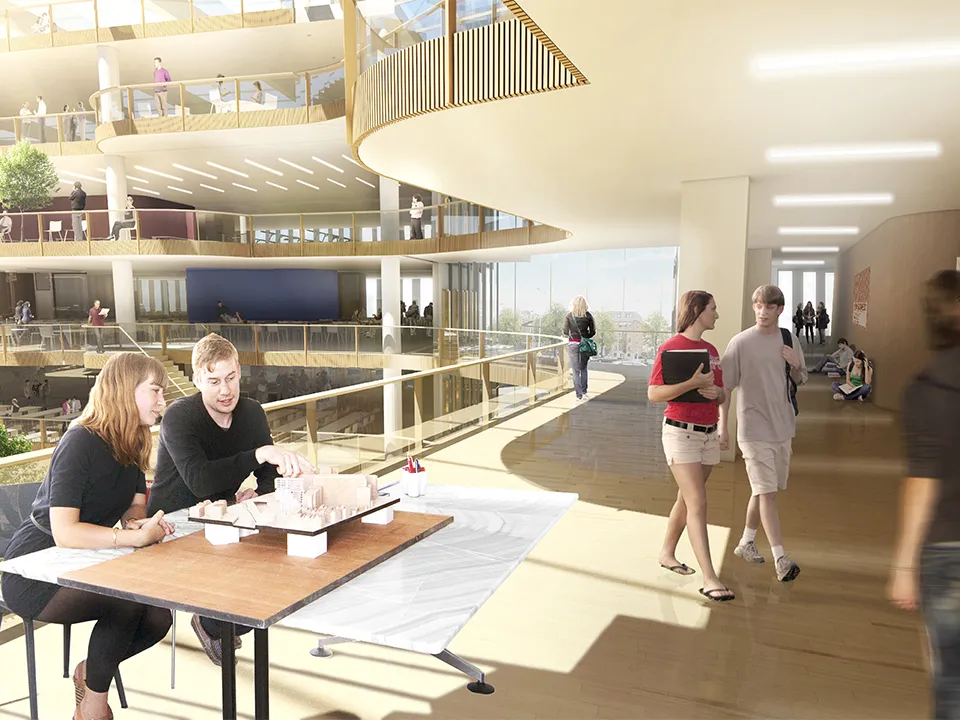
“In 2012, architects Nanne de Ru and Marc Koehler, both former students of the university, asked us to join them in bidding for the Conradhuis project. The brief contained a great deal of detail, both architecturally and in terms of content. While the young architects focused on the programme and how the building would fit the site, we concentrated mainly on the urban-design aspects,” says Pi de Bruijn of de Architekten Cie. “However, following a change in direction, the plans were put on hold. When the university’s board needed space for new courses in April 2018, work began on completing the Amstelcampus, creating a new home for the faculties of Technology, Education and Upbringing, and Digital Media and Creative Industries.”
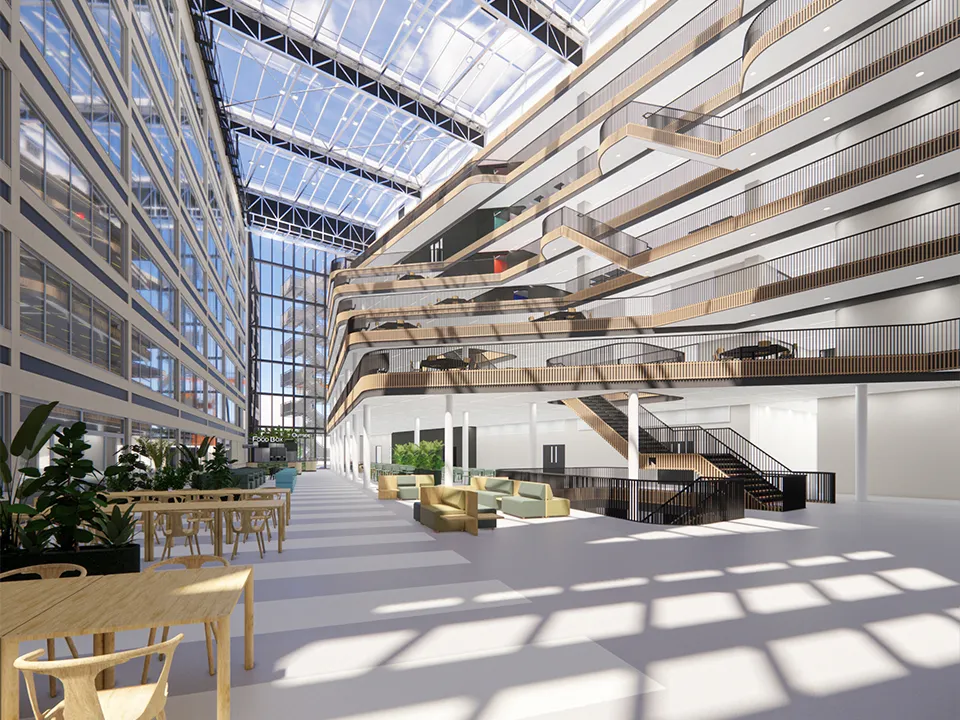
Two volumes linked by an atrium
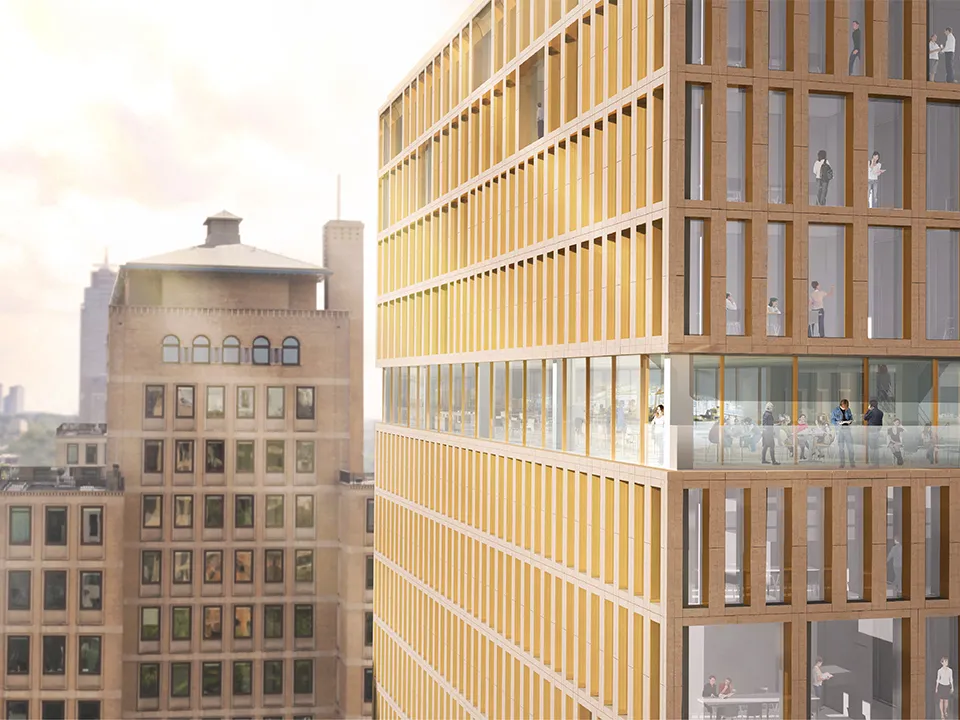
The two volumes of the Conradhuis, with a gross floor area of 23,000 m², fit seamlessly into their urban context. The fourteen-storey tower, with its traditional classrooms, is a landmark that does not overshadow the nearby listed Kohnstammhuis. The recessed façade line makes the upper floors appear to detach from the rest of the building and float above it. The low-rise section, with its teaching spaces, is an urban block of eight storeys.
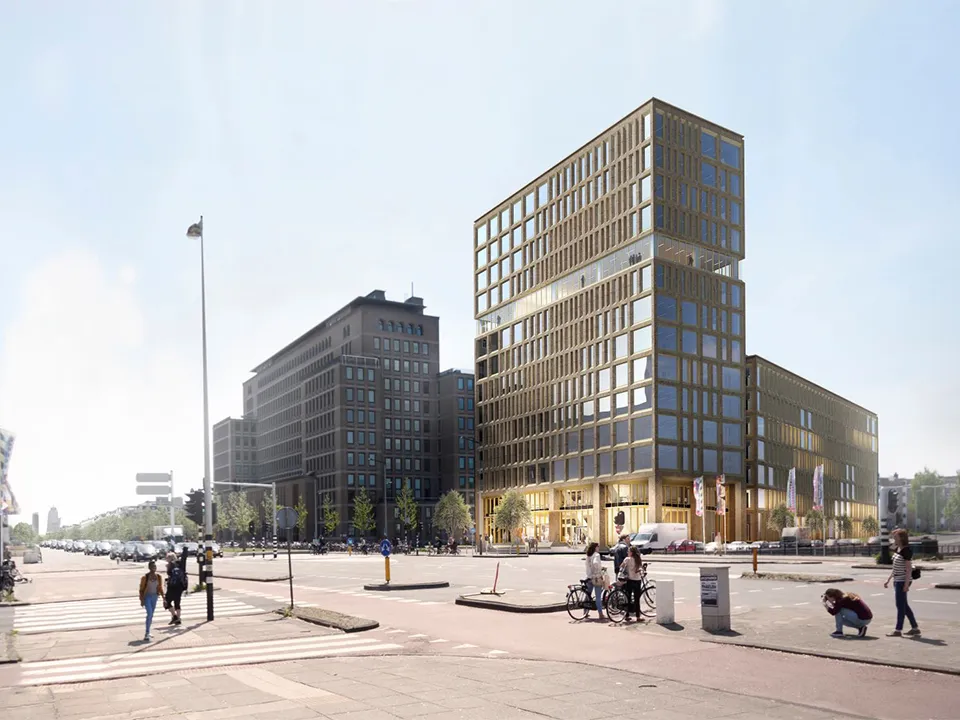
“We spent a long time considering how to make these volumes fit with the existing group of buildings. In the end, we opted for a roof structure with large steel trusses and a glass roof. This creates an impressive atrium, with the clean-lined façade of Theo Thijssenhuis on one side and a lush indoor landscape on the other. Its stepped floors, which narrow as they rise, also accommodate teaching spaces. The multifunctional atrium also houses, among other things, a restaurant,” the architect explains. “A double-height glazed entrance plinth creates a welcoming entrance and brings in natural light. The façades are made of concrete and clad in natural stone. The window reveals are finished partly in natural stone and partly in light bronze-coloured aluminium, creating a very distinctive effect. The play of wide and narrow windows also stands out. Nanne De Ru drew inspiration for this ‘window rhythm’ from a Nike running shoe, where the spacing of the stitching indicates the degree of flexibility.”
Knowledge transfer, future-proofing and sustainability
The architects set out to create a sense of home in this educational building. To achieve this, De Ru and Koehler spent a great deal of time engaging with the university community to ensure each faculty had the right spaces. “The volumes can also be laid out flexibly, allowing them to adapt to the needs of future education. Sustainability was, of course, another key theme,” De Bruijn concludes. “A thermal energy storage system, intelligent LED lighting, demand-controlled ventilation, climate-controlled ceilings, solar shading and solar-control glazing, as well as a sedum roof and nesting boxes for swallows, have resulted in an energy-efficient, healthy building with a BREEAM ‘Excellent’ certificate that also meets the requirements of the Frisse Scholen (Fresh Schools) Programme of Requirements.”
Project information
A feat of structural engineering, crowned by immense steel arch columns for the atrium roof
Visser & Smit Bouw is building the Conradhuis in Amsterdam, working with specialist partners such as De Kok Staalbouw.
The steel construction company, based in Heerle, works on projects in the Netherlands and abroad that require structures of a certain complexity. Everything is managed in-house: engineering, production, protective treatment, assembly and handover. “The most striking features of this prestigious project are the 25- and 28-metre arch columns for the atrium roof and the other roof trusses. Other notable steel structures include the lift shaft against the tower and the canopies, which are currently being finished in our workshop and will be mounted on the façade in the autumn,” says Eddy Dingemans, head of site operations at the third-generation family business. “Every project is unique and brings its own challenges. Alongside the complexity of the structures, logistics are a key consideration here. The location in the busy heart of Amsterdam requires careful preparation and planning for the delivery and installation of the heavy, often long steel structures.”
Project details
Client
Amsterdam University of Applied Sciences
Architect
Team RSG, a collaboration between Powerhouse Company, de Architekten Cie and Marc Koehler Architects
Main contractor
Combinatie Conradhuis, a collaboration between Visser & Smit Bouw and Unica.
A business enquiry for De Kok Staalbouw B.V.? Get in touch
Who worked on it
Conradhuis in Amsterdam
- steel structure
 De Kok Staalbouw
- clientHogeschool van Amsterdam
- architectPowerhouse Company
- architectde Architekten Cie
- architectMarc Koehler Architects
- main contractorVisser & Smit Bouw
- main contractorUnica
Keep following this
Bij een nieuw verhaal krijg je een e-mail. Geen account nodig.
- ProjectConradhuis
- SubjectConstruction projects
- CompanyDe Kok Staalbouw B.V.
- CompanyHogeschool van Amsterdam
- CompanyPowerhouse Company
- Companyde Architekten Cie
- CompanyMarc Koehler Architects