









From closed bastion to the heart of the city
Text Lieke BousemaImage De Nederlandsche Bank and Mecanoo
De Nederlandsche Bank ready for the future, sustainable and open to everyone
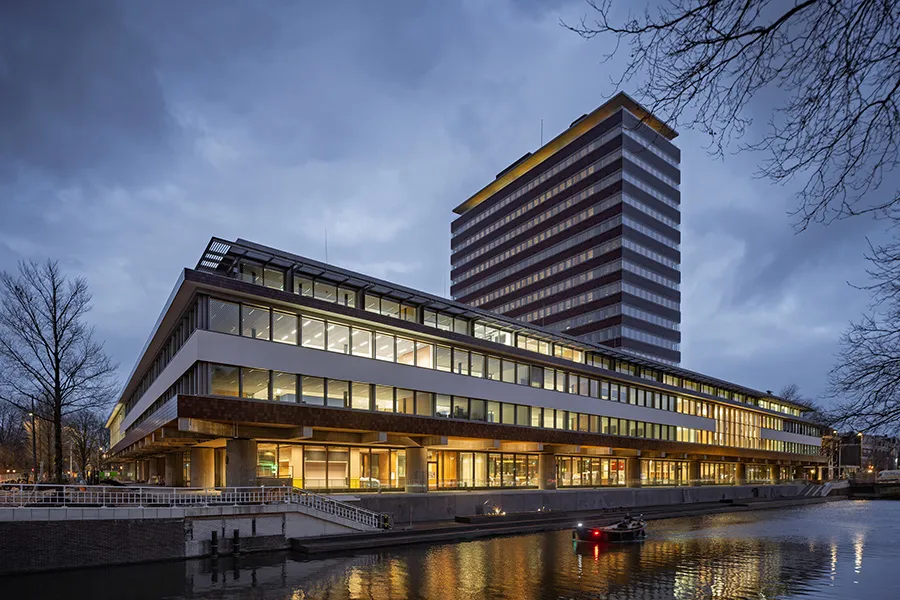
On 26 March, King Willem-Alexander officially opened the refurbished headquarters of De Nederlandsche Bank (DNB). After a renovation lasting almost five years, the 67,000 m2 building is once again home to more than 2,300 employees and ready to meet the challenges of the future. Respecting the original design by architect Marius Duintjer, architecture practice Mecanoo has renovated and upgraded the building’s sustainability, while reconnecting it with the city. The relocation of the banknote operation and more than 200 tonnes of gold to the Cashcentrum in Zeist made it possible to reopen the ground floor and basement to visitors. The building’s striking new entrance, cut right through the enormous concrete vault, creates a unique arrival experience.
More than half a century after opening in 1968, De Nederlandsche Bank’s distinctive building was technically outdated and no longer met sustainability requirements. It had become functionally obsolete, and without technically necessary measures, the continuity of the building and the safety of staff and visitors could no longer be guaranteed in the long term. Increasing security risks prompted the relocation of the gold and cash to Zeist. The multidisciplinary design team, led by Mecanoo, was then asked to find solutions that respected and improved the original design while meeting highly ambitious sustainability targets.
A sequence of experiences
Mecanoo was awarded the design commission for De Nederlandsche Bank in September 2018 following a European tender. “We carefully researched the history of this site and showed the right sensitivity to both the existing building and the existing urban context,” says Richard Hagg, technical director at Mecanoo. “DNB also felt it was very important to move the hard-to-find entrance on the west side to a prominent location on Frederiksplein, where a sequence of experiences begins. Staff and visitors will now approach the building through the newly pierced vault, and on entering will immediately catch glimpses of the building and its functions, including the vault, the financial education exhibition and De Nederlandsche Bank’s art collection.”
A place for connection and inspiration
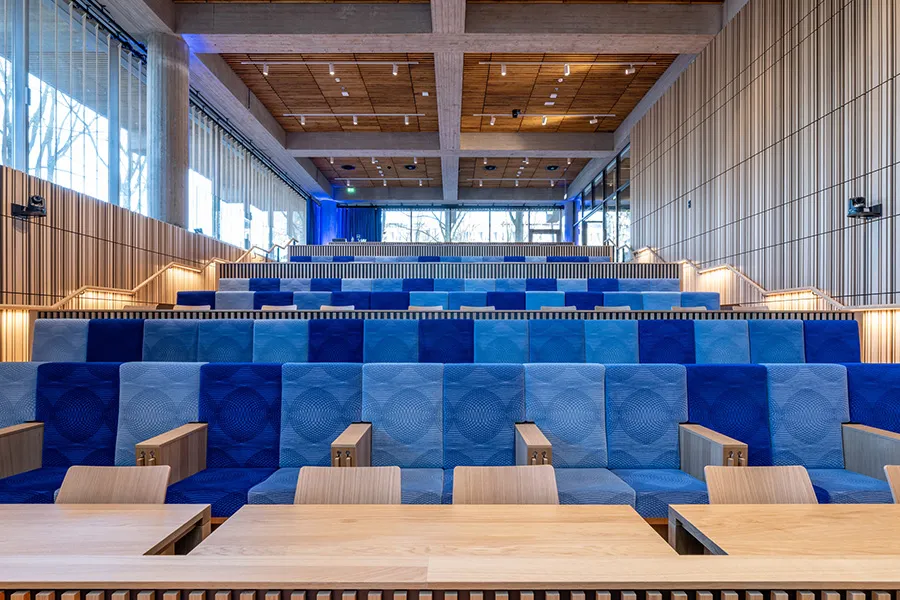
“One of De Nederlandsche Bank’s key missions was to once again be open, transparent and at the heart of society,” Hagg emphasises. “To make this possible, the closed bastion has been transformed into a ‘heart of the city’. Where previously there was only a small visitor centre across the Sarphatistraat, we have opened the entire north wing to the public.” The former gold vault in the north wing was freed by cutting away the surrounding floor slabs, he explains. “The transformed vault has been given a stunning gold finish and is surrounded by voids. This has created a theatrical 4,800 m2 space around and within the freestanding vault, now named De Nieuwe Schatkamer, which is clearly visible from both inside and out.” At De Nieuwe Schatkamer, DNB employees, students, school pupils, local residents and other visitors can meet and view the remarkable art and currency collection. Visitors can also learn about DNB’s core activities through exhibitions, interactive games, seminars and debates.
A place for connection and inspiration
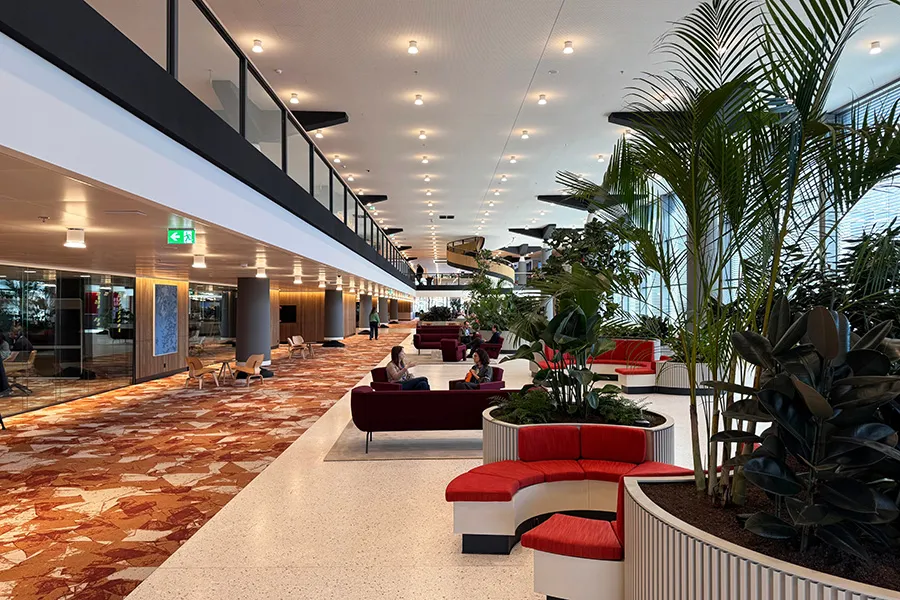
Mecanoo has added a transparent atrium where the tower once stood. This beautifully reveals the tower’s concrete frame, Hagg says. “A standout feature here is the sculptural cylindrical staircase, which connects the upper plinth levels.” The atrium stairs reflect the vision of DNB president Klaas Knot, who wanted to create a healthy building that encourages movement and connection. “At the same time, this layout creates attractive sightlines and provides intuitive wayfinding.”
As close to the original as possible
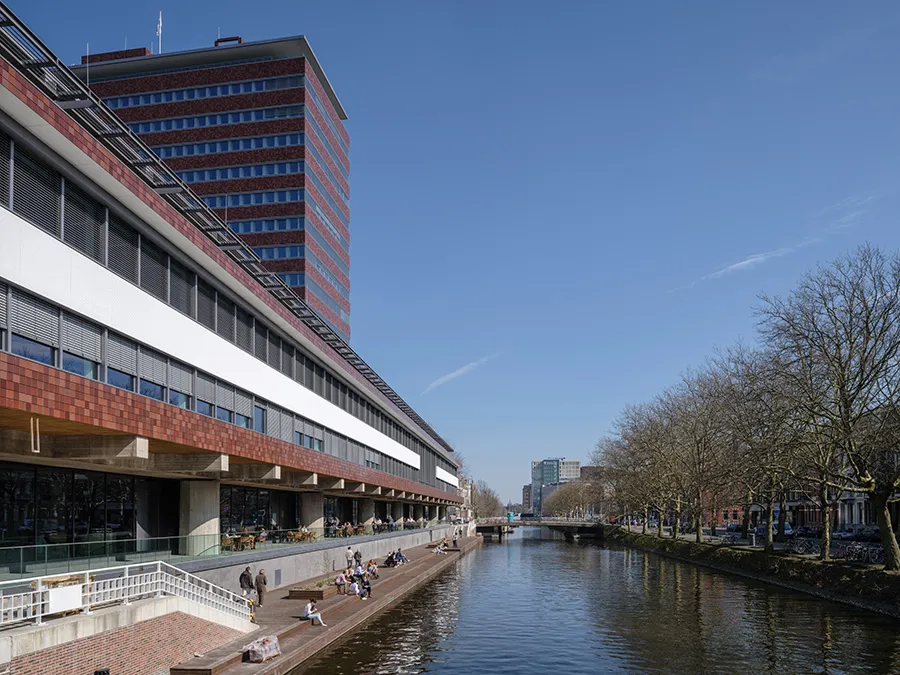
“In his original design, Duintjer clearly sought to connect with the existing city,” Hagg emphasises. “The DNB building has a very low plinth, for example, which relates directly to the surrounding three-storey townhouses and canal houses. The materials also create a connection, with traditional bricks and colour-matched stoneware tiles.” As the façade no longer met technical or thermal requirements, Mecanoo worked closely with the Commissie Ruimtelijke Kwaliteit and the Rijksdienst voor Cultureel Erfgoed to explore how it could be restored as closely as possible to its original form, without compromising sustainability or thermal performance. “This led, for example, to the use of ‘box windows’, which are beautifully integrated into the architecture and significantly reduce the need for cooling.”
Green urban garden
“De Nederlandsche Bank is well aware of the need to improve sustainability, which is even more relevant now than it was in 2018,” Hagg explains. “The bank clearly wanted an energy-neutral building that supports nature. The green urban garden makes an important contribution.” Mecanoo viewed Frederiksplein as Frederikspark from the outset, he says. “Looking at the building lines of the surrounding buildings, the DNB building stands in the middle of a public park. We therefore considered very specifically how to bring the park further inside. One clear design decision that emerged from this was the urban garden. The round tower in the western patio was carefully dismantled for reuse. The enclosed patio, with its security lodge, security checks and fences, was then transformed into a public urban garden with plenty of greenery, winding paths and natural seating areas that enhance biodiversity.”
A focus on sustainability and greening
Alongside the urban garden, the green roofs and the green terrace on the third floor also make an important contribution to DNB’s green ambitions. “The same is true of the courtyard garden on the first floor, which also includes a vegetable garden. Greenery surrounds the building and extends all the way to the Singelgracht, where the quayside has been lowered. This allows staff and visitors to sit by the water and enjoy the setting.”
Prioritising health and wellbeing
The renovated headquarters of De Nederlandsche Bank meets the BREEAM Outstanding and WELL Platinum certification standards. Mecanoo’s design creates a working environment that prioritises health and wellbeing. “There are views of greenery and water throughout the building,” Hagg concludes. “Every workstation has also been designed with the right temperatures, air quality, light levels and acoustics in mind.” As much of the energy required as possible is sourced sustainably. The headquarters has a thermal energy storage system, and wherever possible, photovoltaic panels and sedum roofs have been installed, helping the building contribute to a climate-neutral city.
Question about this story? Ask your question
Keep following this
Get an email when a new story is published. No account needed.
- SubjectConstruction projects