







Safeguarding structural safety in construction projects
Text Roel van GilsImage Jelmer de Haas
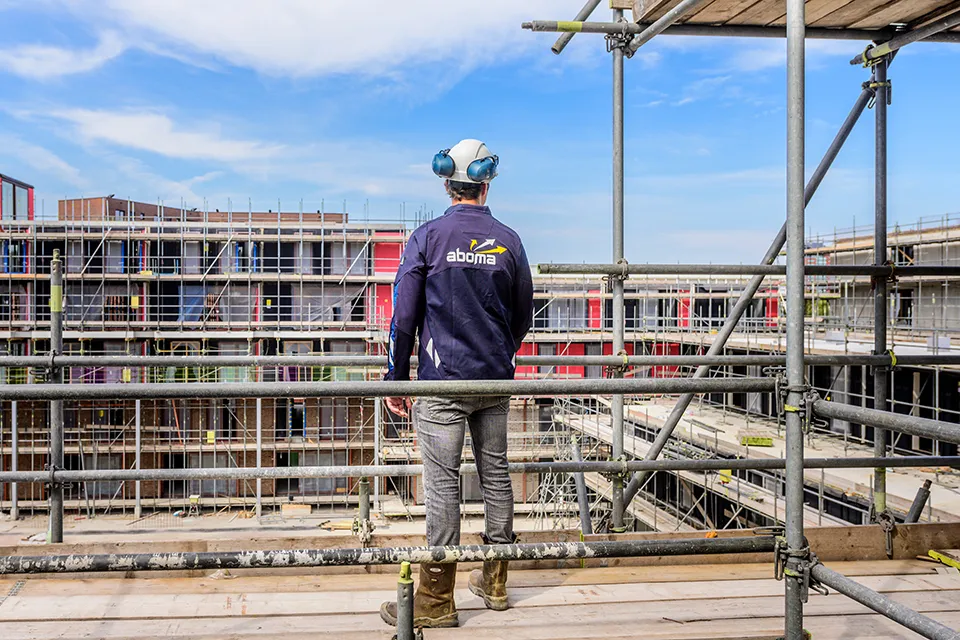
Alongside fire safety, structural safety is a key factor in determining the level of quality assurance required by the Wkb. Yet it remains a neglected aspect of many construction projects. Aboma Consultancy has become a partner of the Knowledge Platform for Structural Safety (KPCV) to help safeguard structural safety in construction projects even more effectively.
Structural safety is a shared responsibility. Yet, according to Dick Stoelhorst, founder and chair of the KPCV, that responsibility is still all too often passed on to someone else. “We often hear people say, ‘The structural engineer will take care of it.’ But an installation contractor, for example, has at least as much influence on structural safety and must be fully involved in the process. The same goes for a site manager. Their job is not just to keep an eye on the schedule, but also, for example, to check that the temporary structure is suitable for concrete pouring. Every partner in the supply chain has a role to play in safeguarding structural safety. We want to make sure everyone understands this, and we also provide practical tools to make it possible, completely free of charge.”
Experts in temporary works
The KPCV sets out assurance actions for every partner in the supply chain. Nearly sixty partners have now joined the initiative. They represent the entire construction sector, from structural engineers and building services contractors to construction companies, with Aboma among the latest to join. “In our day-to-day work, we too see that structural safety is often neglected, and that the structural safety of temporary structures in particular is underestimated or the risks are not properly recognised,” says Pieter Visser of Aboma Consultancy. “At Aboma, we have gained extensive practical knowledge of this very issue on construction sites. We are experts in using temporary works to safeguard structural safety during construction. That is the added value we bring as a partner of the knowledge platform.” Stoelhorst illustrates why this matters with an example: “There were several casualties at a major project in Rotterdam recently. The bracing on a temporary structure was considered an obstruction and was left out. As a result, the structure collapsed during concrete pouring. Expertise on how a temporary structure is assembled, how it works and what can and cannot be done is crucial to safeguarding structural safety during the construction phase too.”
Shared responsibility
The construction sector is becoming increasingly fragmented, Stoelhorst observes. “For temporary structures, people rely heavily on the advice of the suppliers concerned, whereas in the past the client had much more of that expertise in-house. Who still has an overview, and who is responsible for safety? Everyone involved in the design and construction must understand that they are part of the overall process of ensuring a safe structure. At KPCV, we focus on that process and explain how to manage roles, task allocation and responsibilities. We do this by analysing the risks at each stage and defining assurance actions to address them. From the outset, we guide the parties involved in making sound process agreements.” Visser adds: “That is exactly what we embrace in line with Aboma’s vision. People often focus on the end result, but safe construction must be given proper consideration from the drawing board onwards. The design should prevent situations where, for example, you have to tighten a bolt on a component while leaning halfway over a scaffold. The KPCV tools help ensure that.”
BORGR
Major clients such as Rijkswaterstaat, ProRail and the Central Government Real Estate Agency already refer to the KPCV tools. Web tools such as a Personal Scan and a Project Team Scan let users check, among other things, whether there is sufficient process knowledge of structural safety, how responsibilities are allocated within the project and whether all risks have been assigned. The latest addition is the BORGR web tool, which launches on 2 May. It safeguards coordination throughout and between every phase, from the earliest stages to the completion of a construction project. This enables developers and construction companies across the Netherlands to safeguard structural safety throughout the process.
Question about this story? Ask your question
Keep following this
Get an email when a new story is published. No account needed.
- SubjectConstruction projects